
Posted by scispectrum on 7th Mar 2026
COD Test Explained: Principle, Procedure, and Equipment Required (2026 Guide)
Water quality monitoring has become increasingly important in 2026 as industries, municipalities, and environmental authorities work to control pollution and protect natural water resources. Laboratories responsible for water and wastewater testing rely on accurate analytical methods to determine contamination levels and ensure regulatory compliance.
One of the most widely used parameters for assessing water pollution is the Chemical Oxygen Demand (COD) test. This test helps laboratories measure the amount of organic pollutants present in water samples and is commonly used in environmental monitoring and wastewater treatment facilities.
What is COD (Chemical Oxygen Demand)?
Chemical Oxygen Demand (COD) is a measurement that indicates the amount of oxygen required to chemically oxidize organic compounds present in a water sample.
In simple terms, the COD test estimates how much organic pollution exists in water by determining the amount of oxygen needed to break down those substances.
Higher COD values typically indicate:
- High levels of organic pollutants
- Poor water quality
- Industrial or sewage contamination
COD testing is widely used because it provides fast and reliable results compared to some biological testing methods.
Why COD Testing is Important
COD testing plays a critical role in environmental and industrial monitoring. Laboratories use this test to assess the pollution level in water and wastewater.
Key reasons COD testing is important:
- Wastewater Treatment Monitoring
Wastewater treatment plants use COD analysis to evaluate the efficiency of treatment processes.
- Industrial Discharge Control
Industries such as pharmaceuticals, food processing, and chemicals must monitor COD levels in their wastewater before discharge.
- Environmental Protection
Environmental laboratories use COD testing to monitor rivers, lakes, and groundwater contamination.
- Regulatory Compliance
Government pollution control authorities often set limits for COD levels in industrial discharge.
- Process Optimization
COD analysis helps industries improve treatment systems and reduce environmental impact.
Principle of COD Test
The COD test works on the principle of chemical oxidation of organic compounds present in water.
In the laboratory, a strong oxidizing agent—typically potassium dichromate—is used in acidic conditions to oxidize organic matter in the sample.
During this reaction:
- Organic pollutants are oxidized
- Potassium dichromate is reduced
- The amount of oxidant consumed corresponds to the oxygen equivalent required for oxidation
The result is expressed as milligrams of oxygen per liter (mg/L).
After digestion, the remaining dichromate concentration is measured using a spectrophotometer or titration method to calculate the COD value.
Equipment Required for COD Testing
Accurate COD analysis requires several essential laboratory instruments and accessories.
1. COD Reactor / COD Digester
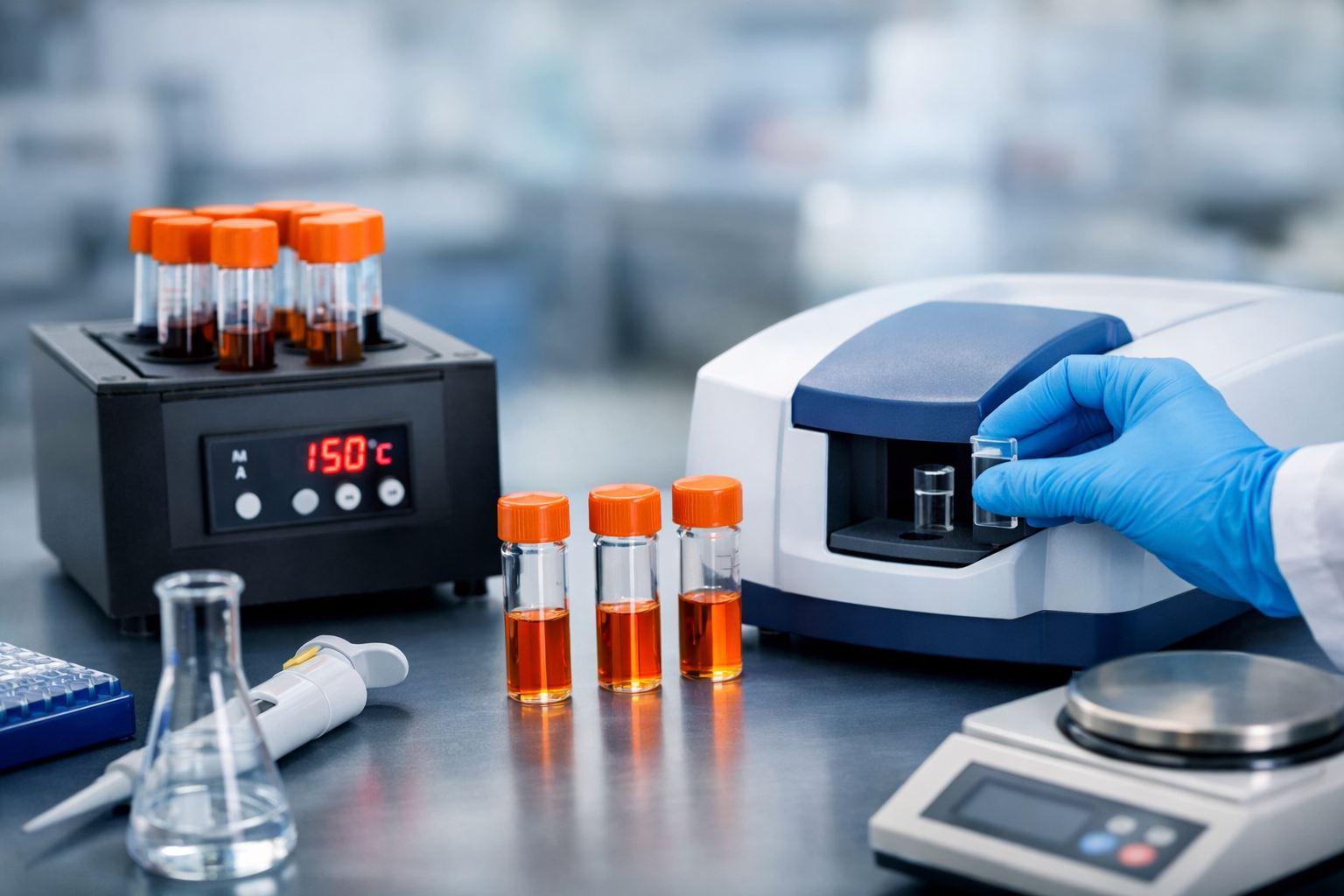
A COD reactor is used to heat the water samples at a controlled temperature during digestion. The digestion process usually occurs at 150°C for about 2 hours. Laboratories commonly use a COD digestion apparatus to ensure consistent heating and reliable results during the digestion stage.
You can explore a COD Digestion Apparatus here:
2. Spectrophotometer
A spectrophotometer is used to measure the absorbance of digested samples. The absorbance value is used to determine COD concentration.
3. Pipettes and Volumetric Glassware
Laboratory pipettes and volumetric flasks ensure accurate measurement of samples and reagents.
4. COD Digestion Vials
Special digestion tubes or vials contain reagents required for the COD reaction and allow safe heating during digestion.
5. Analytical Balance
An analytical balance may be required for reagent preparation or standard solution preparation.
6. Heating Block or Hot Plate
Some laboratories use heating blocks or hot plates during reagent preparation.
Step-by-Step COD Test Procedure
The COD test follows a standardized procedure to ensure consistent and reliable results.
Step 1: Sample Collection and Preparation
- Collect the water sample in a clean container.
- If necessary, filter the sample to remove large suspended particles.
Step 2: Add Reagents
- Transfer a measured volume of the sample into a COD digestion vial.
- Add digestion reagents containing potassium dichromate and sulfuric acid.
Step 3: Digestion Process
- Place the vials in a COD reactor or digestion block.
- Heat the samples at 150°C for approximately 2 hours.
This step oxidizes organic compounds present in the sample.
Step 4: Cooling the Samples
- After digestion, remove the vials from the reactor.
- Allow them to cool to room temperature.
Step 5: Measurement Using Spectrophotometer
- Place the cooled sample in a spectrophotometer.
- Measure the absorbance at the required wavelength.
Step 6: Calculation of COD Value
The COD concentration is calculated based on the absorbance reading and calibration standards.
The final result is usually expressed as:
COD (mg/L)
Factors That Affect COD Test Accuracy
For reliable results, laboratories must ensure proper testing practices. Several factors can influence COD test accuracy.
Common factors include:
- Improper digestion temperature
- Contaminated glassware
- Incorrect reagent preparation
- Inaccurate pipetting
- Poor instrument calibration
- Incomplete sample digestion
Following standard laboratory procedures and maintaining equipment properly can help minimize these errors.
Applications of COD Testing
COD analysis is widely used across multiple industries and environmental monitoring programs.
Major applications include:
Wastewater Treatment Plants
COD helps evaluate the performance of biological treatment systems.
Food and Beverage Industry
Food processing industries monitor wastewater discharge.
Pharmaceutical Manufacturing
Pharmaceutical facilities test wastewater before disposal.
Chemical Industries
Chemical plants use COD testing to monitor industrial effluents.
Environmental Monitoring Laboratories
Environmental labs analyze surface water, groundwater, and wastewater samples.
Choosing the Right Equipment for COD Testing
Selecting reliable laboratory instruments is essential for obtaining accurate COD results.
When choosing equipment for COD testing, laboratories should consider:
- Temperature stability of COD reactors
- Spectrophotometer accuracy and wavelength range
- Quality of digestion tubes and reagents
- Instrument calibration capability
- Ease of operation and maintenance
Reliable instruments ensure consistent results and help laboratories meet regulatory standards.
Laboratories often source these instruments from specialized suppliers such as Scispectrum Lab Essentials, which provides a range of environmental and water testing equipment.
Conclusion
The Chemical Oxygen Demand (COD) test is a fundamental method used in laboratories to measure the level of organic pollution in water and wastewater samples. By determining the oxygen required to oxidize organic matter, the COD test provides a quick and reliable indication of water quality.
Understanding the principle, procedure, and equipment required for COD testing helps laboratories ensure accurate results and maintain environmental compliance.
With proper laboratory practices and reliable analytical instruments, COD analysis remains an essential tool for environmental monitoring, wastewater treatment, and industrial pollution control in 2026.