
Posted by scispectrum on 16th Mar 2026
Colorimeter: Principle, Components, and Laboratory Applications
Introduction
Accurate chemical analysis is essential in laboratories across industries such as environmental testing, pharmaceuticals, food production, and research. One of the commonly used instruments for analyzing the concentration of substances in a solution is the colorimeter. This device measures the intensity of color produced in a chemical reaction and helps determine the concentration of specific compounds.
Colorimeters are widely used because they are simple to operate, cost-effective, and capable of providing reliable results. They play a crucial role in laboratories where rapid and accurate analysis is required.
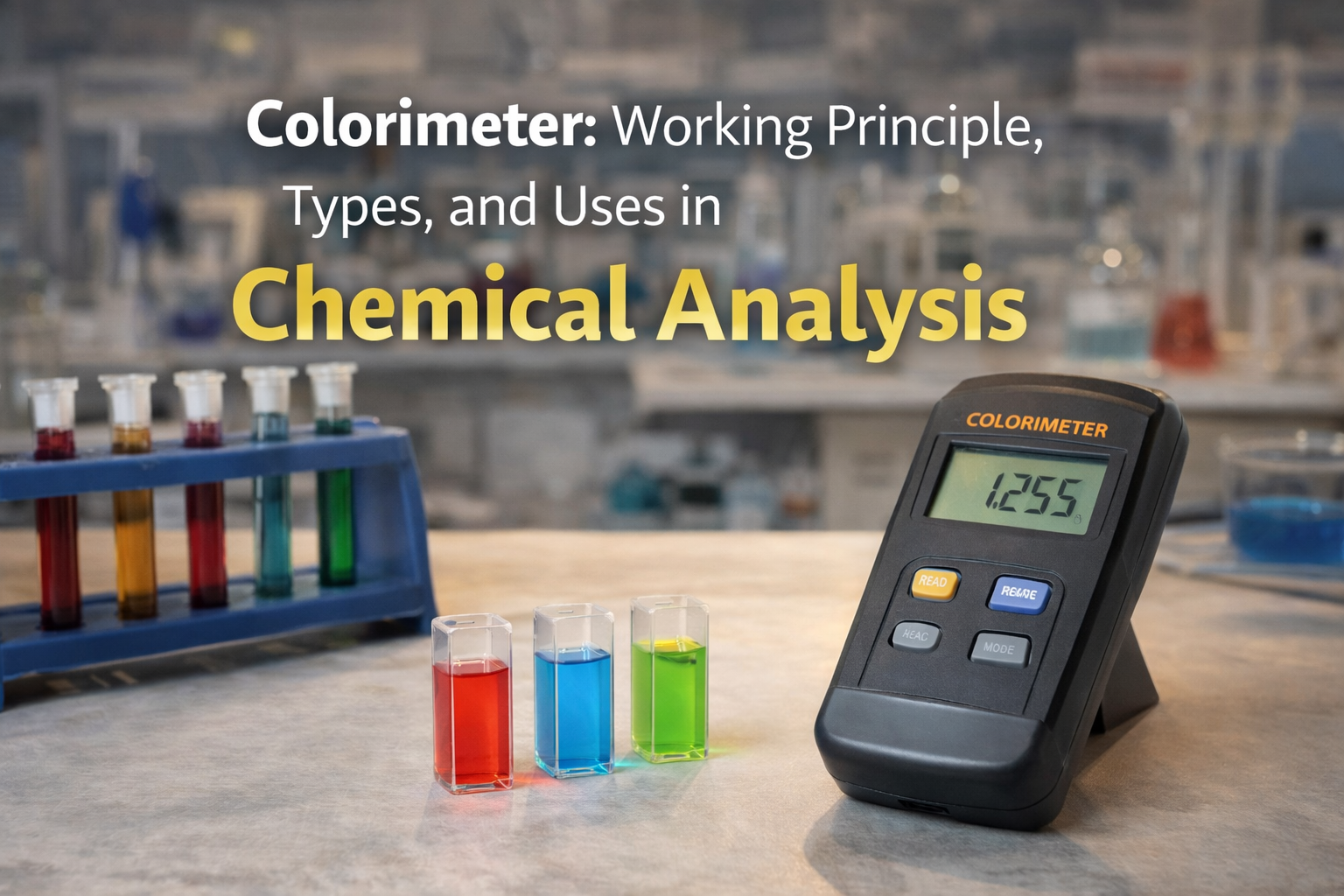
What is a Colorimeter?
A colorimeter is a laboratory instrument used to measure the concentration of colored compounds in a solution by analyzing the intensity of light absorbed by the sample.
The principle behind colorimetry is that different substances absorb light at specific wavelengths. When light passes through a colored solution, part of the light is absorbed while the rest is transmitted. The amount of light absorbed is directly related to the concentration of the substance in the solution.
Colorimeters are commonly used in laboratories to analyze samples where color changes occur during chemical reactions.
Working Principle of a Colorimeter
A colorimeter works based on the absorption of light by colored solutions. When a beam of light passes through a sample solution, certain wavelengths of light are absorbed depending on the chemical composition of the sample.
The instrument measures the amount of light that passes through the sample and compares it with the intensity of the original light source.
The working process typically involves the following steps:
- A light source emits white light.
- A filter selects a specific wavelength suitable for the test.
- The light passes through the sample solution in a cuvette.
- The detector measures the transmitted light.
- The instrument calculates the absorbance or concentration of the substance.
The amount of light absorbed by the sample increases as the concentration of the colored compound increases, allowing accurate measurement of chemical concentrations.
Main Components of a Colorimeter
A colorimeter consists of several essential components that work together to measure light absorption accurately.
1. Light Source
The light source provides the initial beam of light that passes through the sample. Most colorimeters use LED or tungsten lamps as light sources.
2. Filters
Filters are used to select a specific wavelength of light suitable for the analysis. Different filters allow measurement of different substances.
3. Sample Holder (Cuvette)
The cuvette holds the liquid sample. It is usually made of glass or plastic and allows light to pass through the solution.
4. Detector
The detector measures the amount of light transmitted through the sample and converts it into an electrical signal.
5. Display System
The display shows the final measurement result, typically in absorbance, transmittance, or concentration units.
Types of Colorimeters
Colorimeters are available in different types depending on their design and applications.
Digital Colorimeters
Digital colorimeters provide accurate readings with digital displays and are widely used in modern laboratories.
Portable Colorimeters
Portable colorimeters are compact and lightweight, making them suitable for field testing and environmental monitoring.
Visual Colorimeters
Visual colorimeters rely on manual comparison of color intensity with standard color charts. They are less precise but useful for basic testing.
Applications of Colorimeters in Laboratories
Colorimeters are used in many industries where chemical concentration analysis is required.
Water Quality Testing
Colorimeters help measure parameters such as chlorine, nitrates, phosphates, and other contaminants in water.
Food and Beverage Analysis
In the food industry, colorimeters are used to evaluate food color, quality, and chemical composition.
Clinical Laboratories
Medical laboratories use colorimeters for analyzing blood samples, hemoglobin levels, and biochemical reactions.
Environmental Monitoring
Colorimeters assist in detecting pollutants and chemical substances in environmental samples.
Chemical Laboratories
They are widely used in research and quality control laboratories for chemical analysis and reaction monitoring.
Advantages of Using a Colorimeter
Colorimeters offer several advantages that make them valuable laboratory instruments.
- Simple and easy to operate
- Quick and reliable measurements
- Cost-effective compared to advanced analytical instruments
- Compact and portable models available
- Suitable for routine laboratory analysis
Because of these benefits, colorimeters are widely used in laboratories for routine testing and quality control.
Difference Between Colorimeter and Spectrophotometer
Although colorimeters and spectrophotometers both measure light absorption, they differ in complexity and capabilities.
|
Feature |
Colorimeter |
Spectrophotometer |
|
Wavelength Range |
Uses fixed filters |
Uses a wide range of wavelengths |
|
Accuracy |
Moderate accuracy |
Very high accuracy |
|
Applications |
Basic chemical analysis |
Advanced analytical research |
|
Cost |
Lower cost |
More expensive |
Colorimeters are generally used for routine laboratory testing, while spectrophotometers are used for detailed analytical research.
Tips for Accurate Colorimetric Analysis
To obtain reliable results, proper laboratory practices should be followed when using a colorimeter.
- Always calibrate the instrument before use.
- Use clean and scratch-free cuvettes.
- Ensure the sample solution is free from bubbles or particles.
- Select the correct wavelength filter for the test.
- Handle samples carefully to avoid contamination.
Following these practices helps improve measurement accuracy and consistency.
Best Colorimeters for Laboratories
Choosing a reliable colorimeter is important for obtaining accurate and consistent results in laboratory testing. Modern digital photo colorimeters provide stable measurements, multiple wavelength filters, and user-friendly interfaces for routine chemical analysis.
Below are some commonly used laboratory colorimeters suitable for water testing, research laboratories, clinical diagnostics, and quality control applications.
| Product | Wavelength Range | Key Features |
|---|---|---|
| Digital Photo Colorimeter Model ALPHA‑03 | 400–700 nm | 8 optical filters, LED display, high accuracy, suitable for clinical and chemical labs |
| Photo Colorimeter Model 1313 | 400–700 nm | Microprocessor-based system, %T, Absorbance & Concentration modes, auto-zero facility |
| Photo Colorimeter Model 312 | 400–700 nm | Digital optical density measurement, LED light source, stable performance |
| Photo Colorimeter Model 1311 | 400–700 nm | Auto-zero feature, LED display, 8 filter system for various tests |
| Digital and Auto Colorimeter SKY‑405 | 400–700 nm | Digital display, automatic measurement functions, suitable for routine laboratory analysis |
Conclusion
Colorimeters are essential instruments used in laboratories to measure the concentration of substances based on color intensity. Their simple design, fast analysis, and cost-effective operation make them ideal for routine laboratory testing.
From water quality monitoring to clinical diagnostics and food analysis, colorimeters play a significant role in ensuring accurate chemical measurements. As laboratory technologies continue to advance, modern digital colorimeters are becoming even more efficient and user-friendly, making them an indispensable tool in scientific laboratories.