
Posted by scispectrum on 16th Dec 2025
How to Choose the Right Kitchen Thermometer for Baking, Candy & Deep Frying
Do you ever wonder why your homemade caramel turns grainy, or why your deep-fried chicken is sometimes soggy instead of crisp? The answer often comes down to one simple factor: temperature control.
We've all been there following a recipe perfectly, only to have the results fall flat. While visual cues and timers might work for some tasks, achieving the safe, consistent results required for baking, candy making, and deep frying demands precision.
The most critical piece of equipment you own might be the kitchen thermometer.
This guide will demystify the world of cooking thermometers. We’ll show you the essential differences between an instant-read thermometer, a candy thermometer, and a deep fry thermometer, helping you select the perfect tool to transform your cooking from guesswork into reliably delicious results every time.
Types of Kitchen Thermometers Explained
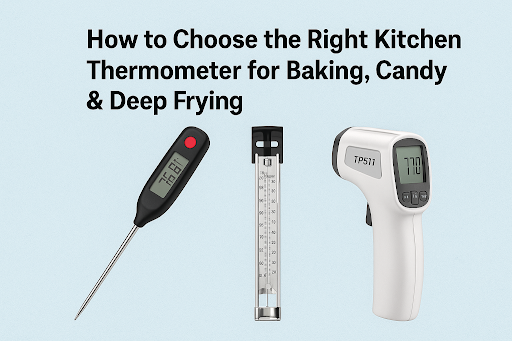
The term "kitchen thermometer" covers a few distinct tools, each optimized for different tasks.
1. Instant-Read Digital Thermometers
- How they work: Use a small electronic sensor at the tip of a thin probe to take a rapid temperature reading (usually 2–5 seconds).
- Best for: Baking (checking the internal temperature of meats, poultry, and bread) and general cooking.
- Key Feature: Speed and wide temperature range.
2. Long-Probe Thermometers (Leave-in)
- How they work: Feature a long probe connected by a heat-resistant wire to a digital base unit, allowing you to monitor temperatures while the oven door is closed.
- Best for: Roasting, grilling, and smoking large cuts of meat over a long period.
- Key Feature: Continuous monitoring and alarm settings.
3. Candy and Deep-Fry Thermometers
- How they work: Typically a sealed glass or metal tube with a high-temperature range liquid (or a durable digital probe) designed to withstand the heat of boiling sugar and hot oil. They usually include a pot clip to secure them to the side of a pot.
- Best for: Boiling sugar and oils.
- Key Feature: High-temperature tolerance and a secure pot clip.
Choosing the Best Thermometer for Your Task
|
Application |
Best Thermometer Type |
Key Considerations |
|
Baking/Roasting |
Instant-Read Digital |
Accuracy for safe doneness; Speed to minimize heat loss. |
|
Candy Making |
Candy Thermometer |
High-temperature range: 212°F to 400°F+ |
|
Deep Frying |
Deep Fry Thermometer |
Long Probe for oil safety; Durability to handle prolonged high heat. |
Featured Thermometers by Scispectrum
Scispectrum offers a range of high-quality ThermoPro thermometers to meet any culinary need. ThermoPro TP509: The Essential Candy/Fry Tool
The TP509 is the perfect, straightforward candy thermometer and deep fry thermometer for home use.
- Temperature Range: 50∘F to 572∘F
- Why You Need It: It has the high-temperature capacity you need for sugar work and oil. Its simple, durable design makes it the workhorse for all your boiling and frying needs.
ThermoPro TP510: Advanced Speed and Accuracy
The TP510 is a premium instant-read digital thermometer that takes the guesswork out of baking and roasting.
- Speed: Ultra-fast 2-3 second response time.
- Accuracy: Calibrated for professional-grade reliability.
- Why You Need It: When you need to quickly check the center of a cake or the doneness of a steak, its speed and accuracy minimize cooling and ensure perfect results every time.
ThermoPro TP511: Stable, Safe, and Large View
The TP511 combines the best features for a specialized cooking application—liquid temperature management.
- Key Features: Secure pot clip, large, easy-to-read screen, and waterproof rating.
- Why You Need It: The secure clip keeps the probe exactly where you need it in a pot of hot oil or boiling sugar, increasing safety. The waterproof design makes cleanup a breeze. It’s an ideal choice for a dedicated deep fry thermometer.
Comparison: Which Thermometer Should You Buy?
|
Thermometer Model |
Best For |
Key Differentiating Feature |
|
TP510 |
Baking/Roasting (Instant-Read) |
Ultra-Fast Speed and professional accuracy for internal checks. |
|
TP509 |
Candy/Frying (Budget-Friendly) |
High-temperature capacity and simple, reliable design. |
|
TP511 |
Candy/Frying (Dedicated/Safety) |
Secure Pot Clip and large screen for hands-free, safe temperature monitoring. |
The Bottom Line: Every serious cook should own at least two: a TP510 (for fast checks of solids) and either a TP509 or TP511 (for continuous monitoring of liquids).
Maintenance and Safety Tips
- Calibration Check: For maximum accuracy, regularly check your thermometer (especially digital ones) in an ice water bath. It should read $32^\circ\text{F}$ or $0^\circ\text{C}$.
- Safety First with Oil: When using a deep fry thermometer, ensure the probe tip is fully submerged but not touching the bottom of the pot. Never leave hot oil unattended.
- Cleaning: Always wipe the probe or stem with a damp cloth immediately after use. Avoid submerging the main digital unit of non-waterproof thermometers.
FAQs About Cooking Thermometers
Which thermometer is best for deep frying?
A dedicated deep fry thermometer like the ThermoPro TP511 is best. It offers a secure pot clip to prevent it from falling into the oil, a long probe for safe distance from the heat, and a high-temperature range to handle oil up to 400°F and higher.
Can I use a candy thermometer for baking?
Yes, but only for checking the internal temperature of high-heat items like bread or roasts. A candy thermometer has the correct temperature range but is usually slower and bulkier than an instant-read digital thermometer (like the TP510), making it less convenient for general baking tasks. It is not designed for quick checks of cakes or delicate items.
How close should the probe be to the food?
When checking internal temperature, the tip of the probe should be inserted into the thickest part of the food, away from bone, fat, or gristle, to get the most accurate reading. When measuring liquids (candy/oil), ensure the tip is fully submerged and not touching the bottom or sides of the pot.
Conclusion
Temperature control is the secret ingredient that separates good cooking from truly great results. Whether you’re baking a perfectly moist cake, crafting silky homemade caramel, or achieving golden, crisp fried chicken, the right thermometer takes the guesswork out of the process. From the quick-read convenience of the TP510 for solids to the reliable high-heat monitoring of the TP509 or TP511 for liquids, investing in the proper tools ensures safety, precision, and consistently delicious outcomes. Mastering your kitchen thermometer is not just about following recipes it’s about understanding your food and cooking with confidence every time.