
Posted by scispectrum on 28th Feb 2026
How to Choose the Right UV-Visible Spectrophotometer for Your Laboratory in 2026
Table of Contents
-
Introduction
-
What is a UV-Visible Spectrophotometer?
-
Working Principle
-
Types (Single vs Double Beam)
-
Key Features to Consider
-
Applications
-
Buying Mistakes to Avoid
-
Budget & Model Selection
-
Conclusion
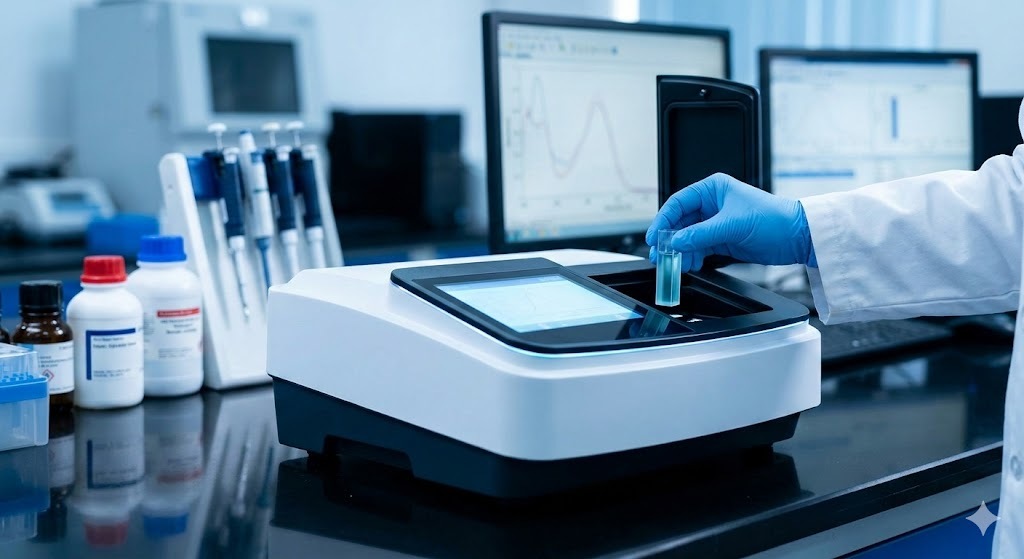
What is a UV-Visible Spectrophotometer?
A UV-Visible (UV-Vis) spectrophotometer is an analytical instrument used to measure the amount of light absorbed or transmitted by a sample as a function of wavelength.
The Working Principle
The device operates based on the Beer-Lambert Law, which states that the absorbance of a solution is directly proportional to the concentration of the absorbing species in the solution and the path length.
- UV Region: Typically covers 190 nm to 380 nm.
- Visible Region: Typically covers 380 nm to 1100 nm.
By measuring how much light is absorbed at specific wavelengths, laboratories can perform quantitative analysis to determine concentrations of chemicals, proteins, nucleic acids, and more.
Types of UV-Visible Spectrophotometers
Choosing the right optical design is the most significant factor in both performance and price.
1. Single Beam Spectrophotometer
In a single beam system, a single path of light passes through the sample. Before measuring the sample, the user must measure a "blank" (reference) to calibrate the machine.
- Best for: Educational labs and routine, quick concentration checks.
- Pros: Compact, cost-effective, and easy to maintain.
2. Double Beam Spectrophotometer
This advanced system splits the light into two paths: one for the sample and one for a simultaneous reference blank.
- Best for: Pharmaceutical QC, kinetics research, and high-precision analytical tasks.
- Pros: Exceptional stability, compensates for lamp fluctuations in real-time, and provides superior reproducibility.
3. Microprocessor vs. PC-Controlled Models
- Microprocessor-based: Features a built-in screen and keypad for standalone operation. Great for labs with limited space.
- PC-controlled: Connected to a computer with specialized software. These are essential for 21 CFR Part 11 compliance and complex data mapping.
|
Feature |
Single Beam |
Double Beam |
|
Optical Path |
Single path (manual blanking) |
Dual simultaneous paths |
|
Stability |
Susceptible to lamp drift |
Automatically compensates for drift |
|
Scan Speed |
Slower |
Faster & more efficient |
|
Typical Range |
190–1100 |
185–1100 nm |
|
Maintenance |
Minimal |
Moderate (more optics) |
|
Investment |
Low to Moderate |
High |
Key Features to Consider in 2026
When evaluating a laboratory spectrophotometer, look beyond the glossy brochure. In 2026, performance is defined by these technical benchmarks:
1. Spectral Bandwidth
The bandwidth (measured in nm) determines the resolution.
- Fixed Bandwidth (e.g., 1 nm or 2 nm): Sufficient for most routine pharmaceutical and chemical assays.
- Variable Bandwidth: Essential for research labs dealing with complex mixtures where fine peak separation is required.
2. Wavelength Accuracy & Repeatability
In a regulated environment, you must trust that "260 nm" on the screen is exactly 260 nm in the chamber. Look for an accuracy of pm ±0.3 nm or better to ensure compliance with pharmacopeia standards.
3. Stray Light Rejection
Stray light is the "noise" that can lead to measurement errors, especially at high concentrations. High-end 2026 models feature dual monochromators to keep stray light below 0.01%.
4. Software & Connectivity (21 CFR Part 11)
For the pharmaceutical industry, software must support audit trails, electronic signatures, and user access levels. Modern instruments now offer Wi-Fi connectivity and cloud-based data backup to integrate with LIMS (Laboratory Information Management Systems).
5. Validation and Calibration
Check if the instrument has built-in automated validation routines (e.g., holmium oxide filters) to perform daily performance checks without external help.
Applications Across Industries
The versatility of the UV-Visible Spectrophotometer makes it a staple in various Indian sectors:
- Pharmaceutical Analysis: Monitoring drug purity, dissolution testing, and identification of Active Pharmaceutical Ingredients (APIs).
- Water & Wastewater Testing: Detecting pollutants like nitrates, phosphates, and heavy metals.
- Food & Beverage: Analyzing color consistency, vitamin content, and detecting adulterants.
- Academic Research: Studying protein-DNA interactions and reaction kinetics in real-time.
Common Buying Mistakes to Avoid
Many laboratories make costly mistakes while purchasing:
❌ Choosing Based Only on Price
Low-cost models may compromise accuracy and durability.
❌ Ignoring Future Requirements
Consider future expansion and additional applications.
❌ Overlooking Compliance Needs
Pharma and NABL-oriented labs require compliance-ready instruments.
❌ Not Checking Service Availability
Local service support is critical for minimal downtime.
❌ Ignoring Software Capabilities
In 2026, digital integration is no longer optional.
Budget & Investment Considerations
The UV-Vis Spectrophotometer price in India varies depending on:
- Single vs double beam configuration
- Software features
- Brand reliability
- Automation level
Entry-Level Models
Suitable for:
- Academic labs
- Routine QC testing
- Budget-conscious setups
Advanced Models
Recommended for:
- Pharmaceutical manufacturing
- Research institutions
- Regulatory-compliant laboratories
While advanced systems have higher upfront costs, they offer better long-term ROI through accuracy, durability, and compliance readiness.
How to Match the Instrument to Your Lab Type
|
Lab Type |
Recommended Model |
|
Academic Lab |
Single Beam |
|
Routine QC Lab |
Single or Entry Double Beam |
|
Pharma Manufacturing |
Double Beam with Compliance Software |
|
Research Institute |
High-Resolution Double Beam |
Understanding your daily sample load and precision requirement will guide your final decision.
Explore Our UV-Visible Spectrophotometer Series
Conclusion
Selecting the right UV-Visible Spectrophotometer in 2026 requires careful evaluation of accuracy, features, compliance, and long-term support. As laboratories in India move toward higher precision and stricter regulatory standards, investing in the right analytical instrument becomes a strategic decision.
Whether you operate a pharmaceutical facility, water testing lab, or research institution, choosing the correct model ensures reliable results, operational efficiency, and regulatory confidence.
Take the time to assess your application needs because precision today defines credibility tomorrow.