
Posted by scispectrum on 24th Mar 2026
Polarimeter: Working Principle, Types, and Applications in Optical Analysis
Introduction
In industries such as pharmaceuticals, food processing, and chemical manufacturing, accurate measurement of substance composition is critical. Many compounds, especially organic ones like sugars and certain drugs, have a unique property—they can rotate plane-polarized light. Measuring this optical rotation helps determine purity, concentration, and quality.
This is where a polarimeter becomes an essential analytical instrument. By understanding the polarimeter working principle, industries can ensure product consistency, compliance, and reliability.
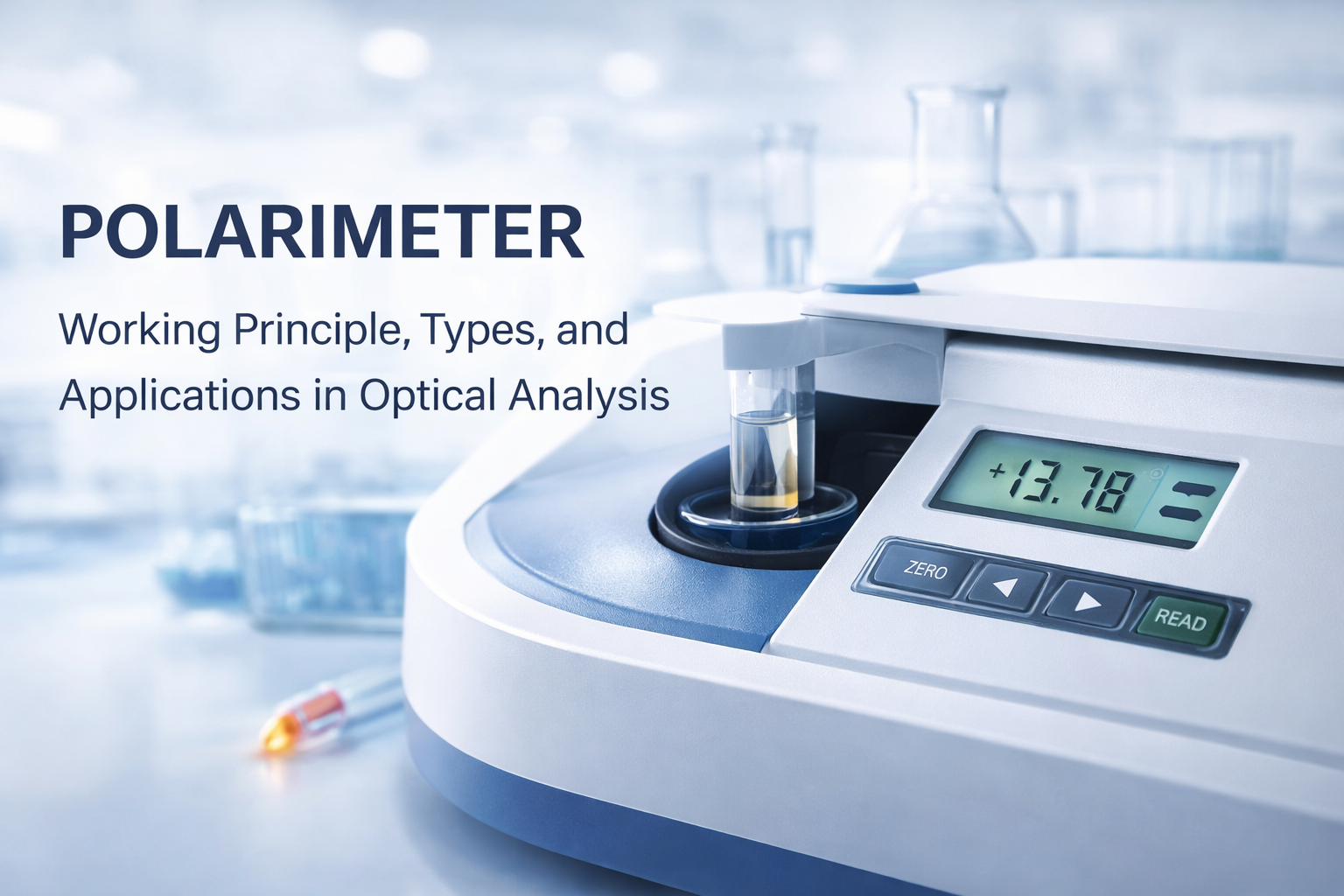
What is a Polarimeter?
A polarimeter is a scientific instrument used to measure the angle of rotation caused by passing polarized light through an optically active substance.
Optically active substances—such as sugar solutions or certain chemical compounds—can rotate the plane of polarized light either to the left (levorotatory) or to the right (dextrorotatory).
The amount of rotation depends on factors such as:
- Concentration of the solution
- Length of the sample tube
- Temperature
- Wavelength of light used
Polarimeters are widely used in laboratories and industries to analyze these properties accurately.
Working Principle of a Polarimeter
The working principle of a polarimeter is based on the interaction between polarized light and optically active substances.
Here’s how it works:
- A light source emits monochromatic light (usually sodium lamp).
- The light passes through a polarizer, converting it into plane-polarized light.
- This polarized light then passes through the sample solution placed in a tube.
- If the sample is optically active, it rotates the plane of polarization.
- An analyzer measures the angle of rotation.
- The instrument displays the angle, which is used to calculate concentration or purity.
Modern digital polarimeters automatically detect and display results, making the process faster and more accurate.
Types of Polarimeters
1. Manual Polarimeter
Manual polarimeters require the user to visually adjust the analyzer to determine the angle of rotation.
- Simple and cost-effective
- Requires skilled operation
2. Digital Polarimeter
Digital polarimeters use sensors and microprocessors to provide precise readings.
- High accuracy
- Easy to use
- Widely used in modern labs
3. Automatic Polarimeter
Automatic polarimeters are advanced systems with automated sample handling and analysis.
- Minimal human intervention
- Ideal for high-throughput laboratories
Applications of Polarimeters
1. Pharmaceutical Industry
Polarimeters are used to measure the purity and concentration of drugs. Many pharmaceutical compounds are optically active, making polarimetry essential for quality control.
2. Sugar Industry
In sugar production, polarimeters determine sucrose concentration in solutions. This helps maintain consistent product quality and optimize processing.
3. Chemical Industry
Polarimeters are used to analyze chemical compounds and reactions, especially those involving chiral molecules.
4. Research Laboratories
In academic and industrial research, polarimeters help study molecular structures and optical properties.
5. Food and Beverage Industry
They are used to measure sugar content and detect adulteration in food products.
Advantages of Using a Polarimeter
Polarimeters offer several benefits in analytical applications:
- High Accuracy: Provides precise measurement of optical rotation
- Non-Destructive Testing: Does not alter the sample
- Quick Results: Fast and efficient analysis
- Reliable Data: Ensures consistent and repeatable measurements
- Wide Application Range: Suitable for multiple industries
These advantages make polarimeters indispensable in quality control and research.
Tips for Accurate Measurement
To obtain reliable results, follow these best practices:
Proper Sample Preparation
Ensure the sample is free from impurities and bubbles, as these can affect light transmission.
Clean Sample Tubes
Always use clean and dry tubes to avoid contamination and measurement errors.
Calibration
Regularly calibrate the polarimeter using standard reference materials.
Temperature Control
Maintain consistent temperature, as optical rotation can vary with temperature changes.
Correct Wavelength
Use the appropriate light source (commonly sodium light) for accurate readings.
Product Overview (Polarimeters)
For laboratories and industrial applications, choosing the right polarimeter is crucial. Modern digital polarimeters offer advanced features such as automatic calibration, temperature compensation, and digital displays for precise and reliable measurements.
| Product Name | Type | Application |
|---|---|---|
| KERRO Manual Disc Polarimeter WXG-4 | Manual Polarimeter | Basic optical rotation measurement in labs |
| Automatic Polarimeter Digital Sucro Pol D (ADVANCE) | Automatic Polarimeter | High-precision industrial & sugar analysis |
| Semi Automatic Polarimeter SAP-2 | Semi-Automatic | Routine lab testing & quality control |
| ADVANCE Manual Polarimeter Model PA-2 | Manual Polarimeter | Educational & laboratory use |
| ADVANCE Manual Polarimeter Standard Model PA-1R | Manual Polarimeter | General optical rotation measurement |
| Deluxe Manual Polarimeter Model PA-1R | Manual Polarimeter | Advanced lab applications |
Conclusion
A polarimeter is a vital instrument for analyzing optically active substances across various industries. By understanding the polarimeter working principle, users can effectively measure optical rotation and determine the purity and concentration of substances.
From pharmaceuticals and sugar production to chemical analysis and research, polarimeters play a key role in ensuring accuracy, quality, and consistency. With advancements in digital technology, modern polarimeters have become more efficient, user-friendly, and essential for today’s analytical laboratories.