
Posted by scispectrum on 17th Mar 2026
Anemometer: Working Principle, Types, and Applications in Wind Measurement
Table of Contents
- Introduction
- What is an Anemometer?
- Working Principle of an Anemometer
- Types of Anemometers
- Applications in Weather Monitoring and Industry
- Best Anemometers for Laboratories
- Advantages of Using Anemometers
- Tips for Accurate Wind Speed Measurement
- Conclusion
Introduction
Measuring wind speed and airflow is essential in many scientific, industrial, and environmental applications. Accurate wind measurements help meteorologists predict weather patterns, engineers design efficient ventilation systems, and renewable energy companies optimize wind turbine performance.
One of the primary instruments used to measure wind speed is an anemometer. This device plays a vital role in weather monitoring, environmental studies, HVAC systems, aviation, and wind energy projects. Modern anemometers are designed to provide precise and reliable wind speed measurements in both laboratory and field conditions.
In this article, we will explore the working principle, types, and major applications of anemometers, along with tips for accurate wind speed measurement.
What is an Anemometer?
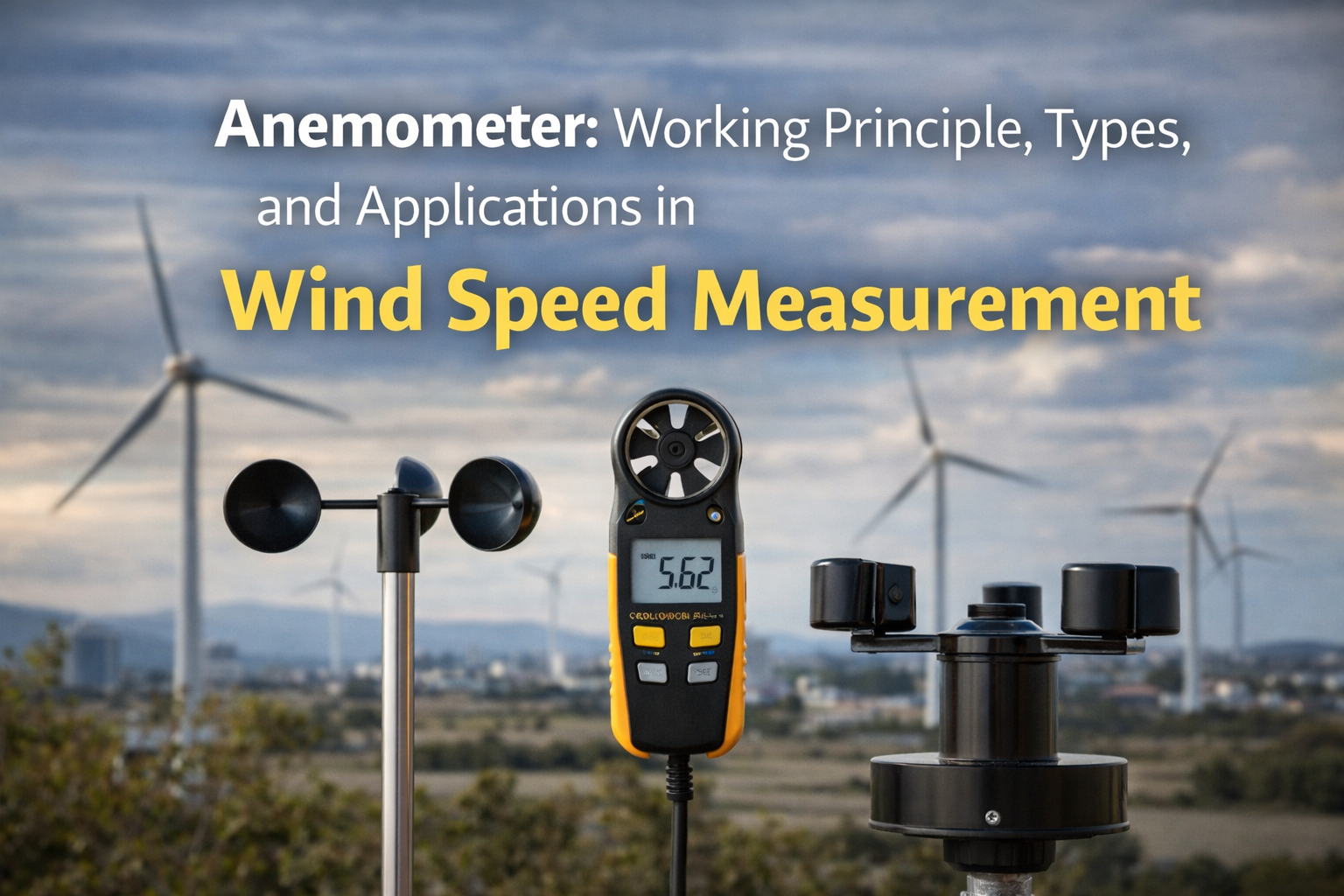
An anemometer is an instrument used to measure the speed and sometimes the direction of wind or airflow. The term “anemometer” originates from the Greek word anemos, meaning wind.
Anemometers are commonly used in meteorological stations, environmental monitoring systems, industrial ventilation testing, and wind energy research. These instruments help determine how fast air is moving, which is critical for weather forecasting, climate studies, and airflow analysis.
Modern anemometers often display results in different units such as:
- Meters per second (m/s)
- Kilometers per hour (km/h)
- Miles per hour (mph)
- Feet per minute (ft/min)
These measurements allow scientists and engineers to analyze airflow behavior and environmental conditions accurately.
Working Principle of an Anemometer
The working principle of an anemometer is based on the movement of air causing mechanical rotation or changes in sensor signals, which are then converted into wind speed measurements.
In most traditional anemometers, wind pushes rotating components such as cups or vanes. The speed of rotation increases as wind speed increases. The instrument measures the rotation rate and converts it into a wind speed reading.
The general working process involves:
- Airflow interacts with the sensor or rotating component.
- The sensor begins to rotate or generate an electrical signal.
- The instrument measures the speed of rotation or signal change.
- A built-in processor converts this information into wind speed values displayed on the screen.
Advanced digital anemometers may also use thermal sensors or ultrasonic technology to measure airflow without moving parts.
Types of Anemometers
Different types of anemometers are available depending on the measurement method and application requirements.
1. Cup Anemometer
The cup anemometer is one of the most widely used types in meteorology. It consists of three or four hemispherical cups mounted on horizontal arms attached to a vertical shaft.
When wind blows, the cups rotate around the shaft. The rotation speed is proportional to the wind speed, allowing the instrument to calculate wind velocity.
Cup anemometers are commonly used in weather stations and climate monitoring systems.
2. Vane Anemometer
A vane anemometer, also called a propeller anemometer, uses a rotating propeller to measure airflow.
The propeller rotates when air passes through it, and the instrument calculates wind speed based on the rotation rate.
These devices are commonly used in:
- HVAC system testing
- Airflow measurement in ducts
- Industrial ventilation analysis
3. Hot-Wire Anemometer
A hot-wire anemometer measures airflow using a thin heated wire.
When air flows over the wire, it cools the wire, causing a change in electrical resistance. The instrument measures this change and calculates the airflow velocity.
Hot-wire anemometers are often used in:
- Laboratory airflow studies
- Aerodynamic research
- Precision airflow measurement
4. Ultrasonic Anemometer
An ultrasonic anemometer uses ultrasonic sound waves to measure wind speed and direction.
The instrument sends sound waves between sensors and measures the time it takes for the signals to travel. Wind affects the travel time, allowing the device to calculate wind velocity accurately.
Ultrasonic anemometers are widely used in:
- Advanced meteorological research
- Wind energy studies
- Environmental monitoring
5. Digital Anemometer
A digital anemometer is a modern electronic device that provides accurate airflow measurements with digital displays and data logging capabilities.
These instruments are portable and easy to use, making them suitable for:
- Field measurements
- Industrial inspections
- Environmental monitoring
Applications in Weather Monitoring and Industry
Anemometers are used in a wide range of industries and scientific fields.
Meteorological Stations
Weather stations use anemometers to measure wind speed and monitor atmospheric conditions. These measurements help meteorologists predict weather changes and storms.
HVAC Systems
In heating, ventilation, and air conditioning systems, anemometers help measure airflow in ducts and ventilation systems. This ensures proper airflow and energy efficiency in buildings.
Wind Energy Projects
Wind energy companies use anemometers to measure wind speed when selecting sites for wind turbines. Accurate measurements help determine the potential energy output of wind farms.
Environmental Monitoring
Environmental scientists use anemometers to study air movement, pollution dispersion, and climate patterns.
Industrial Ventilation Systems
Factories and industrial facilities use anemometers to monitor airflow in ventilation systems, ensuring safe working conditions and proper air circulation.
Best Anemometers for Laboratories
Selecting the right anemometer helps ensure accurate airflow and wind speed measurements in laboratory, HVAC, and environmental applications. Modern digital anemometers provide features such as multi-unit airflow measurement, temperature monitoring, and portable handheld designs for field or lab use.
Below are some commonly used anemometers suitable for laboratory testing and airflow analysis.
| Product | Brand | Key Features | Typical Applications |
|---|---|---|---|
| Lutron AM‑4201 Anemometer | Lutron | Measures air velocity in multiple units, remote vane sensor, LCD display | HVAC airflow measurement, environmental monitoring |
| Lutron AM‑4202 Digital Anemometer | Lutron | Portable airflow meter with temperature measurement and data hold | Industrial ventilation testing, laboratory airflow analysis |
| Lutron AM‑4204 Hot Wire Anemometer | Lutron | High-precision hot-wire probe, telescopic sensor, ideal for low air velocity | Clean rooms, research laboratories, HVAC duct testing |
| Lutron LM‑8010 5‑in‑1 Environmental Meter | Lutron | Measures air velocity, humidity, light, and temperature in one device | Environmental monitoring, industrial inspections |
Advantages of Using Anemometers
Anemometers provide several benefits for measuring airflow and wind speed.
- Accurate wind speed measurements
- Portable and easy to use
- Quick response time
- Suitable for both laboratory and field use
- Available in different designs for various applications
Because of these advantages, anemometers are widely used in scientific research, environmental monitoring, and industrial testing.
Tips for Accurate Wind Speed Measurement
To obtain reliable results when using an anemometer, it is important to follow proper measurement practices.
Proper Placement
Place the anemometer in an open area away from obstacles such as buildings or trees that may block airflow.
Regular Calibration
Ensure the instrument is regularly calibrated to maintain measurement accuracy.
Avoid Obstructions
Make sure the sensor or rotating component is not obstructed by debris or dirt.
Stable Measurement Conditions
Allow the instrument to stabilize before recording measurements to ensure accurate readings.
Conclusion
An anemometer is an essential instrument for measuring wind speed and airflow in various scientific and industrial applications. From weather forecasting and environmental monitoring to HVAC system testing and wind energy research, anemometers play a crucial role in understanding air movement.
With different types available, including cup, vane, hot-wire, ultrasonic, and digital anemometers, users can select the most suitable instrument for their specific measurement needs.
As technology continues to advance, modern anemometers provide greater accuracy, portability, and reliability, making them indispensable tools for professionals working with airflow and wind measurement.