
Posted by scispectrum on 17th Mar 2026
Anemometer: Working Principle, Types, and Applications in Wind Measurement
Anemometer: Working Principle, Types, Applications and Price in India
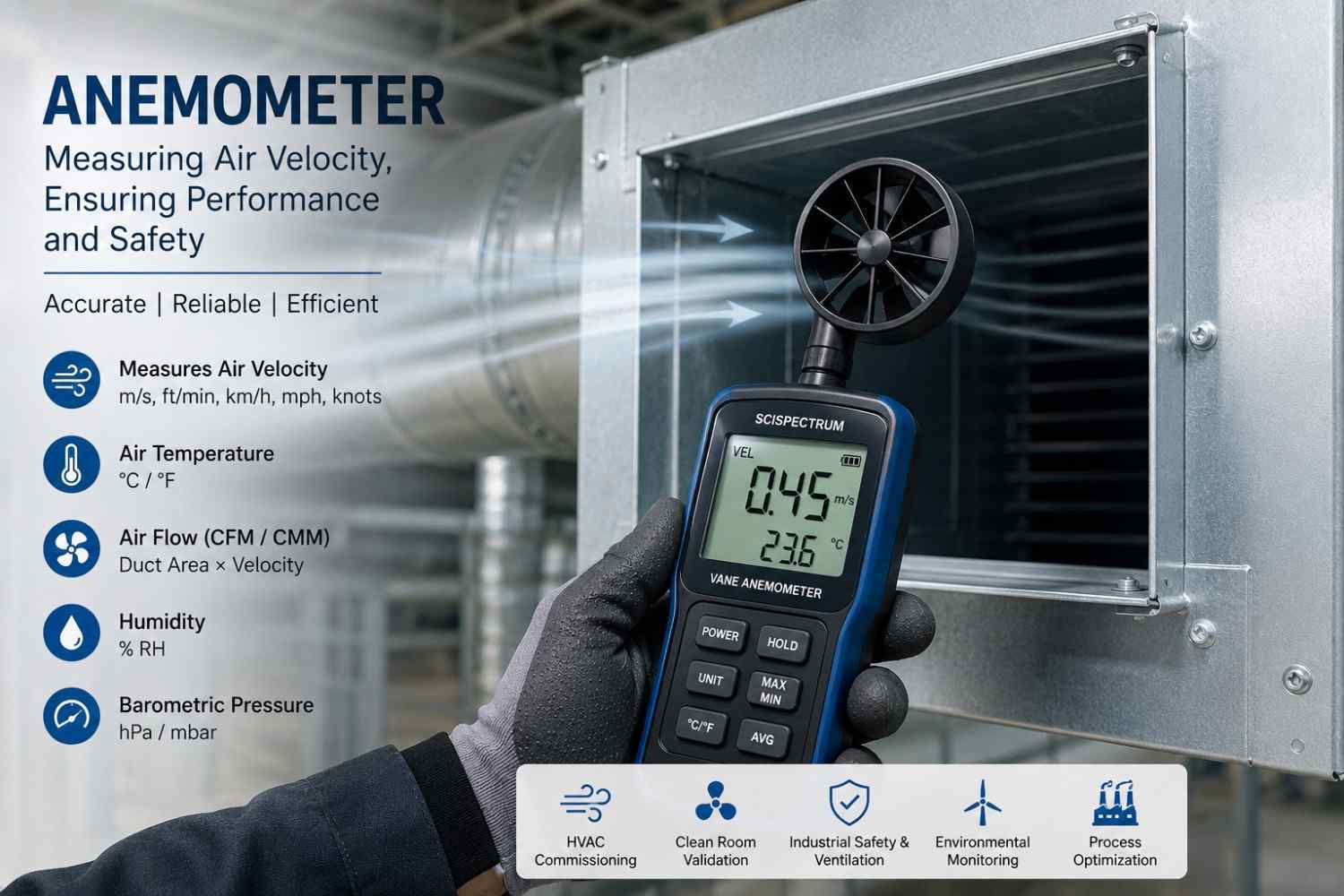
During the HVAC commissioning of a pharmaceutical manufacturing facility in Hyderabad, the HVAC contractor certified all clean room air velocities as compliant with ISO 14644 Class 7 requirements. The validation team arrived for their own verification measurements with a vane anemometer. Every reading came out nearly double the specified value. The problem was not the HVAC system — it was that the contractor had used a cup anemometer rated for outdoor wind speeds to measure the gentle 0.45 m/s laminar airflow in the clean room. The wrong instrument, producing numbers that appeared precise and were entirely meaningless.
That scenario illustrates why understanding anemometer types and working principles is not academic — the choice of instrument determines whether your measurement is real. This guide covers everything you need to understand anemometers: what they measure, how each type works, which application requires which instrument, and every model available in India with actual prices.
Anemometer: An instrument that measures wind speed, air velocity, or the velocity of any flowing gas. The word derives from the Greek anemos (wind) and metron (measure). Modern digital anemometers display readings in m/s, km/h, mph, ft/min, or knots, and most simultaneously measure air temperature. Multi-function models also calculate volumetric air flow (CFM/CMM) and measure humidity, barometric pressure, and other environmental parameters.
What Is an Anemometer
An anemometer is the instrument used wherever the speed or flow of air or gas must be measured, monitored, or recorded. The applications span a remarkable range — from measuring wind speed at a meteorological station or a wind farm site, to balancing airflow in an HVAC duct, to verifying that the unidirectional airflow in a pharmaceutical clean room meets the velocity specification in its ISO 14644 classification.
What distinguishes one anemometer from another — and what makes instrument selection critical — is the measurement principle and the velocity range each type handles accurately. A cup anemometer that reliably measures a 60 km/h coastal wind is useless for measuring the 0.3 m/s laminar airflow inside a Class 5 clean room. A hot wire anemometer that accurately captures turbulent flow at 0.05 m/s cannot survive being mounted on a weather mast. Every type of anemometer has a specific operating window, and using one outside that window produces readings that are either meaningless or actively misleading.
What Does an Anemometer Measure — Parameters and Units
The primary measurement of any anemometer is air velocity or wind speed — the magnitude of the airflow, independent of direction. Beyond this core parameter, modern digital instruments can measure a range of additional quantities simultaneously.
Primary measurements
- Air velocity / wind speed — the speed of the airflow at the measurement point, in m/s, km/h, mph, ft/min, or knots depending on the instrument setting and application.
- Air temperature — built into virtually all digital anemometers via a thermistor or thermocouple. Required because air density — and therefore the energy content of a given velocity — changes with temperature.
- Wind direction — measured by instruments equipped with a direction vane (commonly at weather stations). Reported as degrees from north (0–360°) or as compass bearing (N, NE, E, etc.).
Secondary measurements (multi-function models)
- Volumetric air flow (CFM / CMM) — cubic feet per minute or cubic metres per minute. Calculated from air velocity × duct cross-section area, entered by the operator. Used in HVAC commissioning to verify that supply and exhaust flow rates match design specifications.
- Relative humidity — required for clean room qualification and HVAC performance verification alongside air velocity.
- Barometric pressure — relevant for weather stations and for correcting air density in high-altitude measurements.
- Sound level (dB) — available in environmental multi-function instruments like the Lutron LM-8102, which combines anemometer, sound level meter, light meter, and humidity meter in one unit.
Anemometer units at a glance
| Unit | Full Name | Typical Application | Conversion to m/s |
|---|---|---|---|
| m/s | Metres per second | Scientific, industrial, clean room (ISO 14644) | 1.00 m/s |
| km/h | Kilometres per hour | Meteorology, general weather reporting | ÷ 3.6 |
| mph | Miles per hour | Aviation (USA/UK), construction safety | ÷ 2.237 |
| ft/min (FPM) | Feet per minute | HVAC commissioning, duct balancing | ÷ 196.85 |
| knots | Nautical miles per hour | Marine, aviation, coastal wind measurement | ÷ 1.944 |
| Beaufort | Beaufort scale (0–12) | Marine weather, descriptive classification | Scale-dependent |
Working Principle of an Anemometer
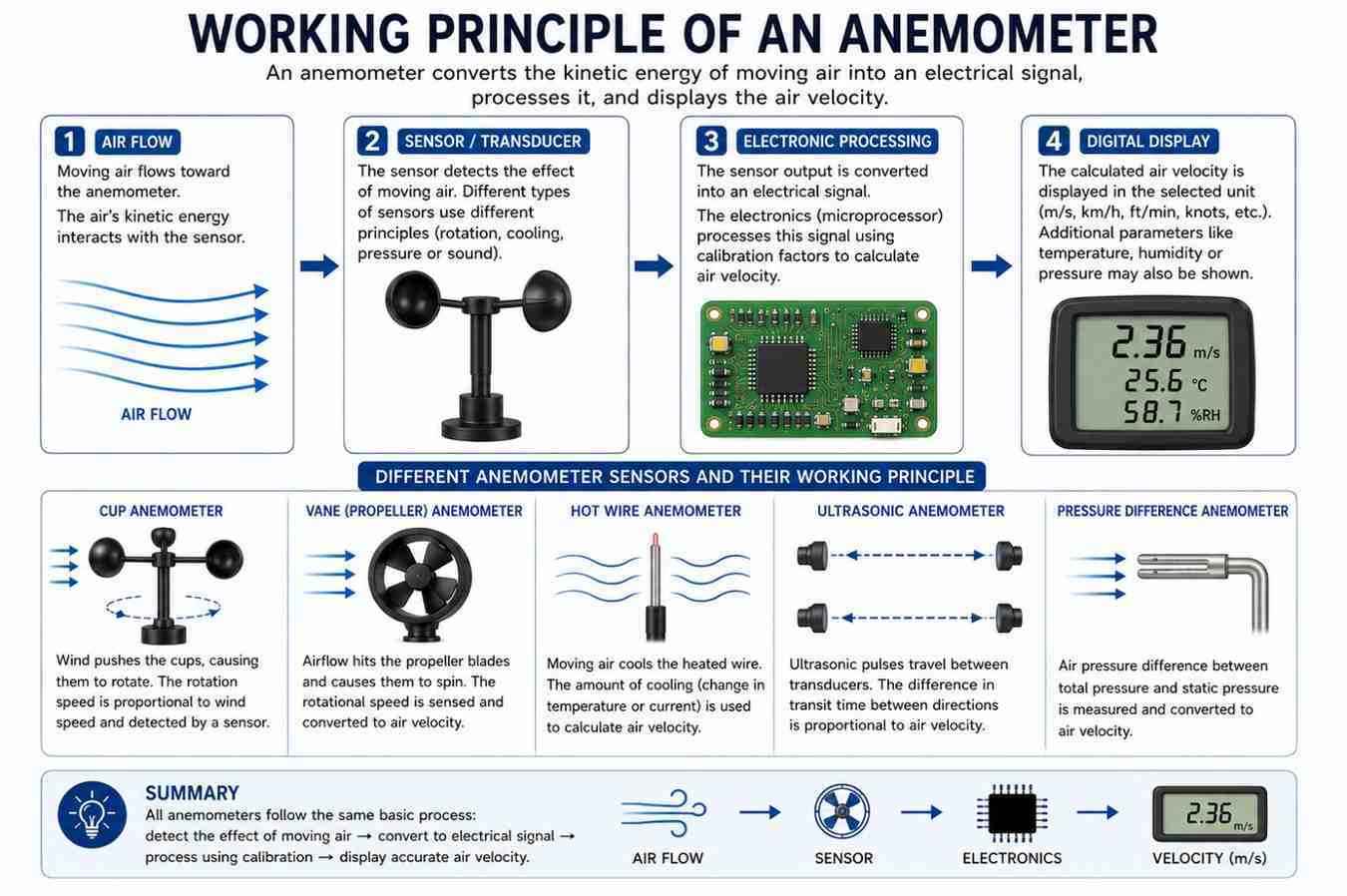
The working principle differs by anemometer type, but all share the same fundamental approach: measure some physical effect of moving air — rotation, cooling, pressure differential, or sound — and convert it to a velocity reading. Here is how each major type works:
Cup anemometer working principle
- Three or four hemispherical cups are mounted on horizontal arms around a central vertical axis.
- The wind catches the open face of each cup more strongly than its convex back, creating a net torque that drives rotation.
- The rotation rate of the shaft is proportional to wind speed — measured by a magnetic pickup, reed switch, or optical sensor generating pulses.
- The instrument counts pulses per second and converts to wind speed using a calibration factor (anemometer factor).
- Display shows wind speed in the selected unit; some models log min/max and average.
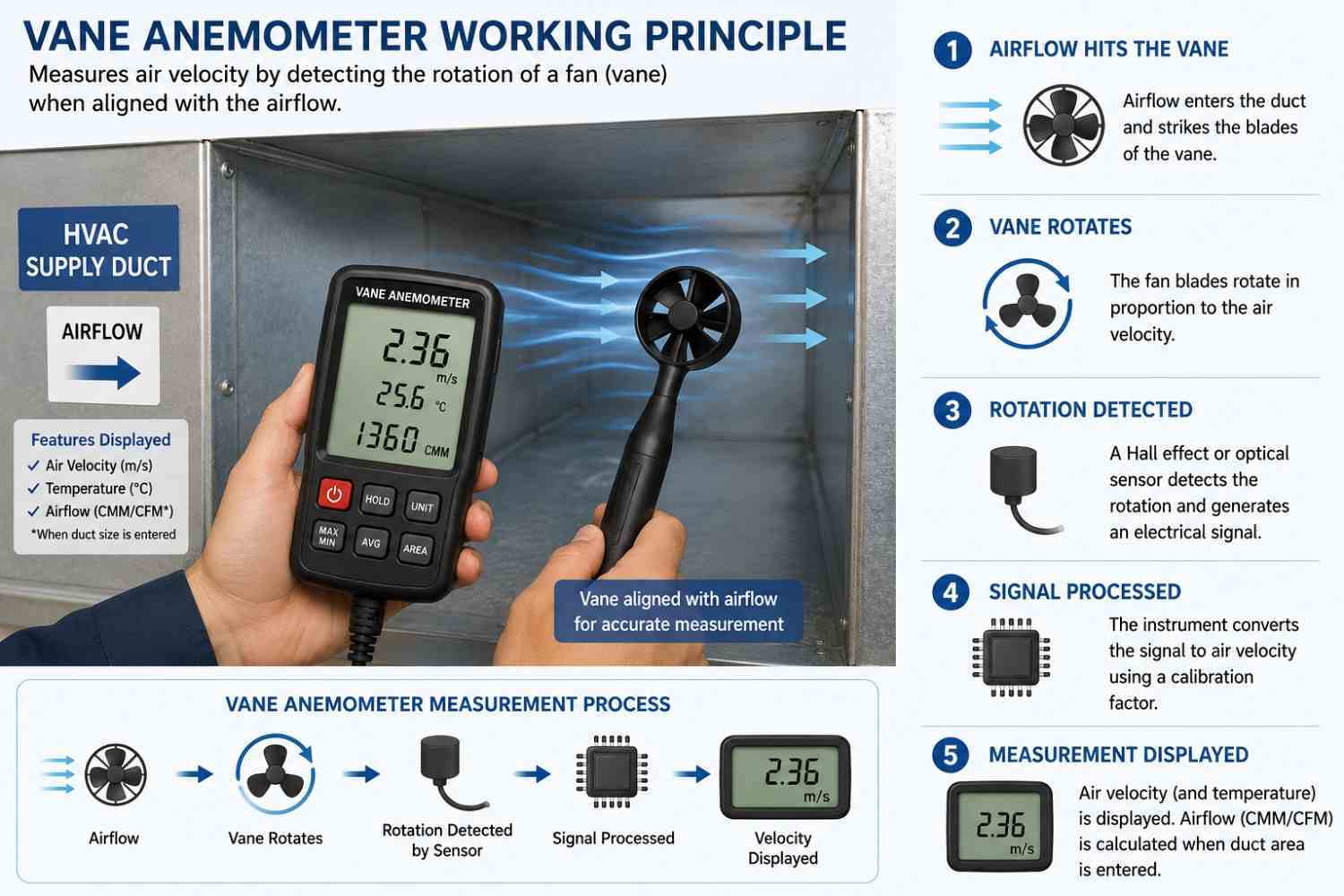
Vane (propeller) anemometer working principle
- A multi-bladed fan or propeller is aligned axially with the airflow direction.
- Moving air strikes the propeller blades and causes rotation at a speed proportional to air velocity.
- The rotational speed is converted to a velocity signal via a Hall effect sensor or optical encoder.
- The electronics compute velocity and, if duct dimensions are entered, volumetric flow (CMM/CFM).
- Most handheld vane anemometers display both velocity and temperature simultaneously.
Hot wire anemometer working principle
- A fine metallic wire (tungsten, platinum — typically 5 µm diameter) is electrically heated to a temperature above ambient.
- Moving air flows over the wire and removes heat — the faster the air, the greater the cooling effect (convective heat transfer).
- The instrument maintains the wire at constant temperature (constant temperature anemometry, CTA) by automatically adjusting current, or operates at constant current and measures the voltage drop.
- The bridge voltage or current required to maintain constant wire temperature is calibrated to air velocity.
- Because the thermal mass of the wire is extremely small, it responds to velocity fluctuations in milliseconds — making hot wire anemometers the only instrument capable of measuring turbulence intensity and velocity fluctuations at high frequency.
Ultrasonic anemometer working principle
- Two or more pairs of ultrasonic transducers are mounted facing each other at defined spacing.
- Each transducer alternately transmits and receives ultrasonic pulses. The time for the sound pulse to travel between transducers changes when air is flowing — shorter in the downwind direction, longer upwind.
- The difference in transit time between the two directions is proportional to air velocity along that axis.
- Three-axis ultrasonic anemometers use three orthogonal transducer pairs to resolve the full three-dimensional wind vector.
- No moving parts — no wear, no zero offset from friction, no starting threshold. The highest accuracy and best long-term stability of any anemometer type.
Types of Anemometers
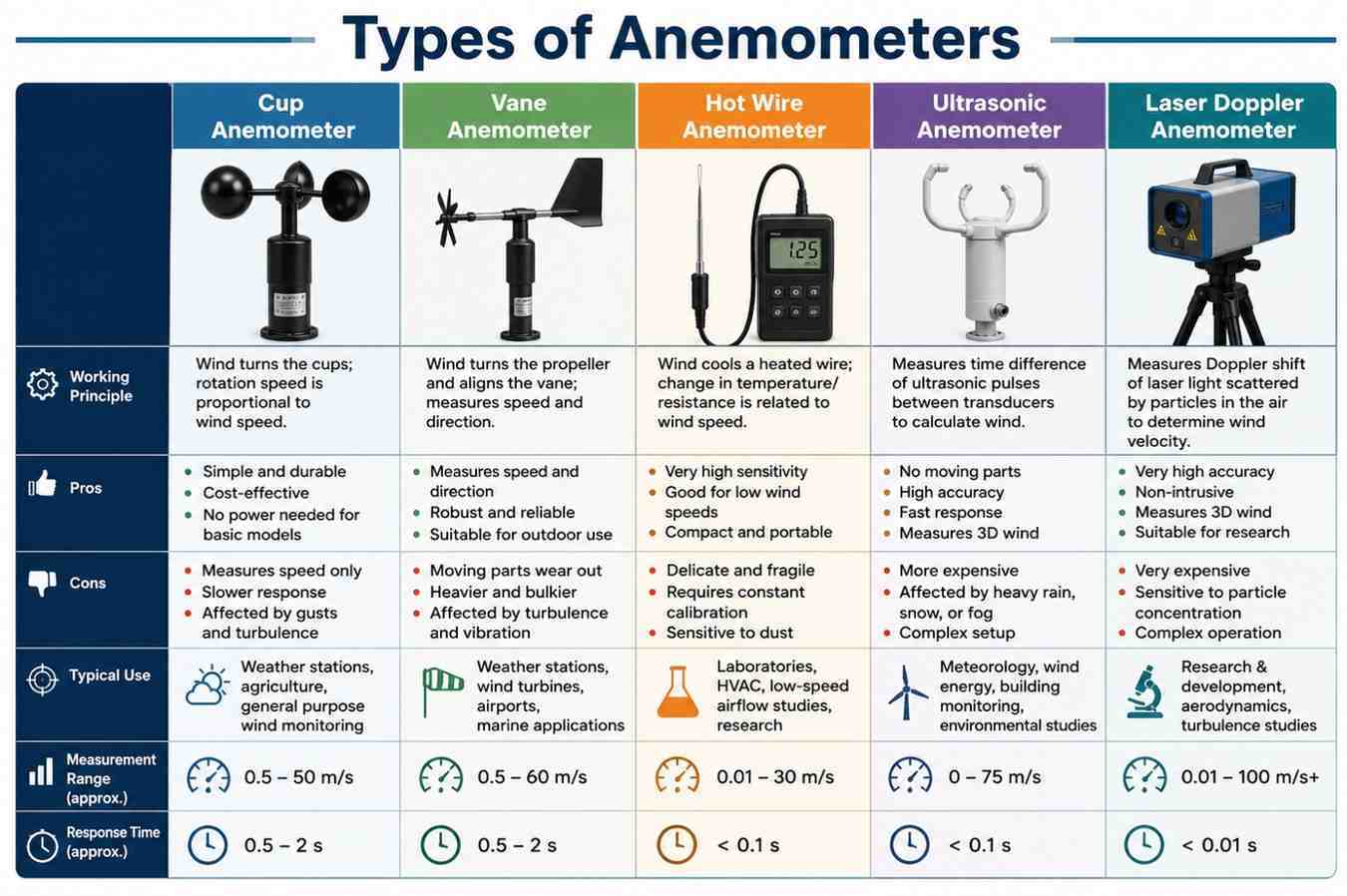
There are five main types of anemometers in practical use. Each has a specific velocity range, accuracy level, maintenance requirement, and set of applications where it outperforms the others.
1. Cup Anemometer
The most recognisable anemometer type — three rotating hemispherical cups on a vertical axis. The cup anemometer was invented by John Thomas Romney Robinson in 1846 and remains the standard instrument at meteorological stations worldwide. It is highly robust, requires minimal maintenance, and performs reliably over the full outdoor wind speed range (typically 0.5–60+ m/s).
Best for: Weather stations, wind farm site surveys, roof-mounted permanent installations, outdoor wind speed logging. Not suitable for directional HVAC measurement (measures only speed, not direction or volume flow) and not accurate at very low velocities due to threshold effects. Cup anemometers are typically integrated with data loggers for continuous wind monitoring.
Indian applications: IMD (India Meteorological Department) weather stations, wind energy resource assessment per MNRE guidelines, construction site wind safety monitoring.
2. Vane (Propeller) Anemometer
A handheld instrument with a fan-type propeller at the tip of a probe. The propeller rotates in the airflow and the rotation speed is converted to air velocity. Vane anemometers are the standard instrument for HVAC commissioning, duct balancing, and general industrial air flow measurement. They directly calculate CFM or CMM when the duct dimensions are entered.
Best for: HVAC duct balancing and commissioning, supply/return air grille measurement, fan performance testing, workshop and factory ventilation checks, general outdoor wind speed measurement. The most common anemometer type in industrial and building services applications in India.
Indian applications: HVAC balancing for commercial buildings, factory floor ventilation compliance, clean room air change verification (for velocities above 0.4 m/s), data centre cooling checks.
3. Hot Wire Anemometer
Uses a fine, electrically heated sensing wire. Air flowing over the wire cools it in proportion to velocity — the instrument measures the electrical power required to maintain the wire at constant temperature and converts it to air velocity. Hot wire anemometers achieve the highest accuracy at very low air velocities and can detect turbulence and velocity fluctuations that mechanical sensors cannot resolve.
Best for: Pharmaceutical clean room validation (ISO 14644, GMP), laminar flow cabinet testing, biosafety cabinet airflow measurement, HVAC systems with very gentle airflow, research applications requiring turbulence intensity measurement, ducts with low velocity air (below 0.4 m/s). The Lutron AM-4204 hot wire model with RS232 output is the choice for GMP documentation in pharma facilities.
Indian applications: Pharma clean room qualification, R&D wind tunnel studies, biosafety cabinet certification per WHO laboratory biosafety guidelines.
4. Ultrasonic Anemometer
Uses time-of-flight measurement of ultrasonic pulses between transducer pairs to determine wind speed and direction. No moving parts means no mechanical wear, no starting threshold, and no zero drift from bearing friction. These are the highest-accuracy, most reliable instruments available — but also the most expensive.
Best for: Permanent weather station installations, offshore platforms, wind turbine control systems, research grade atmospheric measurement, aviation weather (AWOS systems). Typically not handheld — mounted permanently or semi-permanently.
5. Laser Doppler Anemometer (LDA)
Measures the Doppler frequency shift of laser light scattered by particles (dust, seeding particles) in the airflow. Non-contact measurement with extremely high spatial resolution and accuracy. Used exclusively in research — fluid mechanics laboratories, wind tunnel studies, internal combustion engine research, biomedical flow studies. Not a practical field instrument; requires optical alignment and laser safety controls.
| Type | Working Principle | Velocity Range | Best Application | India Price Range |
|---|---|---|---|---|
| Cup | Rotating cups — torque from wind | 0.5–60+ m/s | Weather stations, wind energy | ₹3,000 – ₹25,000+ |
| Vane (Propeller) | Rotating fan — Hall/optical sensor | 0.4–30 m/s | HVAC, duct balancing, factories | ₹3,480 – ₹15,500 |
| Hot Wire | Heated wire — convective cooling | 0.01–20 m/s | Clean rooms, low velocity, research | ₹15,000 – ₹50,000+ |
| Ultrasonic | Transit-time difference — sound | 0–60+ m/s | Permanent stations, offshore, aviation | ₹50,000 – ₹5,00,000+ |
| Laser Doppler | Doppler shift — laser scatter | 0.001–500 m/s | Research, wind tunnels, R&D | ₹5,00,000+ |
Vane vs Hot Wire Anemometer: Which Do You Need
For most buyers in India, the choice comes down to vane versus hot wire. Here is a direct comparison across the criteria that matter in the field:
| Factor | Vane Anemometer | Hot Wire Anemometer |
|---|---|---|
| Starting threshold | ~0.4 m/s — reads zero below this | ~0.01–0.1 m/s — responds at very low velocities |
| Accuracy at low velocity | Poor (below 0.4 m/s) | Excellent (designed for low-velocity work) |
| Accuracy at high velocity | Good (0.4–30 m/s) | Adequate but rarely used above 20 m/s |
| CFM/CMM calculation | Yes — built into most models | Some models (Lutron AM-4204: no; LM-8010: yes) |
| Turbulence measurement | No | Yes — high frequency response |
| Fragility | Robust — propeller survives normal use | Delicate — wire can break if probe tip is struck |
| Clean room use | Not recommended below 0.4 m/s | Required for ISO 14644 clean room qualification |
| Typical India price | ₹3,480 – ₹15,500 | ₹15,000 – ₹50,000+ |
| GMP documentation | Models with RS232 available | Lutron AM-4204 has RS232 — GMP documentation supported |
Applications of Anemometers in Industry and Research
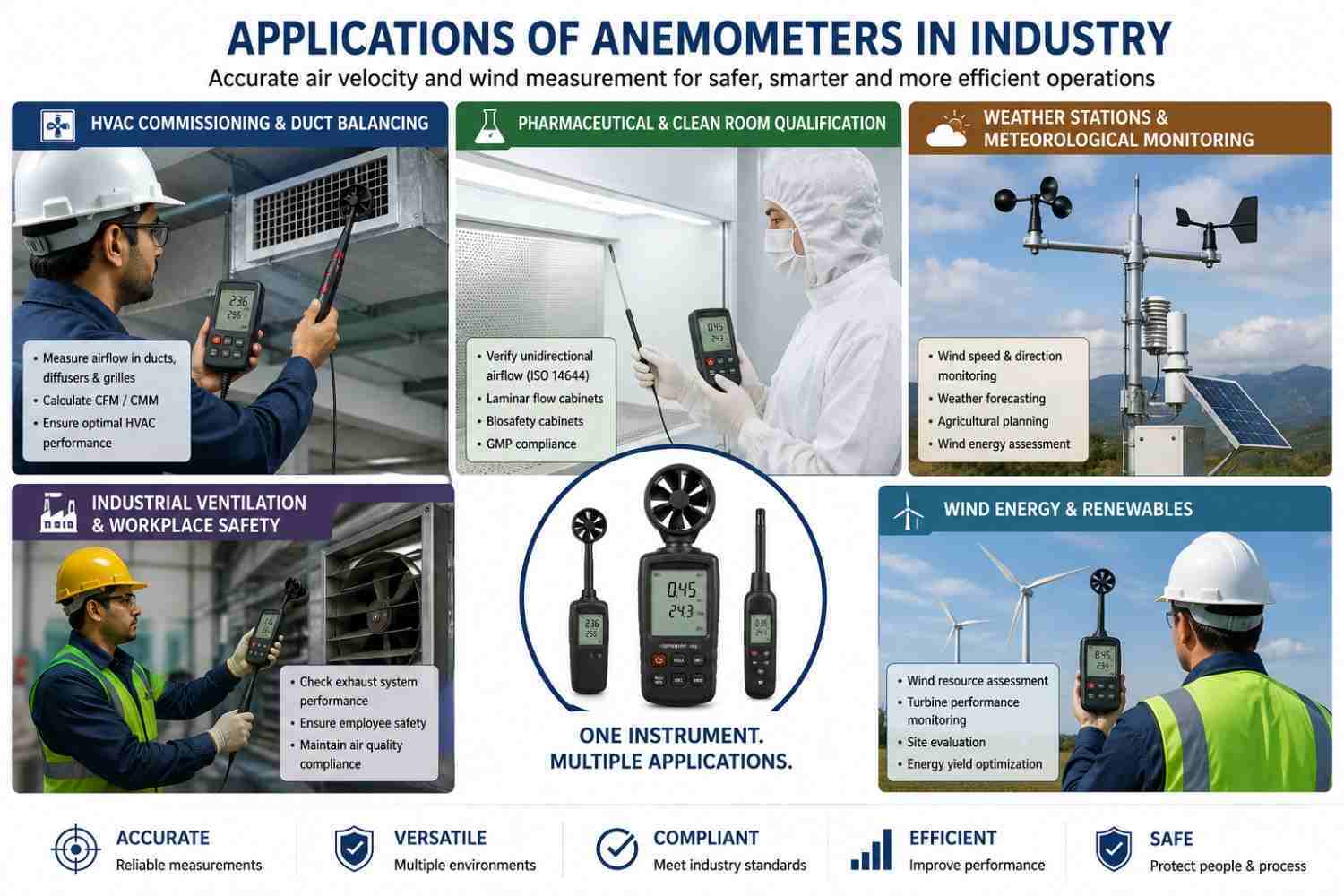
HVAC Commissioning and Duct Balancing
The most common application for digital vane anemometers in India. During HVAC commissioning, every supply air grille, return air grille, and exhaust point must be measured to verify that actual air flow rates match the design specifications. The engineer enters the grille or duct dimensions into the anemometer, holds the vane sensor against the grille, and the instrument calculates CMM or CFM directly. Discrepancies identify which ducts need balancing damps adjusted.
Instruments with a telescoping probe — like the Lutron LM-8010 5-in-1 — allow measurement at ceiling grilles without ladders, and the simultaneous temperature reading helps identify whether cold or hot air is being delivered correctly.
Pharmaceutical Clean Room Qualification
Schedule M (Revised) under the Drugs and Cosmetics Act, and WHO-GMP guidelines followed by Indian pharmaceutical manufacturers, require air velocity measurement as part of clean room qualification and re-qualification. ISO 14644-1 classification requires verifying that unidirectional flow areas maintain the specified velocity profile. For Class 5 (Grade A under EU GMP) laminar flow cabinets and cleanrooms, the requirement is typically 0.36–0.54 m/s (0.45 m/s nominal) — right at the starting threshold of most vane anemometers.
A hot wire anemometer is the correct instrument for this application. The Lutron AM-4204 (₹21,500 excl. GST) with RS232 data output is used in Indian pharma facilities for qualification work where data must be downloaded for GMP records.
Industrial Workplace Safety and Ventilation Compliance
The Factories Act 1948 and BIS standard IS 3483 specify minimum ventilation requirements for industrial workplaces. Industrial hygienists and safety officers use anemometers to verify that exhaust ventilation in welding bays, solvent handling areas, and chemical storage zones is providing adequate air movement to keep contaminant concentrations below permissible exposure limits (PELs). Multi-function anemometers that also measure temperature and humidity — like the Lutron LM-8102 — simplify this compliance measurement work.
Weather Stations and Meteorological Monitoring
Automated weather stations (AWS) deployed by IMD and state governments across India use cup anemometers for wind speed measurement. Agricultural universities use weather stations with anemometers for crop planning and evapotranspiration calculation. Construction sites near coastlines and in high-wind zones use anemometers to ensure crane operations comply with safety cutoff speeds (typically operations stop above 35–45 km/h). Portable digital anemometers integrated with data loggers are used for short-term wind surveys at prospective wind energy sites.
Environmental Testing and Research
Environmental testing labs accredited under NABL use anemometers as part of ambient air quality monitoring — wind speed and direction are required parameters alongside PM2.5, NOₓ, SOₓ, and other pollutants measured during stack emission or ambient surveys. University research departments use anemometers in wind tunnel experiments, atmospheric boundary layer studies, and building aerodynamics research. Pairing an anemometer with an air quality analyser gives a complete picture of both wind conditions and pollutant concentrations during field campaigns.
Construction and Infrastructure Safety
High-rise construction, bridge and tower crane operations, and cable car systems in India require continuous wind speed monitoring. OSHA and Indian CPWD safety norms specify maximum wind speeds for various crane types. Site engineers use cup anemometers or robust portable vane instruments mounted at height to monitor conditions and issue operational stop orders when wind speeds exceed safe limits.
Buying Guide: What to Evaluate Before You Purchase
After identifying which type suits your application, evaluate instruments against these five specifications:
1. Velocity range and starting threshold
Match the instrument's measuring range to your application. HVAC duct measurement typically sees 0.5–10 m/s — a vane instrument covers this easily. Outdoor weather measurement may see 0–40+ m/s — ensure the cup or vane instrument has sufficient high-end range. Clean room measurement at 0.2–0.5 m/s requires a hot wire with a sub-0.1 m/s starting threshold. Check the starting threshold explicitly in the specifications — this is the most commonly overlooked number.
2. Resolution and accuracy
For HVAC commissioning, ±3–5% accuracy at the mid-range velocity is adequate for most balancing work. For clean room qualification documentation under GMP, accuracy of ±2% or better is required — this means a calibrated hot wire instrument with a current calibration certificate. Resolution should be 0.1 m/s for HVAC work; 0.01 m/s for clean room and precision work.
3. CFM/CMM calculation capability
If your primary application is HVAC commissioning or duct balancing, the instrument must calculate volumetric flow (CMM/CFM) directly. You enter the duct or grille dimensions and the instrument does the area × velocity calculation automatically. Not all anemometers have this — the basic Lutron AM-4201 and AM-4202 display velocity only; the LM-8010 and LM-8102 include CMM/CFM calculation.
4. Data output for documentation
For any application requiring documented records — GMP clean room qualification, NABL accreditation, ISO 14644 reporting — the instrument must output data to a printer or PC. RS-232 output (on the Lutron AM-4204) allows downloading to a computer. Instruments with only a digital display require manual transcription, which introduces errors and is not acceptable for regulated pharmaceutical work.
5. Probe type and cable length
A telescoping or remote probe on a cable allows measurement at ceiling grilles without ladders, in confined duct spaces, or in clean rooms where the operator should not enter the measurement zone. The Lutron LM-8010 features a separate vane probe on a cable — the meter unit stays with the operator while only the probe enters the duct or clean room.
Anemometers at Scispectrum: Models and Prices
Scispectrum stocks digital anemometers from Lutron and Workzone — portable handheld instruments covering vane and hot wire technology for HVAC, environmental, and clean room applications. All prices below exclude GST; 18% GST is applicable on all instruments.
Vane Anemometers — HVAC, Duct Balancing, and General Air Velocity
Multi-Function Anemometers — HVAC + Environmental Measurement
| Model | Functions | Key Feature | Price (₹, excl. GST) |
|---|---|---|---|
| Lutron LM-8010 5-in-1 | Anemometer, temp, humidity, light, sound | CMM/CFM calculation, separate probe cable | 12,500 |
| Lutron LM-8102 5-in-1 | Anemometer, sound level, temp, humidity, light | Environmental multi-function, data hold | 15,500 |
Hot Wire Anemometer — Low Velocity and Clean Room Measurement
Frequently Asked Questions
Conclusion
The right anemometer for your application is the one matched to your velocity range, your measurement environment, and your documentation requirement. Vane instruments from ₹3,480 cover the vast majority of HVAC commissioning and industrial air flow work in India. The hot wire AM-4204 at ₹21,500 is the correct choice wherever low-velocity measurement and GMP-ready data output are required — pharmaceutical clean rooms, laminar flow cabinets, biosafety cabinets. Get the type right and the measurement right, and your anemometer readings will stand up to HVAC commissioning sign-off, clean room re-qualification audits, and regulatory inspection alike.
Browse environmental instruments Call +91 7448882650