
Posted by scispectrum on 11th Aug 2026
Conductivity Meter Cell Constant Explained: K=0.1 vs K=1.0 vs K=10
Conductivity Meter Cell Constant Explained: K=0.1 vs K=1.0 vs K=10
Cell constant (K): A fixed geometric value, expressed in cm⁻¹, describing the ratio of electrode spacing to electrode area in a conductivity probe. It converts the meter's measured conductance into true conductivity (µS/cm or mS/cm) for the sample. Common values are K=0.1, K=1.0, and K=10.
Why Cell Constant Selection Determines Accuracy
I've walked into more than one pharma QC lab where the conductivity numbers didn't make sense — too high, too erratic, or just suspiciously flat — and the electrode itself was fine. The instrument was fine. The cell constant was wrong for the sample being measured.
Conductivity meters don't measure conductivity directly. They measure conductance across two electrodes and multiply it by the cell constant to get conductivity. If K doesn't match the conductivity range of your sample, you're either forcing the meter to resolve a signal that's too weak to read accurately, or you're saturating it with a signal that's too strong. Either way, the number on the display looks precise. It just isn't accurate.
K=0.1 vs K=1.0 vs K=10 — What Each Range Is For
Each cell constant is built around a different electrode geometry, which makes it sensitive to a specific conductivity band. Using it outside that band is where accuracy falls apart.
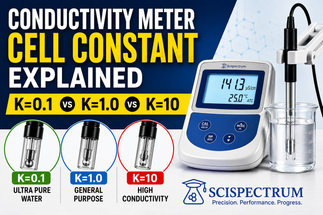
K=0.1 — Ultra-pure and low-conductivity water
Wide electrode spacing, low signal amplification needed. Built for samples in the 0.5 to 200 µS/cm range — think WFI (water for injection), USP purified water, and RO permeate. This is the cell constant most pharma QC labs reach for on their primary water system testing, because IP/USP Stage 1 conductivity limits sit well within this band.
K=1.0 — General-purpose, most common
The default cell constant on most benchtop and portable meters shipped from the factory. Covers roughly 10 µS/cm to 20 mS/cm — drinking water, cooling tower makeup water, general process water, and most industrial in-process checks. If you only own one probe, this is almost certainly the one you have.
K=10 — High-conductivity industrial and effluent samples
Narrow electrode spacing, built to handle strong signals without saturating. Used for brine, concentrated cleaning solutions, ETP discharge with high dissolved solids, and boiler blowdown water — typically anything above 20 mS/cm and into the S/cm range.
How to Choose the Right K Value for Your Application
- Estimate your sample's expected conductivity range before selecting a probe — check your process SOP, previous batch records, or a rough reference range for the water type.
- Match that range to the correct K value using the table below — don't default to K=1.0 just because it's what shipped with the meter.
- Verify with a certified conductivity standard solution close to your expected sample range — not a generic mid-range standard.
- If your lab tests both ultra-pure water and high-conductivity effluent, maintain two separate cell assemblies rather than one "compromise" probe.
- Re-verify cell constant annually or per your calibration SOP — cell constants can drift slightly with electrode fouling or platinisation wear over time.
Cell Constant Selection at a Glance
| Cell Constant | Typical Range | Common Samples | Typical Buyer |
|---|---|---|---|
| K = 0.1 | 0.5 – 200 µS/cm | WFI, USP purified water, RO permeate | Pharma QC |
| K = 1.0 | 10 µS/cm – 20 mS/cm | Drinking water, cooling tower makeup, process water | Industrial / General lab |
| K = 10 | > 20 mS/cm | Brine, boiler blowdown, ETP discharge, concentrated cleaning solutions | Industrial / ETP |
Common Cell Constant Mistakes in Pharma and Industrial Labs
- Using the factory-default K=1.0 probe for WFI testing. It technically reads a number, but resolution at the low end of that range is poor enough to miss real excursions.
- Calibrating with a standard solution far from the sample's actual range. A K=1.0 probe calibrated against a 1,413 µS/cm standard won't be reliable for a 5 µS/cm purified water sample.
- Assuming cell constant is fixed for the probe's lifetime. Platinised electrodes lose surface area over years of use — re-verification catches this before it silently skews your records.
- Sharing one probe across ultra-pure and high-conductivity samples. Cross-contamination and range mismatch both degrade accuracy; keep dedicated probes per application where budget allows.
Conductivity Meters at Scispectrum
We source conductivity meters and multiparameter systems across Eutech, Hanna, and Aquasol with probes covering the full K=0.1 to K=10 range — useful whether you're running WFI compliance testing or ETP discharge monitoring.
Frequently Asked Questions
Conclusion
Cell constant isn't a spec you set once and forget — it's the single factor that determines whether your conductivity readings are actually trustworthy for the sample in front of you. Match K to your expected range, verify it against a certified standard, and don't let a factory-default K=1.0 probe silently undermine your low-conductivity or high-conductivity testing.
Browse Conductivity Meters Call +91 7448882650