
Posted by scispectrum on 10th Jun 2026
Conductivity Meter: Types, Working Principle, Uses and Price in India
Conductivity Meter: Types, Working Principle, Uses and Price in India
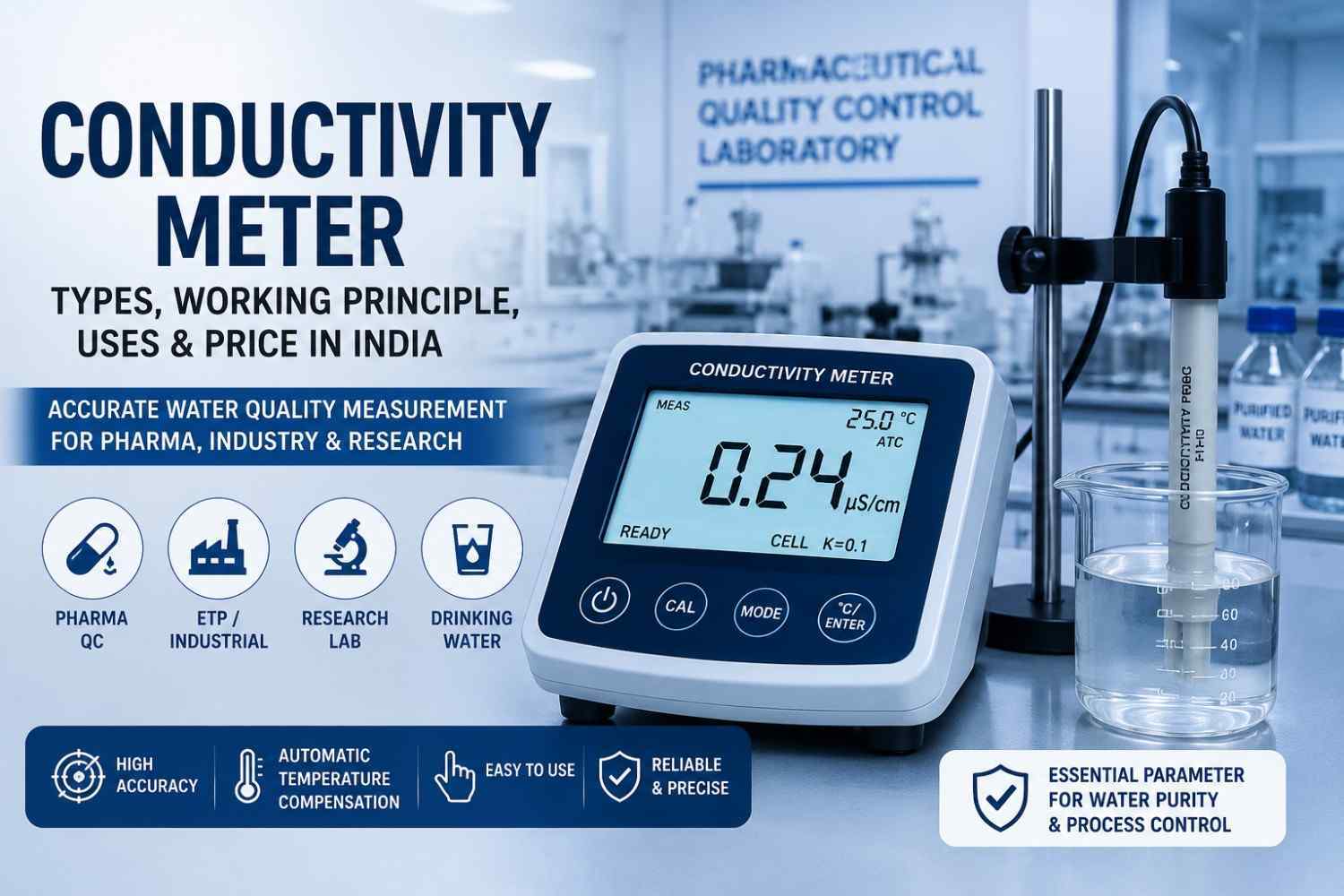
A pharma QC analyst at a plant in Baddi ran a Stage 1 conductivity test on purified water from the new RO-EDI system. The reading came back at 2.4 µS/cm — well above the 1.3 µS/cm IP/USP limit. She repeated the measurement. Same result. The water system was immediately flagged, production was paused, and a three-day investigation began. The conclusion? The conductivity meter was fitted with a K=1.0 cell instead of a K=0.1 cell. The actual water conductivity was 0.24 µS/cm — well within specification. One wrong cell constant. Three days of production lost.
That story captures exactly why conductivity and TDS measurement deserves the same attention as pH in any water quality programme. The technology is straightforward, the instruments are affordable, but the details — cell constant, temperature compensation, calibration standard — determine whether your reading is real or an artefact of your instrument configuration.
Conductivity Meter: An electrochemical instrument that measures the ability of a water or liquid sample to conduct an electric current, expressed in microsiemens per centimetre (µS/cm) or millisiemens per centimetre (mS/cm). Conductivity is directly proportional to the concentration of dissolved ions in the sample. A TDS meter is functionally a conductivity meter that multiplies the conductivity reading by a conversion factor (typically 0.5–0.7) to estimate Total Dissolved Solids in parts per million (ppm) or mg/L. The two measurements are inseparable — TDS is always derived from conductivity, never measured directly.
What Is a Conductivity Meter and How Does It Relate to TDS
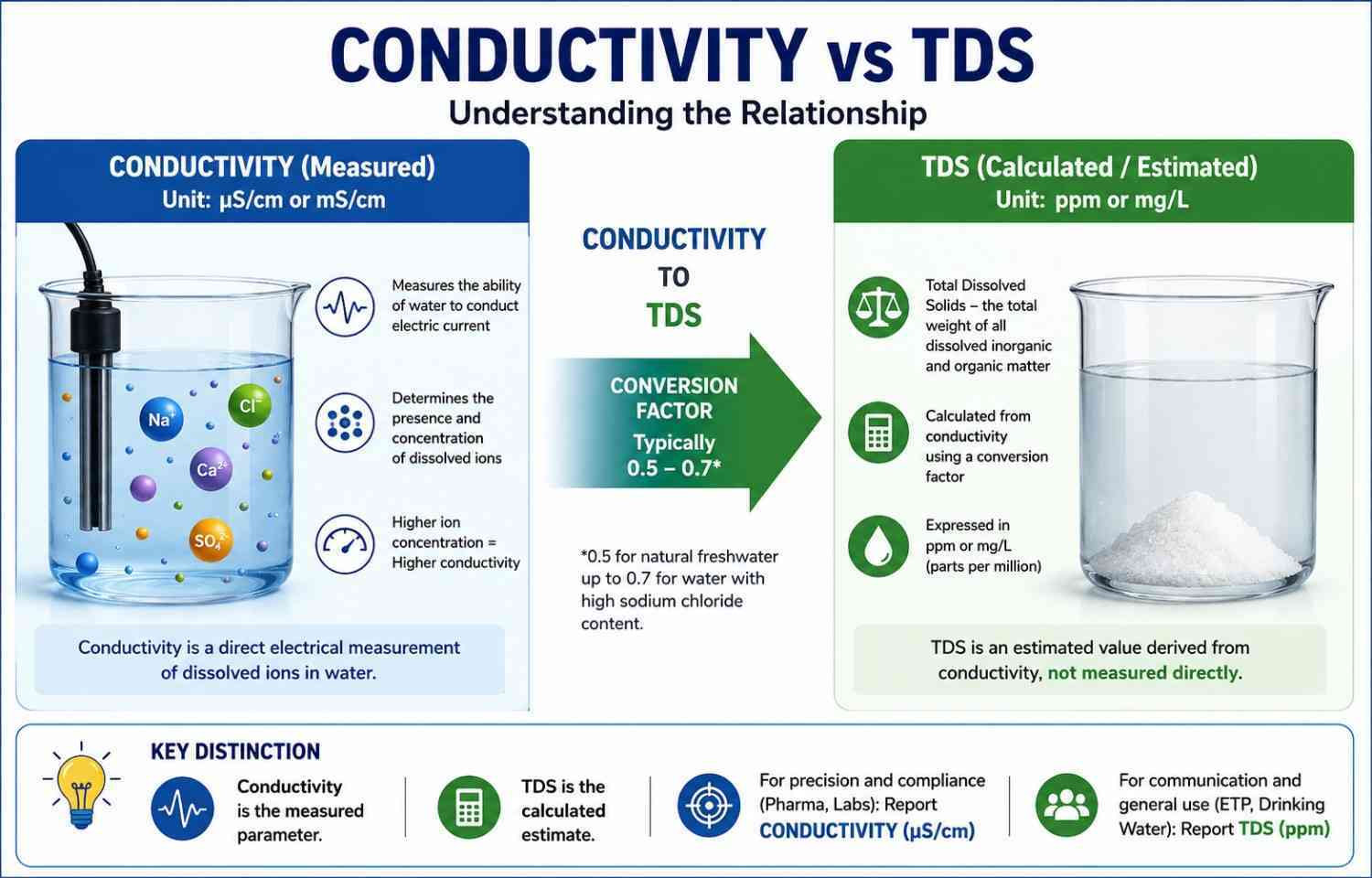
A conductivity meter measures how easily an electric current passes through a water sample. Pure water — with no dissolved ions — is a poor conductor, with conductivity below 1 µS/cm. As salts, minerals, acids, or bases dissolve in water, they dissociate into ions (Na⁺, Cl⁻, Ca²⁺, SO₄²⁻, etc.), and the conductivity increases proportionally. The more ions present, the higher the conductivity.
TDS — Total Dissolved Solids — is the total weight of all dissolved inorganic and organic matter in water, expressed in ppm or mg/L. A true TDS measurement requires evaporating the sample and weighing the residue (gravimetric method per IS 3025 Part 16). This is time-consuming and impractical for routine testing. Instead, TDS meters estimate TDS by measuring conductivity and applying a conversion factor — typically 0.5 for natural freshwater, up to 0.7 for water with high sodium chloride content.
Working Principle of a Conductivity Meter
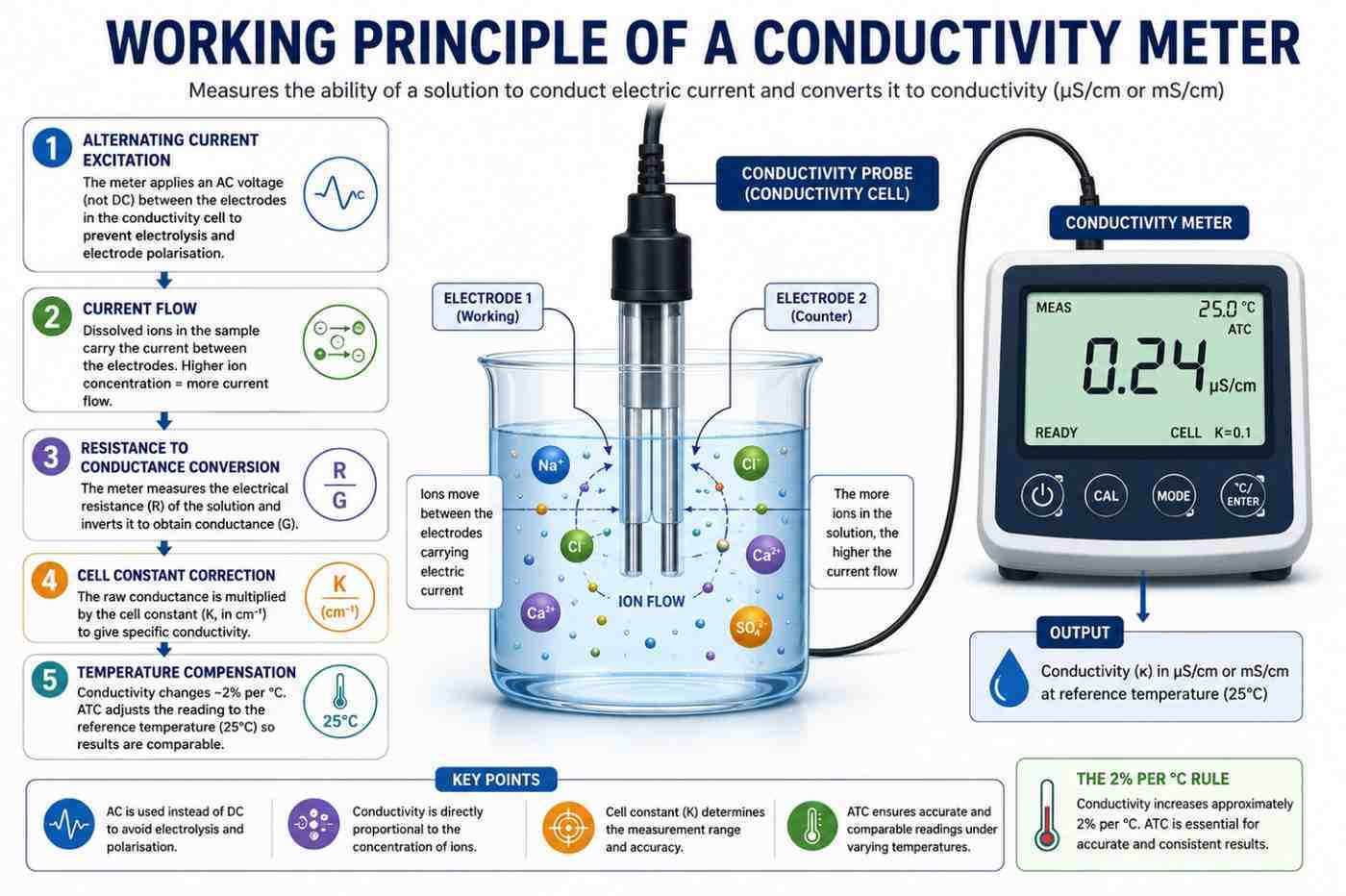
A conductivity meter applies an alternating voltage between two elecrodes immersed in the sample. The resulting current flow is measured and converted to conductivity using the cell constant. Here is how it works step by step:
- Alternating current excitation — the meter applies an AC voltage (not DC) between two or four electrodes in the conductivity cell. AC is used to prevent electrolysis and electrode polarisation that would distort the measurement.
- Current measurement — the dissolved ions in the sample carry the current between the electrodes. The higher the ion concentration, the more current flows.
- Resistance to conductance conversion — the meter measures the electrical resistance of the solution and inverts it to give conductance (in siemens).
- Cell constant correction — the raw conductance is multiplied by the cell constant (K, in cm⁻¹) to give specific conductivity in µS/cm or mS/cm.
- Temperature compensation — conductivity changes approximately 2% per °C. ATC adjusts the reading to the reference temperature (25°C) so results are comparable across measurement sessions.
Cell Constant: The Most Misunderstood Specification
The cell constant (K) is the single most important — and most frequently mismatched — specification in conductivity measurement. It determines the measurement range and accuracy of the meter-cell combination. Using the wrong cell constant is the conductivity equivalent of using the wrong pH electrode for pure water — the instrument gives you a number, but the number is wrong.
| Cell Constant (K) | Optimal Range | Typical Applications | Indian Context |
|---|---|---|---|
| K = 0.01 | 0.01–1 µS/cm | Ultra-pure water, semiconductor rinse water | Not common in Indian pharma — used in chip fabs |
| K = 0.1 | 0.1–10 µS/cm | Pharmaceutical purified water, WFI, RO permeate | Required for IP/USP Stage 1 conductivity test (limit 1.3 µS/cm) |
| K = 1.0 | 10–2,000 µS/cm | Drinking water, surface water, general lab work | Most common cell — suits IS 10500, NABL labs, environmental testing |
| K = 10 | 2,000–200,000 µS/cm | Seawater, brine, concentrated effluent, chemical process | ETP inlet measurement for high-salinity wastewater (textiles, tanneries) |
Types of Conductivity and TDS Meters
Pen-type / Pocket EC and TDS Testers
Compact, all-in-one instruments with a built-in sensor. The Hanna HI98303 conductivity tester (₹7,250), Eutech ECOTestr EC High (₹7,500), and Aquasol AMTDS01 TDS meter (₹5,250) are the most popular in this segment. They are suitable for quick spot checks — drinking water screening, hydroponics, RO reject monitoring, field sampling. Not suitable for pharma QC, NABL lab work, or any application requiring a separate replaceable cell and GLP documentation.
Portable Digital Conductivity Meters
Handheld instruments with a separate probe on a cable. The Lutron CD4302 (₹8,000) and EI 601/602/611 series (₹9,100) are entry-level lab portables. The EI 641 (₹17,900) adds TDS measurement alongside conductivity — a popular combination in Indian environmental labs. For field use requiring IP54 or higher protection, the Eutech CON603PLUSK (₹48,900) is the choice — battery-powered, waterproof, and capable of measuring conductivity, TDS, and salinity with auto-ranging.
Benchtop / Laboratory Conductivity Meters
For pharmaceutical QC, NABL-accredited labs, and research applications. The EI 1601 microprocessor-based conductivity/TDS meter (₹32,500) and EI 1602 EC/TDS/salinity meter (₹36,900) are widely used in Indian environmental and research labs — microprocessor control, auto-ranging, RS-232 output. For pharma compliance, the Eutech CON70043S benchtop (₹57,500) and Eutech CONWP15003K (₹60,900) provide GLP data logging, K=0.1 cell compatibility, and the Eutech brand that pharma purchasing departments recognise. The Eutech EBEC172001 4-cell benchtop (₹1,16,500) is the top-tier instrument — 4-cell conductivity probe with RS-232, covering resistivity and salinity alongside conductivity and TDS.
Multiparameter Meters (pH + Conductivity + TDS)
Instruments that measure pH, conductivity, TDS, and temperature from a single unit. The Eutech PCTestr 35 pen-type (₹19,900) and Aquasol AMPAL multi-parameter (₹16,500) are popular for field work where carrying multiple instruments is impractical. For labs measuring multiple parameters on the same water sample, a benchtop multiparameter meter can simplify documentation — one instrument calibration record instead of three.
Applications in Pharma, ETP, Research, and Drinking Water
Pharmaceutical Purified Water and WFI (IP/USP Compliance)
Conductivity is the primary purity indicator for pharmaceutical water systems — more informative than pH for assessing ionic contamination. The IP and USP Stage 1 conductivity test specifies a limit of 1.3 µS/cm at 25°C for purified water. Failure at Stage 1 triggers Stage 2 and Stage 3 testing with pH-adjusted limits. For WFI, the limit is also 1.3 µS/cm. A K=0.1 cell with 0.01 µS/cm resolution is the minimum instrument requirement. GLP data logging and RS-232/USB output are required for cGMP compliance documentation.
ETP and Industrial Water Treatment
In effluent treatment plants, conductivity measurement tells the operator about the total ionic load of the incoming wastewater and the efficiency of treatment processes. RO systems use conductivity to monitor permeate quality and calculate rejection percentage — a rising permeate conductivity signals membrane fouling or failure. Cooling tower blowdown conductivity determines the cycles of concentration and chemical treatment dosing. Boiler feedwater conductivity must be kept below 50–200 µS/cm depending on boiler pressure to prevent scaling and carryover.
Drinking Water Testing (IS 10500 Compliance)
BIS IS 10500:2012 does not specify a conductivity limit directly but specifies a TDS limit of 500 mg/L (acceptable) and 2,000 mg/L (permissible). Since TDS is derived from conductivity, a conductivity reading above approximately 1,000 µS/cm (using a 0.5 conversion factor) indicates TDS above the acceptable limit. Municipal water testing, packaged water QC, and FSSAI compliance labs all use conductivity/TDS meters as primary screening instruments.
Research and Environmental Testing
NABL-accredited environmental labs testing surface water, groundwater, and industrial effluent under IS 3025 Part 14 measure conductivity as a mandatory parameter. Soil conductivity (measured in soil-water extracts) indicates salinity for agricultural research. Freshwater ecology studies use conductivity as a primary indicator of water body health and pollution loading.
Buying Guide: Key Specifications to Evaluate
1. Cell constant compatibility
Confirm the meter accepts the cell constant you need. Pharma labs need K=0.1; general water testing needs K=1.0; high-conductivity effluent needs K=10. Some meters auto-detect the cell constant; others require manual entry. Eutech benchtop models accept all cell constants via their CONSEN probe range. EI instruments are typically supplied with a K=1.0 cell and K=0.1 cells must be ordered separately.
2. Measurement range and resolution
Pharma purified water: 0–20 µS/cm range with 0.01 µS/cm resolution. Drinking water and environmental: 0–2,000 µS/cm with 0.1 µS/cm resolution. Industrial effluent: 0–200 mS/cm auto-ranging. A meter with auto-ranging saves time when measuring across a wide range of sample types in the same session.
3. Temperature compensation
ATC with a temperature coefficient of 2%/°C (adjustable) is standard. Some instruments allow you to change the coefficient — useful for non-aqueous samples or specific acid/base solutions. For natural water and pharma water, the 2% default is correct. Verify the meter compensates to 25°C as the reference — some older instruments use 20°C, which gives different reported values.
4. GLP data output
For pharma QC, NABL accreditation, and cGMP documentation, the meter must store and output time-stamped calibration and measurement records. RS-232 or USB connectivity for LIMS integration. Entry-level pen-type and digital meters do not have this capability — budget for a microprocessor-based instrument if documentation is required.
5. Calibration standards
Conductivity meters are calibrated using NIST-traceable standard solutions — typically 84 µS/cm, 1,413 µS/cm, and 12,880 µS/cm KCl solutions. For pharma ultra-pure water calibration, a 10 µS/cm or 100 µS/cm standard is used. Ensure your chosen meter supports calibration at the standard values you will use. The Reagecon 84 µS/cm standard solution (500 mL) is available through Scispectrum for routine calibration.
Conductivity and TDS Meters at Scispectrum: Models and Prices
All prices below exclude GST. 18% GST is applicable on all instruments. Instruments sourced from authorised distributors with proper GST invoices for institutional procurement.
TDS Testers — Quick Screening and Basic Use
Conductivity Testers — Portable Pen-Type and Field Instruments
| Model | Brand | Range | Key Feature | Price (₹, excl. GST) |
|---|---|---|---|---|
| SKY-476A Conductivity/TDS | SKY | 0–1999 µS/cm | Dual conductivity + TDS | 5,400 |
| Hanna HI98303 DiST 3 | Hanna | 0–2000 µS/cm | Waterproof, auto-off | 7,250 |
| Eutech ECOTestr EC High | Eutech | 0–19.99 mS/cm | Waterproof, dual range | 7,500 |
Laboratory and Benchtop Conductivity Meters
| Model | Brand | Measures | Key Feature | Price (₹, excl. GST) |
|---|---|---|---|---|
| EI 601/602/611 Digital | EI-DVI | Conductivity | Lab-grade digital, ATC | 9,100 |
| EI 641 Digital Conductivity/TDS | EI-DVI | Conductivity + TDS | Dual parameter, auto-ranging | 17,900 |
| EI 1601 Microprocessor | EI-DVI | Conductivity + TDS | Auto-ranging, RS-232, microprocessor | 32,500 |
| EI 1602 Microprocessor | EI-DVI | EC + TDS + Salinity + Temp | 4-parameter, RS-232 | 36,900 |
| Eutech CON603PLUSK | Eutech | Conductivity + TDS | IP54, battery, portable benchtop | 48,900 |
| Eutech CON70043S Benchtop | Eutech | Conductivity + TDS | GLP, RS-232, K=1.0 cell, pharma | 57,500 |
| Eutech CONWP15003K Benchtop | Eutech | Cond + TDS + memory 150 | GLP, IP54, main/battery, pharma | 60,900 |
| Eutech EBEC172001 4-Cell Benchtop | Eutech | Cond + TDS + Sal + Resistivity | 4-cell probe, RS-232, top-tier | 1,16,500 |
Frequently Asked Questions
Conclusion
Conductivity is the most direct measure of water purity available in a routine laboratory — faster than TOC, more informative than pH for ionic contamination, and simpler to calibrate than either. For pharmaceutical purified water, the specification is tight (1.3 µS/cm), the cell constant is critical (K=0.1), and the documentation is non-negotiable (GLP). For ETP and industrial water treatment, conductivity tells you instantly whether your RO membrane is working, your cooling tower chemistry is in range, and your effluent ionic load is where it should be. Match the cell constant to your sample range, calibrate with traceable standards, and compensate for temperature — and conductivity measurement is one of the most reliable, lowest-maintenance parameters in your water testing programme.
Browse conductivity meters Browse TDS meters