
Posted by scispectrum on 8th Jun 2026
Dissolved Oxygen Meter: Complete Buying Guide for Pharma and Water Labs in India
By Scispectrum Lab Essentials | 1 June 2026 | 11 min read
Choosing the right dissolved oxygen meter — from a ₹13,000 Lutron portable to a ₹2.25L Eutech benchtop — depends entirely on your application.
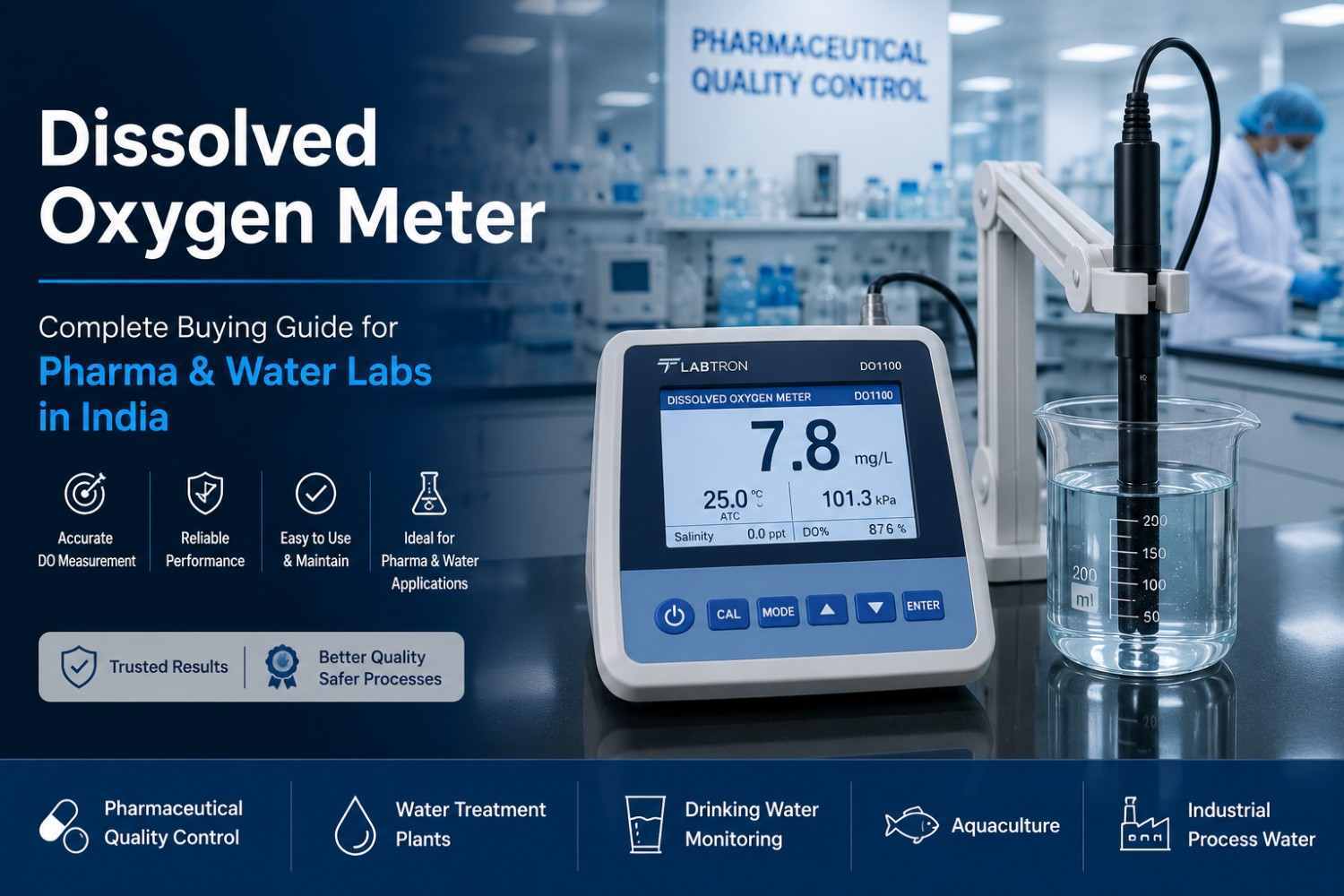
Table of Contents
- What Is a Dissolved Oxygen Meter and Why Does It Matter
- Polarographic vs Optical: The Sensor Technology Decision
- Specifications That Actually Matter When Buying a DO Meter
- Choosing by Application: Pharma, ETP, BOD, Research
- Dissolved Oxygen Meters Available in India: Prices and Models
- Calibration, Maintenance, and the Mistakes That Cost You
- Frequently Asked Questions
A pharma QC manager once told me their purified water loop had been running "in spec" for months — pH fine, conductivity fine, TOC fine. Then a validation consultant flagged dissolved oxygen. It was sitting at 6.8 mg/L in a system that should have been below 2 mg/L after the RO-EDI stage. Nobody had been measuring it. The instrument they eventually bought was the same cost as a single batch investigation that might have been triggered had the issue surfaced during an audit. That story is not unusual. Dissolved oxygen is one of the most under-monitored parameters in Indian pharmaceutical water systems — and one of the most informative. This guide covers everything you need to select the right dissolved oxygen meter for your lab, plant, or monitoring application: sensor technology, specifications, every model available in India with actual prices, and the calibration errors that silently compromise your data.
Dissolved Oxygen (DO) Meter: An electrochemical or optical instrument that measures the concentration of molecular oxygen (O₂) dissolved in a liquid sample, expressed in mg/L (ppm) or percentage of air saturation (% sat). It consists of a DO probe (polarographic or optical sensor), a built-in temperature sensor for automatic compensation, and a display unit that converts the signal into a calibrated readout. Standard measurement range: 0–20 mg/L or 0–200% saturation.
What Is a Dissolved Oxygen Meter and Why Does It Matter
Dissolved oxygen — the molecular O₂ physically dissolved in water — is a critical parameter across four very different domains in Indian laboratories and industry:
- Pharmaceutical water systems: Purified water and WFI systems are designed to deliver water with controlled chemistry and low microbial load. DO is a marker for system integrity — elevated DO in a closed-loop system signals a leak, inadequate degassing, or a compromised membrane. High DO also accelerates oxidative degradation of oxygen-sensitive APIs in sterile manufacturing.
- BOD testing: BOD₅ analysis is the standard method for measuring the organic load of wastewater, mandated by CPCB for industrial effluent discharge compliance. It requires measuring DO at the start and end of a 5-day incubation — the difference gives the BOD value in mg/L.
- ETP aeration monitoring: Aerobic biological treatment depends on maintaining DO in the aeration tank above 2 mg/L. Too low and microbial treatment fails; too high and aeration energy is wasted. Daily DO monitoring in the aeration basin is how ETP operators keep their biology functional.
- Aquaculture and environmental research: Fish and shrimp require DO above 5 mg/L for healthy growth. Freshwater ecology research routinely monitors DO as a key water health indicator.
The reason DO measurement is often neglected in Indian ETPs and smaller pharma plants is that DO meters have traditionally been more expensive and maintenance-intensive than pH or TDS meters. Both barriers have dropped significantly. Entry-level portable DO meters now start below ₹14,000, and optical sensor technology has largely eliminated the maintenance burden of polarographic instruments.
Polarographic vs Optical: The Sensor Technology Decision
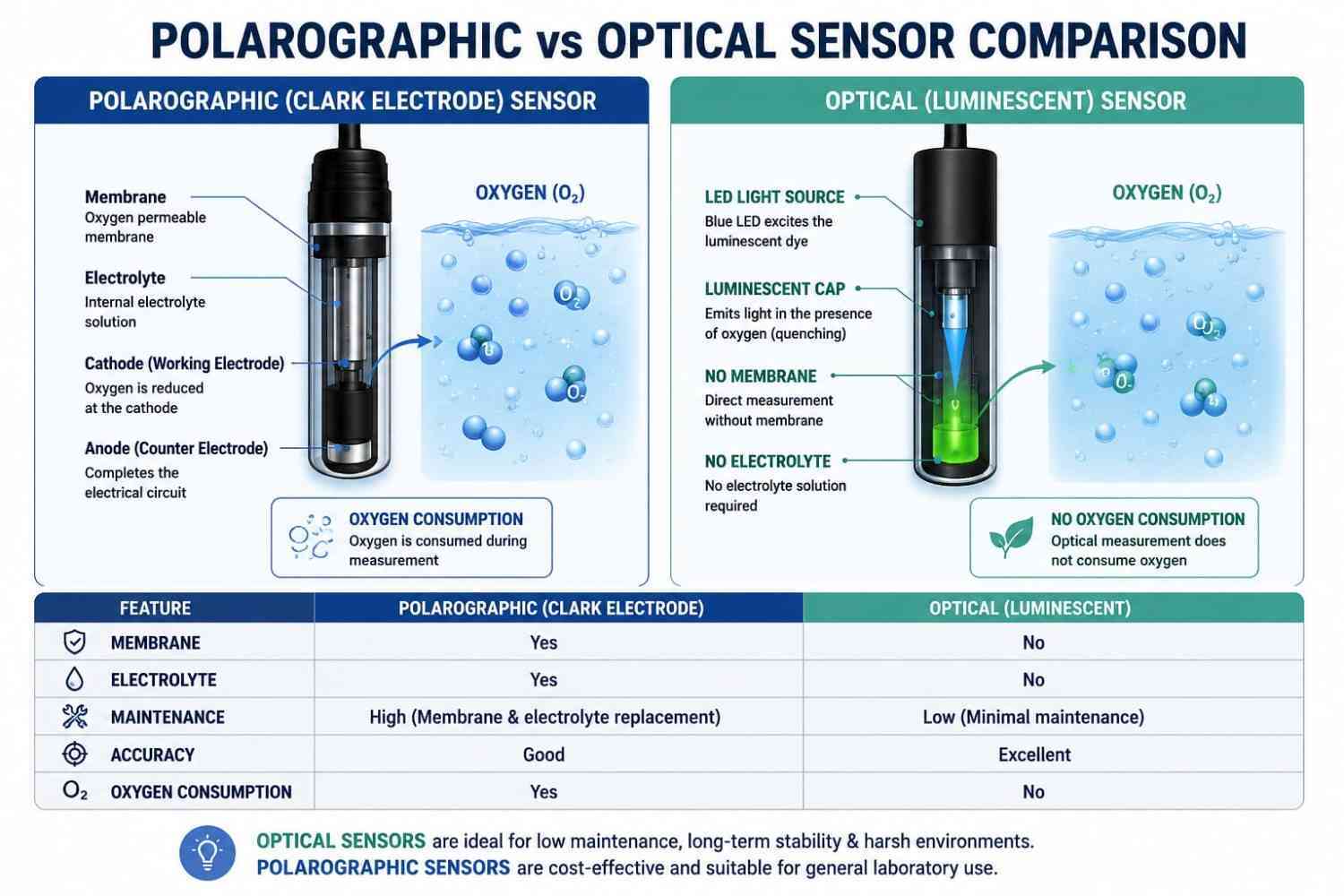
Before you look at any other specification, understand the sensor technology — because it determines not just accuracy, but your total cost of ownership, maintenance burden, and suitability for your application.
Polarographic (Clark-type) Sensors
The traditional technology. A platinum or gold cathode and silver anode, separated from the sample by a gas-permeable PTFE membrane filled with KCl electrolyte. Oxygen diffuses through the membrane and is electrochemically reduced at the cathode, generating a current proportional to oxygen concentration. This is the Clark electrode — still the basis of most mid-range DO meters sold in India today, including all Lutron models (PDO-519, DO-5510, Model 5519) and the Aquasol AMDO01.
Polarographic sensors consume oxygen during measurement, requiring sample stirring to prevent a depleted boundary layer forming at the membrane. They need membrane replacement every 2–4 weeks under heavy use and electrolyte refilling at every membrane change. The membrane is the critical consumable and the most common failure point.
Optical (Luminescent / Fluorescent) Sensors
Optical sensors work on a completely different principle. A luminescent dye cap is excited by a blue LED. Oxygen molecules quench the luminescence — the more oxygen present, the lower the signal. No oxygen is consumed. No membrane. No electrolyte. No stirring requirement. The Eutech DO 2700 uses optical sensor technology; this is one of the primary reasons it commands a price premium over polarographic benchtop instruments.
Optical sensors are far more resistant to hydrogen sulphide interference (which rapidly poisons polarographic cathodes in biological effluent), require sensor cap replacement only every 1–2 years, and are the sensor of choice for high-frequency use, continuous monitoring, and ETP aeration tanks.
|
Parameter |
Polarographic (Clark) |
Optical (Luminescent) |
|
Oxygen consumption |
Yes — stirring required |
No — stirring not needed |
|
Maintenance |
Membrane + electrolyte every 2–4 weeks (heavy use) |
Sensor cap every 1–2 years |
|
H₂S interference |
High — poisons cathode |
Minimal |
|
Response time |
30–90 seconds |
15–60 seconds |
|
India examples |
Lutron PDO-519, DO-5510, Aquasol AMDO01 |
Eutech DO 2700 |
|
Best for |
BOD testing, budget ETP monitoring, occasional use |
Pharma water, continuous ETP, high-frequency use |
Pro Tip: If your ETP has a biological treatment stage and you are using a polarographic DO meter, check when the membrane was last replaced. In most Indian ETPs we have seen, membranes are changed months after they should be — which means DO readings have been systematically low for weeks without anyone realising it. An optical meter eliminates this failure mode entirely, though at a higher upfront cost.
Specifications That Actually Matter When Buying a DO Meter
Measurement Range and Resolution
Standard DO meters cover 0–20 mg/L, which handles every routine application — pharma water (0–8 mg/L), BOD testing (0–20 mg/L), and ETP aeration monitoring (target 2–4 mg/L). Resolution of 0.1 mg/L is adequate for ETP and BOD work; 0.01 mg/L is preferred for pharma water systems where you are tracking trends in a low-oxygen range. Every Lutron model in our catalogue offers 0.1 mg/L resolution; the Eutech 1730 and DO 2700 benchtop instruments offer 0.01 mg/L.
Automatic Temperature Compensation (ATC)
DO saturation is strongly temperature-dependent — at 25°C, air-saturated water holds 8.26 mg/L; at 30°C, 7.54 mg/L; at 40°C, only 6.41 mg/L. Every DO meter must have ATC. Without it, a 5°C temperature difference between calibration and measurement conditions introduces a 0.4 mg/L systematic error. All models in our catalogue include ATC.
Barometric Pressure Compensation
This is the specification most Indian buyers overlook — and the one that causes the most systematic error in labs located inland. At Bangalore's altitude of 920m, barometric pressure is approximately 910 mbar versus the sea-level standard of 1013 mbar. The DO saturation at 25°C at Bangalore altitude is 7.75 mg/L — not 8.26 mg/L. A meter calibrated to 8.26 mg/L without pressure correction reads 0.51 mg/L high across the entire range. For pharma water monitoring where you are tracking values below 2 mg/L, that is a 25% error. The Eutech 1730 and DO 2700 both accept barometric pressure input. Budget portable meters typically do not — account for this in your SOPs if you are at significant altitude.
GLP Compliance and Data Output
For pharmaceutical labs, GLP-capable meters store time-stamped calibration records alongside measurement data — a requirement for cGMP documentation and NABL accreditation. The Eutech 1730 offers USB output; the Lutron Model 5519 offers RS-232 with data logger capability. Entry-level portables display readings only — adequate for ETP operator logs but not for auditable pharma QC records.
IP Rating for Field Use
For ETP and outdoor monitoring, IP67 is the minimum — dust-tight and waterproof to 1 metre immersion. The Eutech DO602K is rated IP54 (splash-proof). Lutron portables (PDO-519, DO-5510) have dust and splash resistance suitable for plant-floor use. No benchtop instrument should be taken into the field.
Choosing by Application: Pharma, ETP, BOD, Research
Pharmaceutical Purified Water and WFI Monitoring
In a pharmaceutical water system, DO is measured as part of the water quality monitoring programme. It is not always required as a routine release test by IP or USP, but it is a standard parameter in water system qualification (IQ/OQ/PQ) and ongoing monitoring for WHO-GMP, EU GMP, and USFDA-registered facilities. Indian pharma companies preparing for USFDA or EU GMP audits are increasingly being asked to demonstrate DO monitoring in their water systems.
The instrument must be a benchtop DO meter with GLP data logging, traceable calibration, and a reliable low-range sensor. The Thermo Scientific Eutech 1730 benchtop DO meter (₹1,31,500 incl. GST) is the standard choice in Indian pharma QC labs — GLP-capable, USB output, polarographic with 0.01 mg/L resolution. For labs also running BOD testing or wanting optical sensor reliability, the Eutech DO 2700 (₹2,25,000 incl. GST) adds optical measurement, BOD incubation timing, and RS-232 connectivity in one instrument — the premium is justified if you are running both pharma water and BOD testing from the same bench.
Pair your DO meter with a conductivity meter for complete compendial water testing — most pharma water SOPs require pH, conductivity, TOC, and DO to be measured from the same sample point, and having all instruments GLP-documented in parallel simplifies your documentation considerably.
Pro Tip: In pharma water systems, measure DO directly from the sample port — not from a beaker left open on the bench. The moment purified water is exposed to the atmosphere, O₂ exchange begins and the reading drifts within seconds. The only accurate DO measurement of a closed pharmaceutical water system is one taken at the sampling valve with the probe inserted directly into the flow, or from an immediately sealed sample vessel with no headspace. Most Indian pharma QC labs are not doing this — and their DO readings are reflecting ambient air equilibration, not the actual water system state.
BOD Testing in Environmental and Industrial Labs
BOD₅ analysis requires measuring DO at time zero and after five days of incubation at 20°C. The key instrument requirement is accuracy across the full 0–9 mg/L range — samples at the start of incubation are close to saturation, and you need reliable readings at both ends to calculate a meaningful BOD₅ value.
For BOD labs, a portable DO meter with a long probe cable and a BOD bottle adaptor is the practical setup. The Lutron PDO-519 (₹15,250 incl. GST) is the most commonly used instrument in Indian NABL environmental labs for BOD work. The Lutron DO-5510 Professional (₹22,750 incl. GST) adds a larger display and higher-grade construction, worth the step-up for labs running high volumes. The Lutron Model 5519 (₹21,750 incl. GST) is the choice if you need RS-232 data logging to maintain electronic records of BOD incubation data — available with optional PC software.
Pro Tip: For BOD testing, always measure the initial DO before capping the BOD bottle. If the starting DO is below 6 mg/L, the sample may not have enough oxygen for a valid 5-day incubation, and your BOD result will be artificially low. Seed the dilution water correctly and verify the Day 0 DO before sealing. This is the single most common source of invalid BOD results in Indian environmental labs — not instrument error, but inadequate sample preparation.
ETP Aeration Tank and Field Monitoring
The target DO range in an aerobic biological treatment tank is 2–4 mg/L. For manual daily monitoring, a rugged portable with splash resistance and a long probe cable is the right tool. The Lutron PDO-519 (₹15,250) and Lutron DO-5509 pocket meter (₹13,250) are the entry points for ETP use. The Aquasol AMDO01 (₹25,500) is an Indian-made portable with 0–20 mg/L range and 0–200% saturation display, suitable for ETP monitoring on a mid-range budget.
For ETP operators who need a tougher, IP54-rated instrument for harsher conditions, the Eutech DO602K (₹94,500) offers a dust and water-ingress protection rating alongside 0.01 mg/L resolution — a significant step up in durability and accuracy from the Lutron portables, suited to plants where the instrument is used multiple times daily on an industrial floor.
Research and University Labs
Research applications span freshwater ecology field sampling (needs long cable, barometric compensation, rugged construction), fermentation monitoring in biotech (needs fast response, bioreactor port compatibility), and aquaculture studies (needs salinity correction, 0–20 mg/L range). A multiparameter meter measuring DO alongside pH, conductivity, and temperature in a single probe is often the most practical research lab solution — it reduces calibration overhead and gives a complete water chemistry picture from one dip.
Dissolved Oxygen Meters Available in India: Prices and Models
Below is every dissolved oxygen meter currently available through Scispectrum, organised by price tier and use case. All prices include GST and are sourced from authorised distributors.
Entry Level — ₹5,800 to ₹17,000
Suitable for: ETP spot checks, small water testing labs, basic environmental screening, educational labs.
|
Model |
Brand |
Range |
Type |
Price (₹) |
|
Lutron |
0–19.9 mg/L |
Pocket portable |
13,250 |
|
|
Lutron |
0–19.9 mg/L |
Portable |
15,250 |
|
|
Kerro |
0–16 mg/L |
Pen type |
16,500 |
Mid Range — ₹20,000 to ₹30,000
Suitable for: BOD labs, ETP professional use, industrial QC, general water testing with data recording.
|
Model |
Brand |
Range |
Key Feature |
Price (₹) |
|
Lutron |
0–20 mg/L |
RS-232 + data logger |
21,750 |
|
|
Lutron |
0–20 mg/L |
Professional grade |
22,750 |
|
|
Aquasol |
0–20 mg/L, 0–200% |
Indian brand, field use |
25,500 |
|
|
Lutron |
0–20 mg/L |
Pen/portable, detachable probe |
26,500 |
Professional / Laboratory Grade — ₹78,750 to ₹2,25,000
Suitable for: Pharmaceutical QC labs, NABL-accredited labs, R&D, BOD testing with GLP documentation, high-frequency industrial monitoring.
|
Model |
Brand |
Sensor |
Key Features |
Price (₹) |
|
Aquasol |
Polarographic |
Benchtop, DO + pH combo |
78,750 |
|
|
Eutech |
Polarographic |
IP54, 0.01 mg/L resolution, portable benchtop |
94,500 |
|
|
Eutech (Thermo) |
Polarographic |
GLP, USB, 0.01 mg/L, pharma standard |
1,31,500 |
|
|
Eutech (Thermo) |
Optical (luminescent) |
GLP, BOD timer, RS-232, optical sensor, top-tier |
2,25,000 |
For most Indian pharma QC labs, the Eutech 1730 is the practical sweet spot — it covers all compendial water testing requirements at ₹1,31,500. The DO 2700 at ₹2,25,000 makes sense when the lab is also running BOD testing and wants optical sensor reliability in a single instrument. For ETP operators and BOD environmental labs, the Lutron PDO-519 (₹15,250) or DO-5510 (₹22,750) have been the workhorses of Indian industrial and environmental labs for years — well-supported, cost-effective, and fit for purpose at their price point.
Calibration, Maintenance, and the Mistakes That Cost You
Standard Calibration Protocol
The correct method is water-saturated air calibration:
- Rinse the probe with deionised water and shake off excess — the membrane should be moist, not dripping.
- Hold the probe in moist ambient air, sheltered from wind, for 5–10 minutes to equilibrate.
- Enter barometric pressure if your meter supports it — look up the local value for your city and altitude.
- Set the calibration point to 100% saturation or the corresponding mg/L value at your current temperature.
- For polarographic probes: inspect the membrane — any staining, pinhole, or bubble means replace before calibrating.
Common Errors That Invalidate Your Data
- Not correcting for altitude. Bangalore (920m), Pune (560m), and Hyderabad (545m) have meaningfully lower barometric pressure than sea level. At Bangalore, the DO saturation at 25°C is 7.75 mg/L — not 8.26 mg/L. An uncorrected calibration reads 0.51 mg/L high across the range, which for pharma water monitoring below 2 mg/L is a 25% systematic error.
- Measuring without stirring (polarographic probes). In a still sample, oxygen around the membrane is consumed and creates a depleted boundary layer. Without stirring, readings run 0.5–1.5 mg/L lower than the true value — the most common source of unexpectedly low DO readings in ETP aeration tanks.
- Not allowing temperature equilibration. If the probe is at 20°C and the sample is at 30°C, wait for the temperature display to stabilise before accepting a reading. A cold probe in warm water gives a false-low DO reading until the temperature sensor catches up.
- Overdue membrane replacement. A polarographic membrane that has not been replaced on schedule gives systematically low, sluggish readings with a long response time — without any obvious error message. If calibration is taking more than two attempts or response time exceeds 60 seconds, the membrane needs replacing, not the meter.
- Measuring pharma water from an open beaker. Purified water in contact with air begins equilibrating with atmospheric oxygen immediately. The only accurate DO reading of a pharmaceutical water system comes from measuring directly at the sampling port, not from a collected sample.
Pro Tip: After replacing a polarographic membrane, soak the probe in DI water for 30 minutes and then apply power (polarise the electrode) for 15–30 minutes before your first calibration. Skipping the polarisation step causes slow, noisy, unstable response for several hours after membrane replacement — a problem that looks like a faulty instrument but is simply an impatient technician.
Frequently Asked Questions
What is a dissolved oxygen meter used for?
A dissolved oxygen meter measures the concentration of O₂ dissolved in water, expressed in mg/L or percentage saturation. In India it is primarily used in pharmaceutical water systems (purified water and WFI monitoring under WHO-GMP/cGMP), BOD testing in NABL-accredited environmental labs, ETP aeration tank control, aquaculture, and freshwater ecology research. DO measurement is increasingly expected in pharma water systems during USFDA and EU GMP audits.
What is the difference between a polarographic and optical DO sensor?
Polarographic sensors electrochemically reduce oxygen at a membrane-covered cathode, consuming oxygen in the process — they require stirring, membrane replacement every 2–4 weeks under heavy use, and electrolyte refilling. They are susceptible to hydrogen sulphide poisoning in biological effluent. Optical sensors measure oxygen by its quenching effect on a fluorescent dye cap — no oxygen is consumed, no membrane is needed, and the sensor cap lasts 1–2 years. All Lutron and Aquasol instruments in our catalogue are polarographic. The Eutech DO 2700 uses optical technology.
What dissolved oxygen meter is best for pharmaceutical water testing in India?
The Thermo Scientific Eutech 1730 (₹1,31,500 incl. GST) is the standard instrument for Indian pharma QC labs — GLP data logging, USB output, 0.01 mg/L resolution, and the Eutech brand name that purchasing departments and auditors recognise. For labs also running BOD testing or wanting optical sensor reliability without membrane maintenance, the Eutech DO 2700 (₹2,25,000 incl. GST) covers both applications with optical technology.
How do I calibrate a dissolved oxygen meter correctly?
Use the water-saturated air method: rinse the probe, allow it to equilibrate in moist ambient air (not dry, not submerged) for 5–10 minutes, then calibrate to 100% saturation at your current temperature. If your meter supports barometric pressure input — which the Eutech 1730 and DO 2700 do — enter the local pressure. This matters significantly for labs in Bangalore, Pune, and Hyderabad where altitude reduces DO saturation by 0.4–0.6 mg/L compared to sea level. Polarographic probes must have a clean, intact membrane and be moist at the time of calibration.
What is an acceptable DO level in an ETP aeration tank?
The target range in an aerobic biological treatment tank is 2–4 mg/L. Below 2 mg/L, aerobic bacteria are oxygen-starved and BOD removal efficiency drops sharply. Above 4–5 mg/L, you are over-aerating — wasting electricity without improving treatment. For daily ETP monitoring, the Lutron PDO-519 (₹15,250) or Lutron DO-5509 (₹13,250) are practical choices for plant operators.
What is the price range of dissolved oxygen meters in India?
DO meter prices in India (GST inclusive) range from ₹13,250 for the Lutron DO-5509 pocket meter, to ₹15,250 for the Lutron PDO-519, ₹22,750 for the Lutron DO-5510 Professional, ₹25,500 for the Aquasol AMDO01, ₹1,31,500 for the Eutech 1730 benchtop, and ₹2,25,000 for the Eutech DO 2700 with optical sensor and BOD capability. All prices include GST.
Conclusion
Choosing a dissolved oxygen meter comes down to three decisions: sensor technology (optical for high-frequency or H₂S-exposed applications, polarographic for occasional BOD and budget-constrained ETP use), accuracy and GLP capability to match your compliance requirement, and barometric correction for your city's altitude. For most Indian pharma QC labs the Eutech 1730 (₹1,31,500) is the right instrument; for BOD labs and ETP operators the Lutron PDO-519 (₹15,250) or DO-5510 (₹22,750) have served thousands of Indian labs reliably. Browse the full range of dissolved oxygen meters at Scispectrum or contact us on +91 7448882650 to discuss which model fits your specific application.
↑ Back to top