
Posted by scispectrum on 13th Jun 2026
How to Choose the Right pH Electrode for Your Application
How to Choose the Right pH Electrode for Your Application
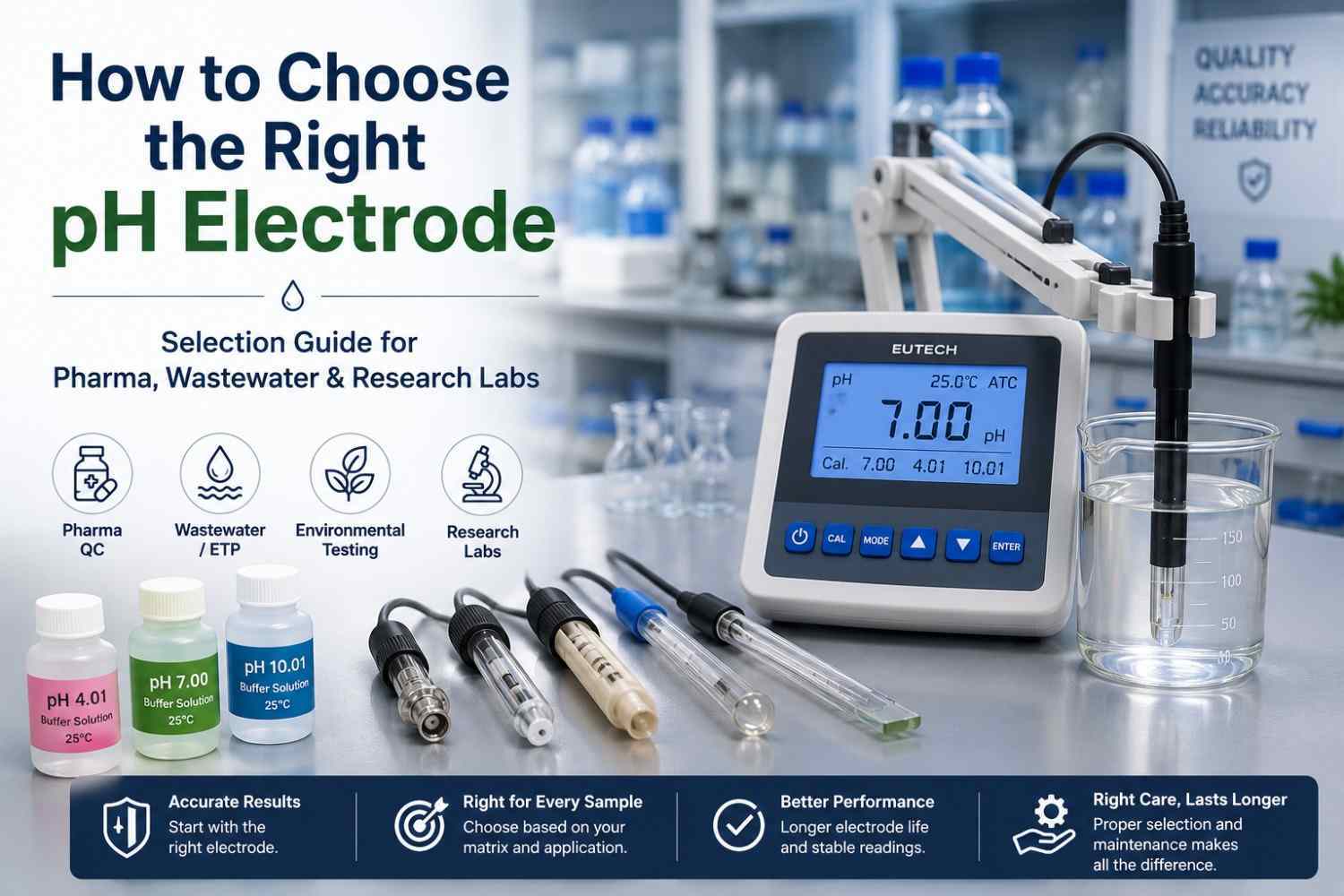
A senior analyst at a pharmaceutical plant in Vapi had been using the same pH meter for three years without problems. Then, overnight, his purified water pH readings became unstable — drifting between 5.9 and 7.2 on the same sample, calibration slope dropped to 82%, and two-point calibration took four attempts. The meter was fine. The problem was a three-year-old electrode that had been sitting in distilled water between measurements instead of 3M KCl storage solution. The reference junction was permanently depleted. A new electrode — ₹7,250 — solved the problem in minutes. Three years of data quality had been degrading gradually as the electrode aged, and nobody noticed until it failed visibly.
The pH electrode is the component that actually contacts your sample and develops the voltage your meter reads. Everything else — the high-impedance voltmeter, the temperature sensor, the display — is processing that signal. Buy the wrong electrode, store it incorrectly, or use it past its service life, and no amount of meter quality will give you accurate readings. This guide tells you exactly how to match the right electrode to your specific application.
pH Electrode (Combination Electrode): An electrochemical sensor consisting of a pH-sensitive glass membrane (indicating electrode) and a stable reference electrode combined in a single housing. The glass membrane develops a voltage proportional to hydrogen ion activity in the sample, measured against the stable reference potential. Most modern laboratory pH electrodes are combination electrodes — both elements in one probe — connected to the pH meter via a BNC coaxial connector. Resolution of 0.01 pH or better is standard for laboratory-grade electrodes.
What Is a pH Electrode and Why It Matters More Than the Meter
A pH meter without its electrode is a voltmeter that cannot measure pH. The electrode is the sensing element — the part of the system that actually measures the hydrogen ion activity of your sample. The meter simply reads and converts the electrode's output voltage into a pH value using the Nernst equation.
This means that the electrode is where measurement errors originate. A depleted reference junction produces unstable readings. A fouled glass membrane gives slow response. A poisoned silver reference (from sulphide exposure) can never recover. A wrong electrode type for the sample matrix produces systematically incorrect data that looks valid — there is no error message, just wrong numbers.
The practical implication: when you invest ₹41,400 in a Eutech pH 700 benchtop meter and pair it with the wrong electrode for your water type, you have spent ₹41,400 to record inaccurate data with high precision. Understanding electrode selection is not an advanced topic — it is the fundamental requirement for any meaningful pH measurement.
The Anatomy of a Combination pH Electrode
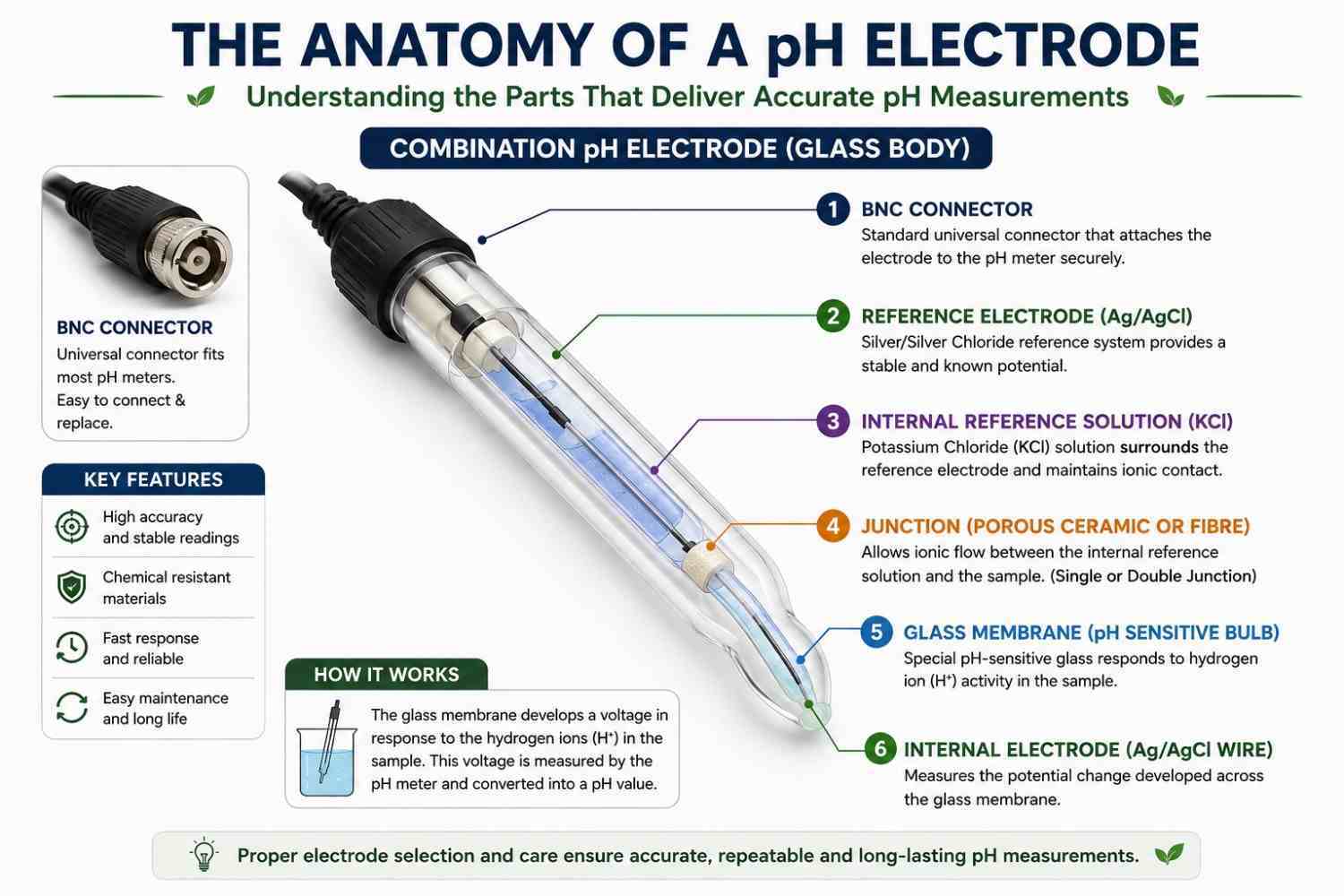
Every combination pH electrode has the same three functional elements, regardless of brand or price:
- Glass membrane — a thin, ion-selective glass tip at the base of the electrode. Hydrogen ions (H⁺) from the sample penetrate a very thin layer of the glass surface and create a voltage difference between the inner and outer surface of the membrane. This voltage is proportional to the pH of the sample per the Nernst equation.
- Reference electrode — a silver/silver chloride (Ag/AgCl) wire in a potassium chloride (KCl) electrolyte solution. It provides a stable, known electrical potential against which the glass membrane voltage is measured. The reference contacts the sample through a liquid junction (a porous ceramic plug, a fibre, or an open pore) that allows slow KCl outflow to maintain electrical continuity.
- Inner buffer solution — fills the space around the glass membrane inside the electrode body. It establishes the inner reference potential and is either a gel (gel-filled electrodes) or a liquid KCl solution (refillable electrodes).
The Four Key Decisions in pH Electrode Selection
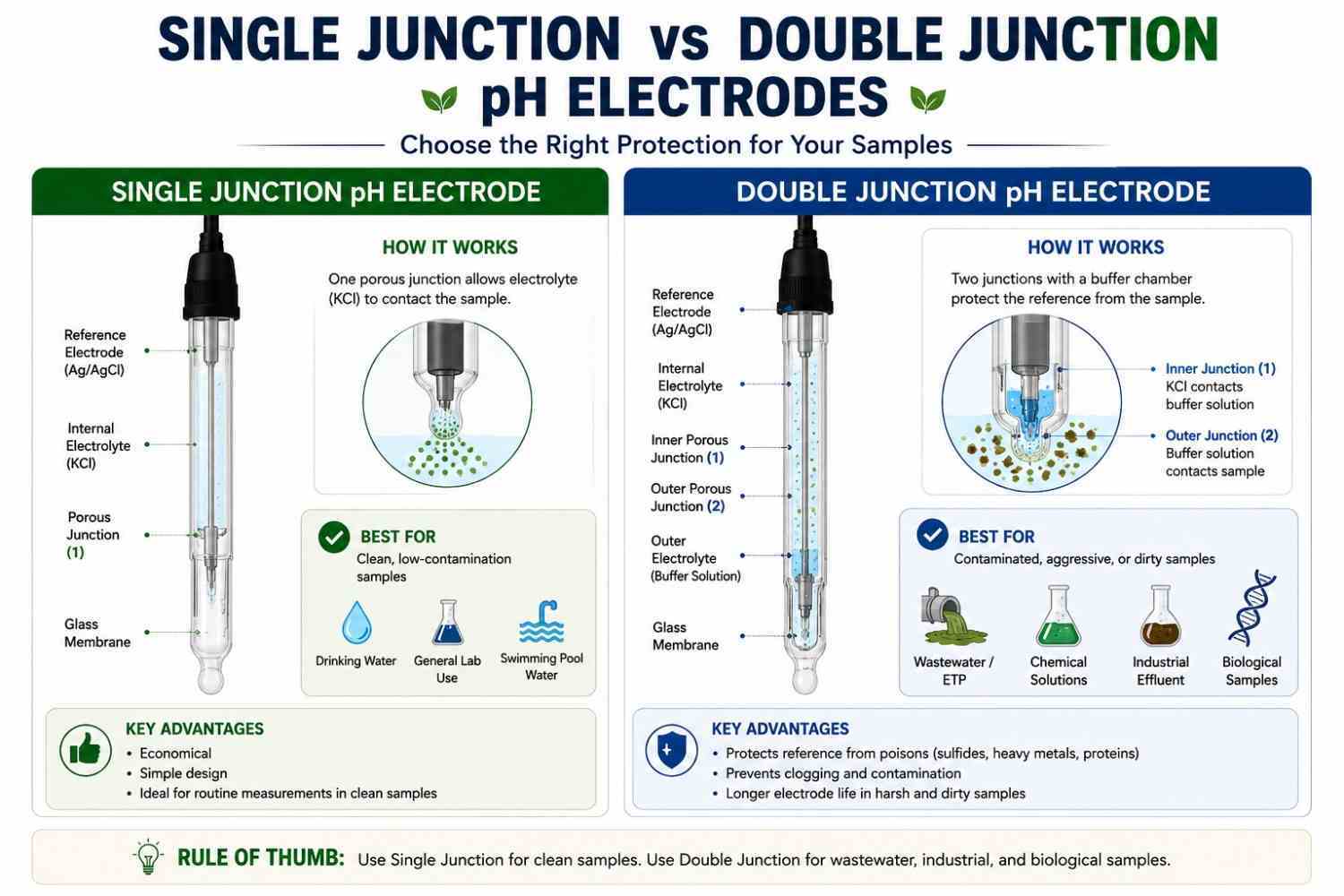
Decision 1 — Single junction vs double junction
The reference junction is where the reference electrolyte contacts the sample. In a single-junction electrode, one porous plug separates the KCl from the sample. In a double-junction electrode, a second outer chamber filled with a secondary electrolyte (typically KNO₃ or a similar non-reactive salt) acts as a buffer between the KCl and the sample.
Why does this matter? In samples containing sulphides, heavy metals (Pb²⁺, Hg²⁺, Ag⁺), or proteins — all common in wastewater, biological effluent, and food samples — the sulphide or metal ions penetrate the single junction and react with the silver wire reference, permanently poisoning it. A double-junction electrode prevents this by keeping the outer junction free of silver ions. For any ETP or wastewater pH measurement, double junction is not optional — it is the only configuration that survives.
Decision 2 — Glass body vs plastic body
Glass-body electrodes have a glass outer casing. They are more chemically inert, provide a cleaner electrical signal with less noise, and are preferred for pharmaceutical and research applications. Plastic-body electrodes are more impact-resistant, suitable for field use, and handle rough environments (ETP, industrial floors, outdoor sampling) better. Both types measure pH equally accurately when used correctly — the choice is primarily about durability vs signal quality.
Decision 3 — Gel-filled vs refillable reference
Gel-filled electrodes have the KCl electrolyte immobilised in a gel matrix. They are sealed, maintenance-free, and can be stored in any orientation — ideal for field portables and general lab use where simplicity matters. Refillable electrodes have liquid KCl that can be replenished. The liquid reference provides a faster-flowing, more stable junction potential — preferred for high-accuracy pharmaceutical QC and research work where measurement precision matters and the electrode sees frequent use.
Decision 4 — Standard vs specialty electrode
Standard combination electrodes work for 80% of pH measurement applications. But specific sample types require specialised designs:
- Low-ionic-strength electrode — for pharmaceutical purified water and RO permeate. Standard electrodes drift and give unstable readings in ultra-pure samples because the KCl reference electrolyte dominates the solution ionic environment. Low-ionic-strength designs use a very small junction outflow to minimise this effect.
- Flat-surface electrode — for semi-solid samples: agar gels, skin, paper, textile, leather, meat surfaces. The flat glass membrane can make direct contact with the sample surface.
- Spear-tip electrode — for penetrating semi-solids (soil, fruit flesh, meat). The pointed tip allows physical insertion into the sample.
- Micro electrode — for small-volume samples where a standard 12mm diameter probe cannot fit. Research and diagnostic applications.
| Application | Junction | Body | Fill Type | Special? |
|---|---|---|---|---|
| Pharma purified water / WFI | Single junction | Glass preferred | Refillable | Low-ionic-strength design |
| ETP / wastewater / sludge | Double junction | Plastic (field-durable) | Gel-filled | Standard |
| General lab / drinking water | Single junction | Plastic or glass | Gel-filled or refillable | Standard |
| Food / beverages | Single junction | Plastic | Gel-filled | Hygienic design; spear for fruits/meats |
| Research / high precision | Single junction | Glass | Refillable | Standard or micro as needed |
| Semi-solid surfaces (gels, paper) | Single junction | Glass | Refillable | Flat-surface electrode required |
| Soil / organic matter | Double junction | Plastic | Gel-filled | Spear or soil-specific design |
| Protein solutions / biological | Double junction | Glass or plastic | Refillable | Anti-clog junction design |
Electrode Selection by Application
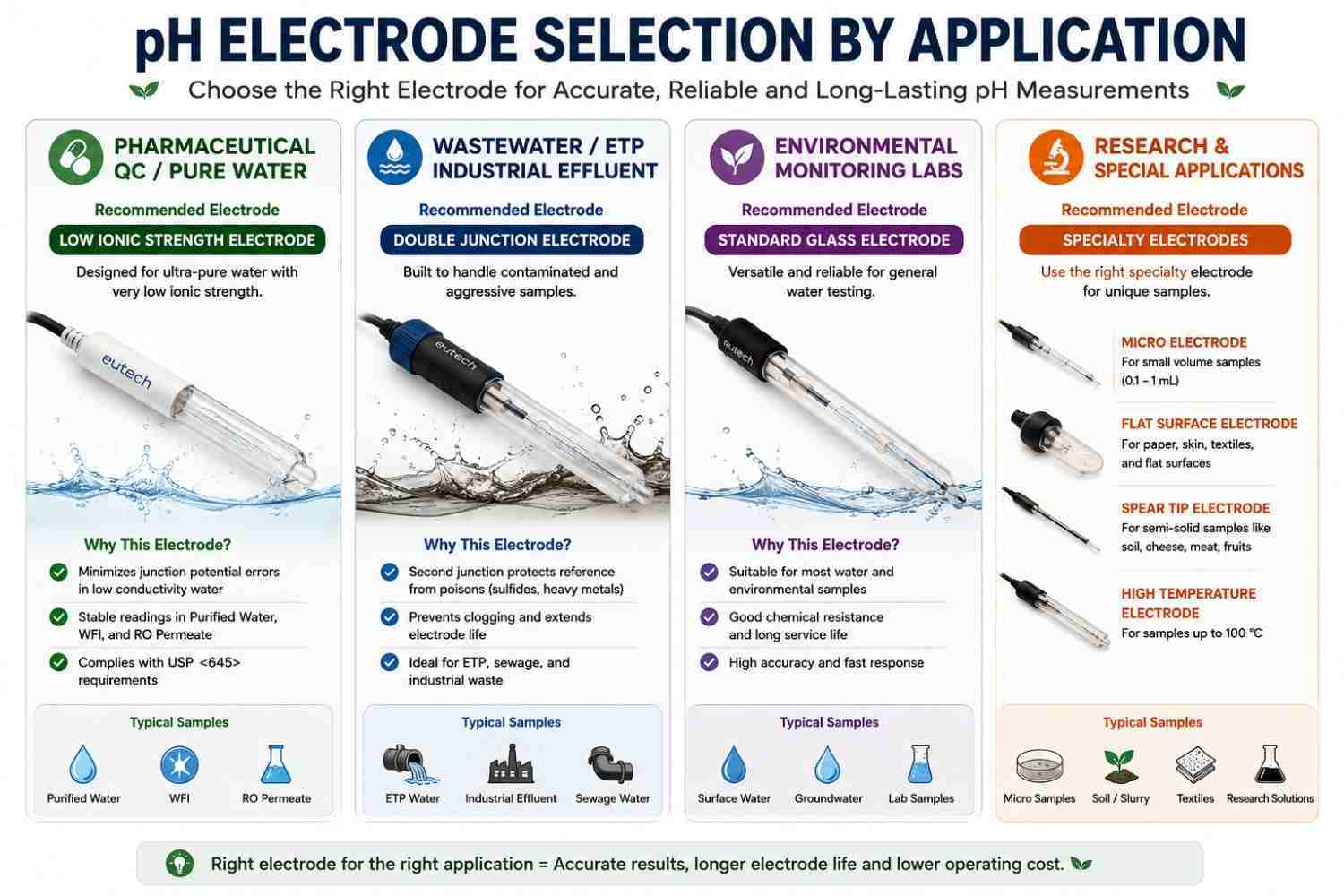
Pharmaceutical QC labs (IP/USP water testing)
The single most commonly made electrode mistake in Indian pharma labs is using a standard general-purpose combination electrode on pharmaceutical purified water. The result is continuously drifting readings that never stabilise — a typical sign that the electrode reference junction potential is being disrupted by the extremely low ionic strength of the sample. The solution is a low-ionic-strength electrode with a reduced-flow reference junction. Measure in a closed sampling cell or flow-through system — never from an open beaker where CO₂ absorption rapidly lowers the pH of ultra-pure water.
ETP, wastewater, and industrial effluent monitoring
Industrial effluent — especially from electroplating, textile dyeing, and tanneries — contains sulphides (S²⁻) and heavy metals that irreversibly poison silver/silver chloride references. An ETP operator who uses a standard single-junction electrode will find the electrode giving increasingly erratic readings within weeks and will be unable to recondition it. The only correct choice for wastewater is a double-junction electrode with an epoxy plastic body that resists the physical and chemical abuse of plant-floor conditions. Replacement frequency in aggressive effluent: 3–6 months regardless of junction type.
Environmental and NABL laboratory testing
Environmental labs testing surface water, groundwater, and effluent under IS 3025 Part 11 need a reliable, accurate electrode for a wide pH range (typically 2–12 across sample types). A good-quality refillable glass-body single-junction electrode is the standard for lab bench use. The Hanna HI1131B (₹19,500) is commonly specified in NABL-accredited environmental labs for its versatility and compatibility with Hanna benchtop instruments.
When to Replace Your pH Electrode
Electrode replacement is often delayed in Indian labs because the degradation is gradual — there is rarely a sudden, obvious failure. The following indicators reliably signal replacement is needed:
- Calibration slope below 90% (below 85% — replace immediately)
- Response time exceeds 60 seconds to reach a stable reading on a buffer
- Zero point drift beyond ±30 mV from the theoretical value (±7 mV pH₇ point)
- Readings unstable or oscillating despite sample being well-stirred and temperature stable
- Two-point calibration cannot be completed within three attempts
- Visible damage to glass membrane — cracks, chips, discolouration
In routine water testing labs, electrodes last 12–18 months under normal use. In food processing or environmental labs with aggressive samples, 6–12 months. In ETP and wastewater applications, as little as 3–6 months for single-junction electrodes, 6–12 months for double-junction. Running an electrode past its service life compromises every measurement made with it — including the ones that passed specification.
Storage and Maintenance — The Rules That Prevent Permanent Damage
Two storage errors cause most premature electrode failures in Indian labs, and both are irreversible once done:
Storage protocol
- Short-term storage (between measurements, same day) — keep in pH 4 buffer or 3M KCl solution
- Overnight storage — protective cap with a few drops of 3M KCl or manufacturer storage solution, sealed tightly
- Long-term storage (days to weeks) — 3M KCl storage solution in the protective cap; check and top up monthly
- Refillable electrodes — check the fill level monthly; top up with fresh 3M KCl before the level drops below the lower fill hole
Cleaning protocol
Between samples, rinse with deionised water and blot dry gently with soft tissue — never wipe the glass membrane, as wiping generates static charge that distorts the reading. After aggressive samples (concentrated acid, protein, oil, wastewater), rinse with dilute HCl (0.1 M) for 30 seconds, then with DI water, then soak in pH 7 buffer for 10 minutes before recalibrating.
pH Electrodes at Scispectrum: Models and Prices
All prices exclude GST. 18% GST is applicable. Eutech electrodes use BNC connectors compatible with Eutech pH meters; Hanna HI1131B uses BNC connector compatible with Hanna meters. Lutron PE-03 fits Lutron pH 208 and compatible BNC meters.
| Model | Type | Body / Fill | Best For | Price (₹) |
|---|---|---|---|---|
| Lutron PE-03 | Single junction, gel | Plastic / gel-filled | Budget portable, general use, Lutron PH-208 | 2,500 |
| Eutech ECFC7252101B | Single junction, sealed | Plastic / gel-filled | General lab, drinking water, food QC, ETP field | 7,250 |
| Eutech ECFC7352901B | 3-in-1, ATC, single junction | Plastic / gel-filled | Eutech Tutor DS series with ATC temp sensing | 13,750 |
| Eutech ECFG7350401B | Single junction, refillable | Glass / refillable | Pharma purified water, sensitive samples, precision lab | 13,500 |
| Eutech ECFC7252201B | Double junction, gel-filled | Plastic / gel-filled | ETP wastewater, sulphide-rich samples, industrial | 12,250 |
| Eutech ECFC72521R01B | Single junction, refillable | Plastic / refillable | High-frequency lab use, longer service life | 16,750 |
| Hanna HI1131B | Single junction, refillable | Glass / refillable | Hanna meters (HI2020, HI2211); NABL environmental | 19,500 |
| Eutech ECFG7252001B | Flat surface, refillable | Glass / refillable | Paper, skin, textile, leather, agar gels, semi-solids | 47,500 |
| Eutech ECFG4390401B | Glass-calomel, micro | Glass / calomel reference | Research, small-volume samples, high precision | 44,500 |
Frequently Asked Questions
Conclusion
The right pH electrode is the one matched to your sample matrix — not the cheapest available, not the most expensive in the catalogue, and not the one that came with the meter by default. For pharmaceutical purified water, a low-ionic-strength glass-body refillable electrode. For ETP and wastewater, a double-junction plastic-body gel-filled design that survives sulphide exposure. For NABL environmental lab work, a precision refillable glass-body electrode with a calibration slope above 95%. Store in 3M KCl, never in distilled water, and monitor calibration slope at every session — it is the earliest and most reliable signal that replacement is approaching. A ₹7,250–₹19,500 electrode investment protects the data quality of a ₹41,000–₹91,500 pH meter.
Browse pH electrodes at Scispectrum Call +91 7448882650