
Posted by scispectrum on 2nd Jun 2026
pH Meter for Water Testing: How to Choose the Right One for Your Lab or Plant
pH Meter for Water Testing: How to Choose the Right One for Your Lab or Plant
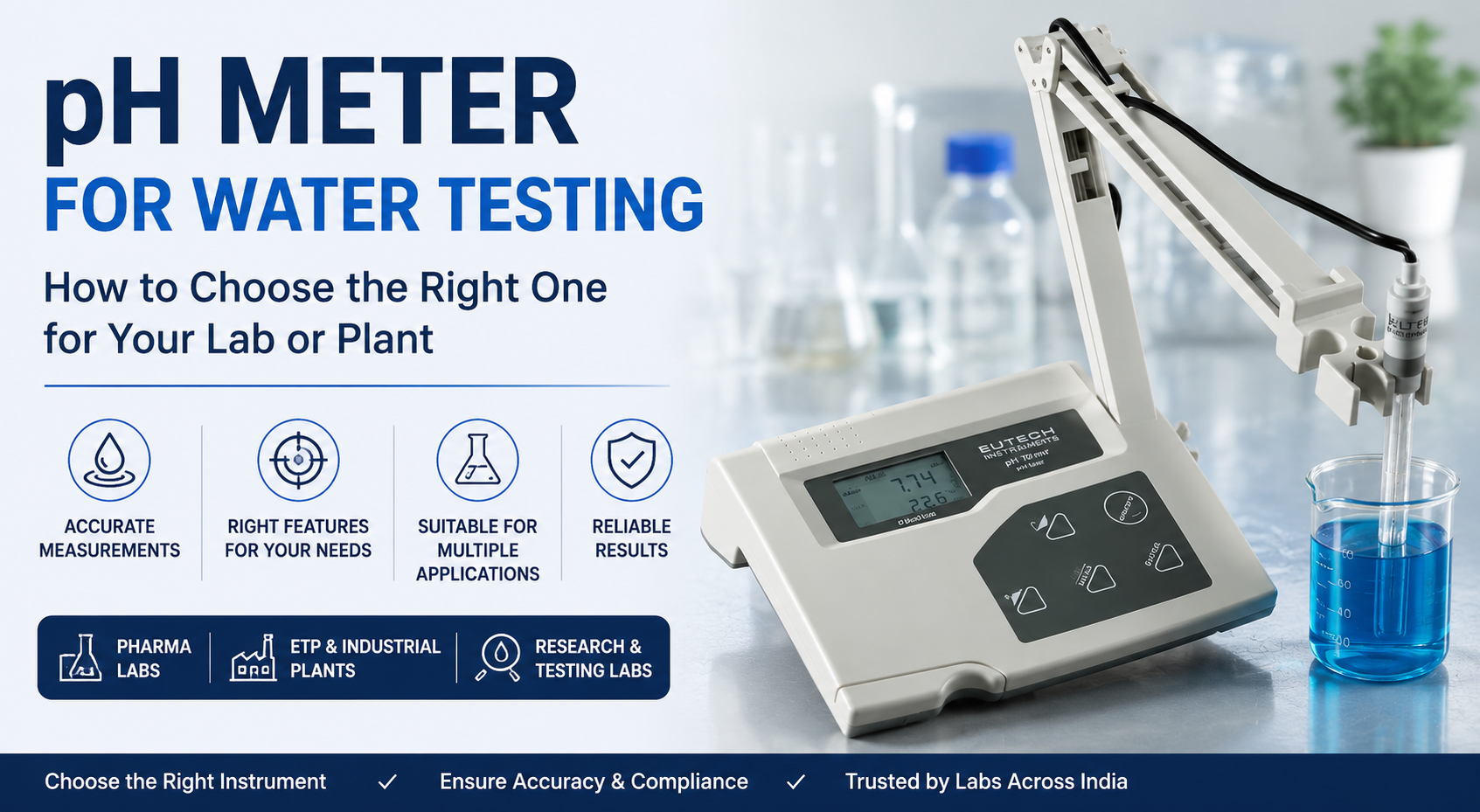
A QC manager once called us after a failed NABL audit. Their pH readings on purified water had been inconsistent across three shifts — sometimes within spec, sometimes not, with the same water from the same loop. The instrument? A ₹4,000 pen-type pH tester. No ATC, no calibration log, no replaceable electrode.
It was, technically, a pH meter. Just not the right one for a pharmaceutical water system. That distinction — between a pH meter that exists in your lab and one that is fit for purpose — is exactly what this guide is about.
pH Meter for Water Testing: An electrochemical instrument that measures the hydrogen ion activity in a water sample to determine its acidity or alkalinity on the pH scale (0–14). It consists of a pH-sensitive glass electrode, a reference electrode, and a high-impedance voltmeter that converts the millivolt potential between the electrodes into a pH reading. Resolution ranges from ±0.1 pH in basic models to ±0.001 pH in precision laboratory instruments.
Why Your Choice of pH Meter Matters More Than You Think
pH is one of the most frequently measured parameters in water testing — and also one of the most frequently measured incorrectly. The reasons are almost always instrumental.
A meter with poor temperature compensation drifts as water temperature changes. An electrode that has not been conditioned properly gives sluggish responses. A single-point calibration on a meter used across a pH 4–10 range introduces systematic errors in the non-linear regions of the electrode response.
Choosing the correct instrument for your water type, environment, and regulatory requirements is not just a procurement decision. It is a quality decision.
Water Types and What They Demand from a pH Meter
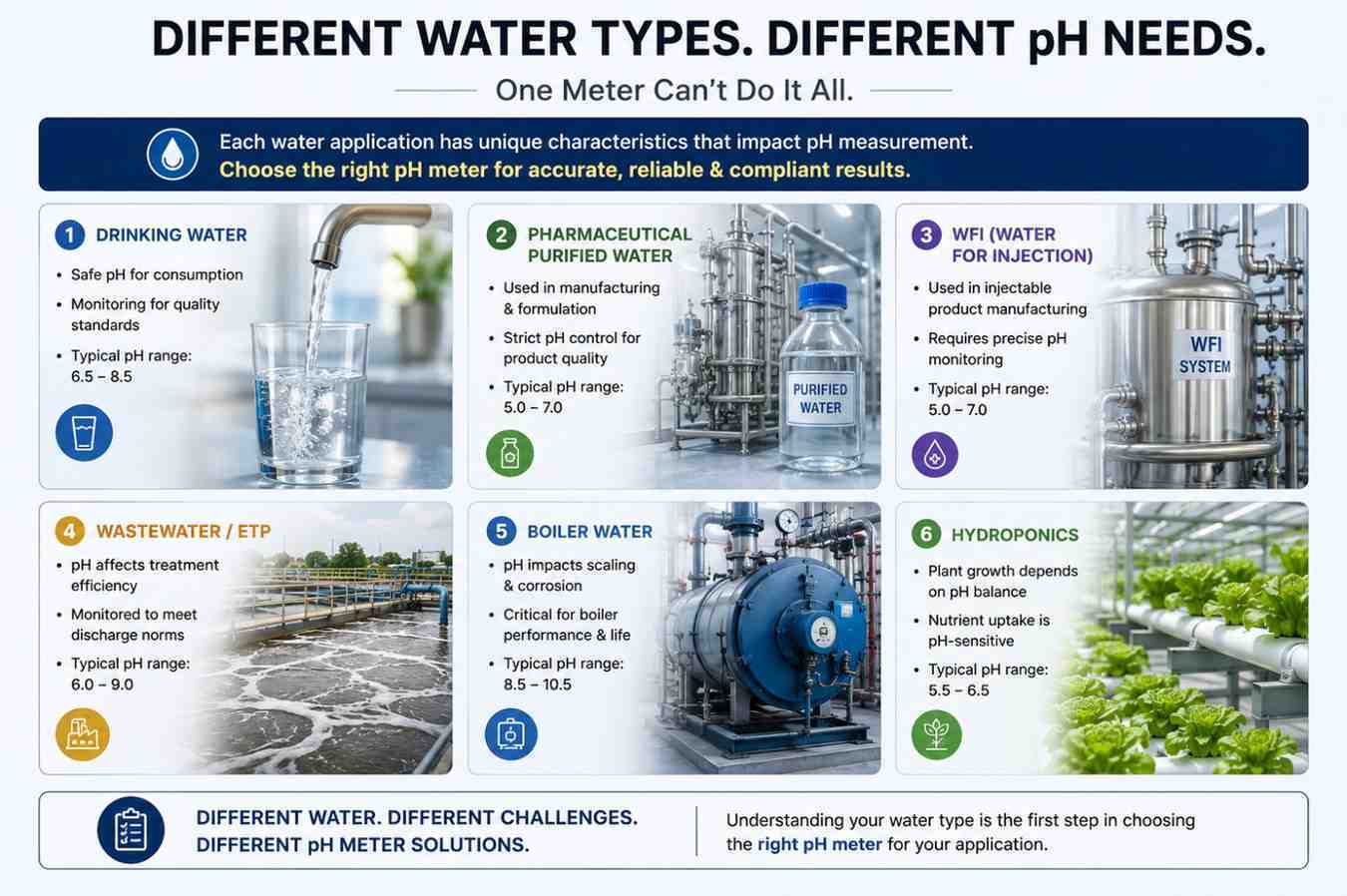
Not all water is the same. Different water matrices place different demands on a pH measurement system. Before selecting a meter, identify exactly what you are measuring.
| Water Type | Typical pH Range | Key Challenge | Minimum Requirement |
|---|---|---|---|
| Drinking / Municipal Water | 6.5–8.5 | Chlorine interference, temperature variation | Portable with ATC, ±0.01 pH |
| Pharmaceutical Purified Water | 5.0–7.0 | Low ionic strength, slow response | Benchtop with GLP, ±0.01 pH |
| Water for Injection (WFI) | 5.0–7.0 | Ultra-pure, CO₂ absorption | Benchtop, closed-cell measurement |
| Effluent (ETP Inlet) | 2–12 | Sulphides, heavy metals, fouling | Portable IP67, double-junction electrode |
| Effluent (ETP Outlet / CPCB discharge) | 6.5–8.5 | Compliance documentation | Portable with data logging, IP67 |
| Boiler / Cooling Tower Water | 8.0–10.5 | High temperature, scaling | Wide-range meter, high-temperature ATC |
| Process / RO Permeate | 5.5–7.5 | Low conductivity — junction potential drift | Low-ionic strength electrode, benchtop preferred |
| Hydroponics / Irrigation Water | 5.5–7.0 | Nutrient solution interference, portability | Portable or pen-type with ATC |
Key Specifications to Evaluate Before You Buy
1. Accuracy and Resolution
Resolution is the smallest increment the display shows (e.g. 0.1, 0.01, or 0.001 pH). Accuracy is the total measurement error across the range. For most water testing applications, ±0.01 pH resolution is sufficient. Pharma applications require ±0.01 pH accuracy as a minimum; high-end research applications may need ±0.001–0.002 pH.
2. Automatic Temperature Compensation (ATC)
pH measurement is temperature dependent — the electrode response changes approximately 0.003 pH per °C near neutral pH. ATC automatically adjusts measurements using a built-in temperature sensor, reducing operator error and improving consistency across varying conditions. For any serious water testing application, ATC should be considered mandatory.
3. Calibration Points
One-point calibration corrects offset only — suitable for basic screening. Two-point calibration (pH 4 and 7, or 7 and 10) corrects both offset and slope — standard for pharmaceutical water testing. Three-point calibration (pH 4, 7, and 10) provides the best accuracy across a wide range — recommended for ETP and industrial applications with varying sample pH.
4. GLP Compliance and Data Output
GLP-compliant instruments store calibration date, time, electrode slope, offset, and measurement records — required for pharmaceutical QC, GMP-regulated facilities, and NABL-accredited laboratories. Look for USB connectivity, RS-232 output, printer compatibility, and LIMS integration capability.
5. BNC Connector vs Integrated Electrode
A BNC connector allows you to replace the electrode without replacing the meter — lower lifetime cost, better flexibility, easier upgrades. Pen-type testers with integrated probes require full unit replacement when the electrode fails. For routine laboratory use, a BNC-based system is the better long-term investment.
6. IP Rating for Field Applications
For field use, IP67 (dust-tight, waterproof to 1m immersion) is the minimum for ETP monitoring, borewell testing, and on-site water quality checks. IP65 (dust-tight, water jet resistant) suits lighter field conditions. Benchtop laboratory meters carry no IP rating and should remain in controlled laboratory environments.
| Specification | Pharma QC Lab | ETP / Field | Research Lab | Small Lab |
|---|---|---|---|---|
| Accuracy | ±0.01 pH | ±0.01–0.02 pH | ±0.001–0.01 pH | ±0.01–0.1 pH |
| Calibration | 2–3 Point + GLP | 2–3 Point | 3 Point + GLP | 1–2 Point |
| ATC | Required | Required | Required | Preferred |
| IP Rating | Not Required | IP67 Minimum | Not Required | IP54+ Preferred |
| Data Output | USB / RS-232 | Optional | USB / RS-232 | Not Required |
| Electrode Type | Low-Ionic, BNC | Double-Junction, Epoxy | Application-Specific | General Purpose |
| Typical Price | ₹18,000–₹55,000 | ₹8,000–₹25,000 | ₹15,000–₹45,000 | ₹500–₹8,000 |
Choosing by Application: Pharma, ETP, Research, Small Lab
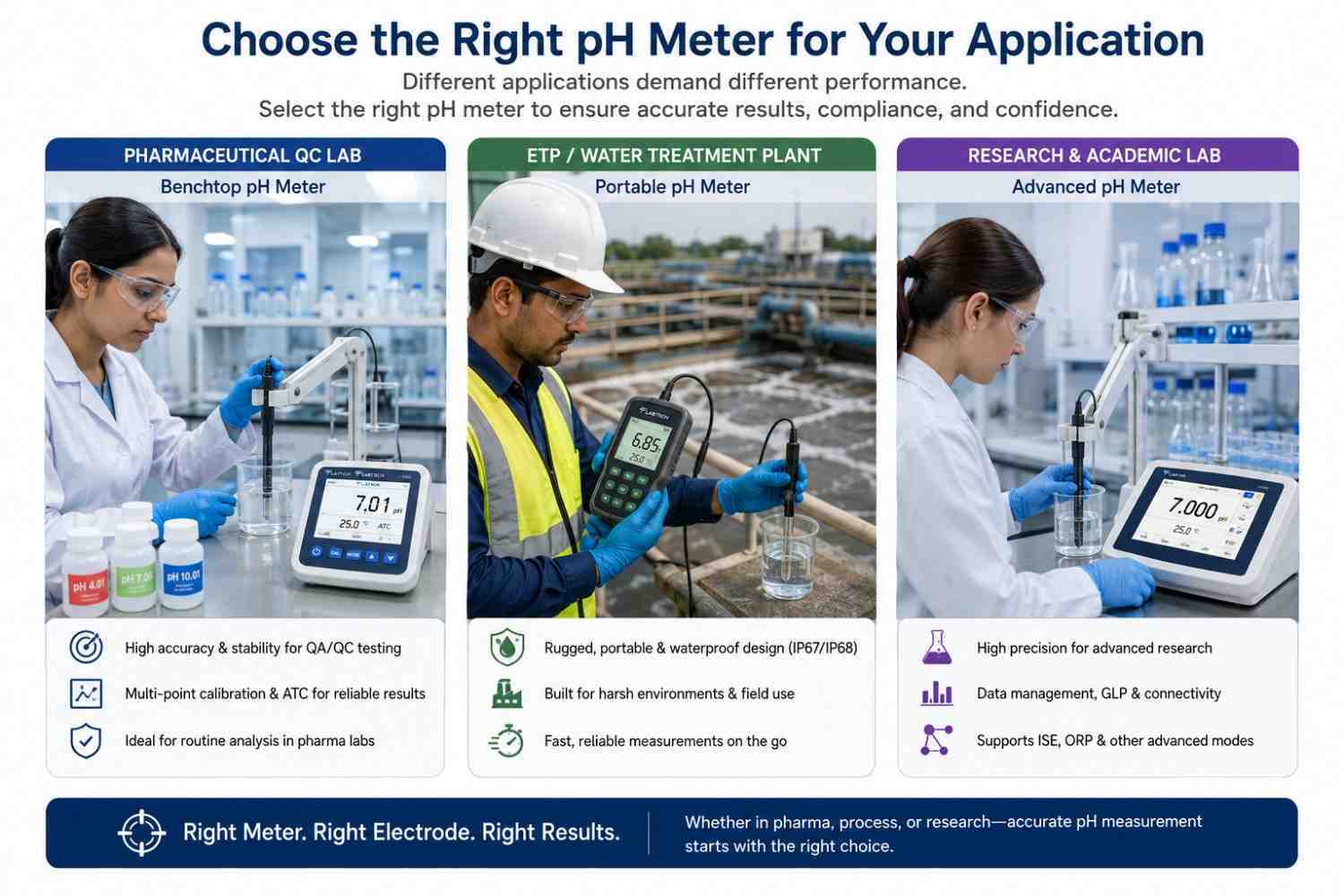
For Pharmaceutical and Biotech Water Testing
The Indian Pharmacopoeia (IP) and USP both specify pH measurement requirements for Purified Water (PW) and Water for Injection (WFI). The acceptance criteria for purified water is generally pH 5.0–7.0, and testing requires a calibrated, temperature-compensated pH meter.
A benchtop pH meter with GLP data logging is the standard instrument for pharmaceutical QC laboratories. Popular instruments used in Indian pharma facilities include the Eutech pH 700 Series, Hanna HI2211, and Mettler Toledo FiveEasy Plus — all supporting ATC, multi-point calibration, GLP documentation, and audit-ready records.
For Industrial ETP and Water Treatment Plants
ETP applications require a portable pH meter capable of operating under harsh conditions — high suspended solids, sulphide contamination, heavy metals, wide pH fluctuations, and outdoor environments. Key requirements: IP67 waterproofing, ATC, double-junction electrode, rugged epoxy-body probe, and data logging capability.
Single-junction electrodes foul rapidly in wastewater. Double-junction designs provide substantially better protection. For CPCB compliance monitoring at discharge points, documented measurement records are essential — many facilities now use portable instruments with onboard memory or digital data export.
For Research and Academic Laboratories
Research applications often require greater flexibility — higher accuracy, wider measurement ranges, specialised electrodes (micro-tip for small volumes, flat-surface for gels, non-aqueous for solvent work), and data export capability. A benchtop meter with advanced calibration functions and USB connectivity is typically the preferred solution.
For Small Water Testing Labs and Individual Users
Smaller labs and individual users generally prioritise affordability and ease of use — drinking water testing, food processing QC, hydroponics, educational labs, and routine screening. Entry-level portable meters and pen-type testers serve these applications well. For users performing frequent testing, a meter with a BNC connector and replaceable electrode is more economical long-term than replacing entire pen-type units.
The Electrode Is Half the Instrument — Don't Ignore It
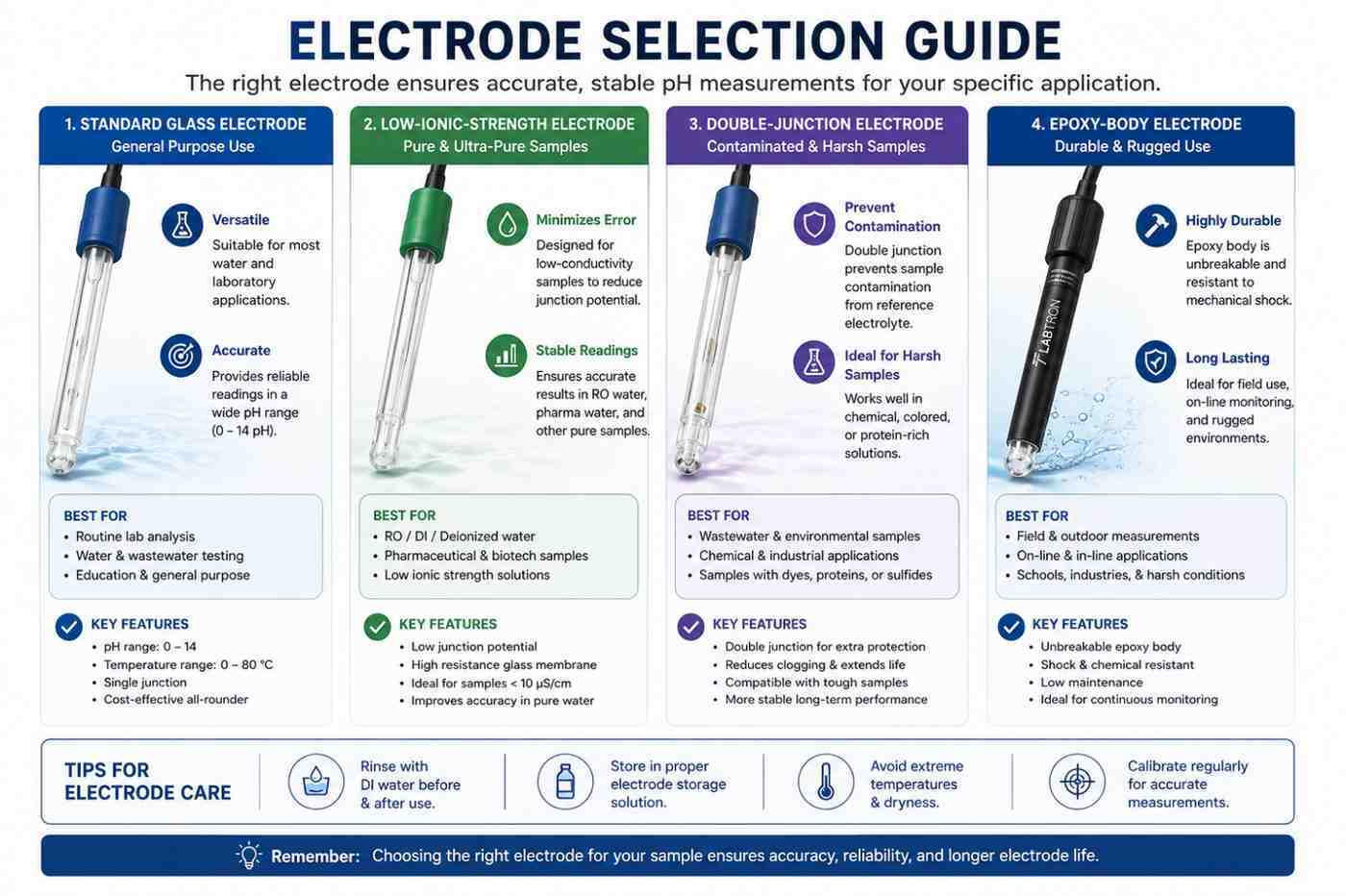
Many buyers focus entirely on the meter and treat the pH electrode as an afterthought. A premium meter paired with an unsuitable or degraded electrode will produce poor results. A mid-range meter with the correct electrode, properly maintained, can provide highly reliable measurements.
Selecting the Right Electrode
| Factor | Option A | Option B | When to Choose |
|---|---|---|---|
| Sample type | Standard glass electrode | Low-ionic-strength electrode | Pure/pharma water → Option B |
| Sample type | Standard glass | Flat-surface electrode | Gels, semi-solids → Option B |
| Environment | Glass-body (lab) | Epoxy-body (field) | ETP, outdoor → Option B |
| Reference junction | Single-junction | Double-junction | Wastewater, sulphides, heavy metals → Option B |
| Maintenance | Gel-filled (low maintenance) | Refillable (longer life) | High-frequency pharma use → Option B |
When to Replace an Electrode
- Calibration slope falls below 90% (pharma labs should target above 95%)
- Response time becomes noticeably slower than when new
- Zero point drifts beyond ±30 mV from theoretical value
- Stable calibration can no longer be achieved consistently
In routine laboratory environments, electrodes typically last 12–18 months. In aggressive wastewater applications, replacement may be necessary every 3–6 months.
Common Mistakes That Ruin pH Measurements in Water Testing
After years of supporting pharmaceutical facilities, ETPs, and research laboratories, these mistakes appear repeatedly — and are entirely preventable.
- Calibrating at room temperature, measuring at process temperature. ATC compensates for slope changes but cannot fully eliminate junction potential effects at extreme temperatures. Allow samples to cool to room temperature, or use electrodes rated for elevated temperatures.
- Using expired or contaminated buffer solutions. Calibration accuracy depends entirely on buffer quality. Use fresh buffers, never return used buffer to the original bottle, and replace opened buffers per manufacturer recommendations. Contaminated buffers lead directly to inaccurate calibration.
- Cross-contaminating calibration buffers. Moving an electrode directly between buffers introduces contamination. Always rinse with deionised water and blot gently dry — never wipe the glass membrane, as wiping generates static charges that affect readings.
- Not allowing the reading to stabilise. Electrodes need 30–60 seconds to equilibrate when moving between different temperatures, pH values, or from storage solution to a sample. Reading immediately gives a transient value that may not be representative.
- Ignoring the reference junction condition. A clogged or poisoned reference junction is one of the most common causes of unstable measurements. Wastewater containing sulphides or heavy metals can permanently damage standard single-junction electrodes — switch to double-junction design for these applications.
- Single-point calibration across a wide pH range. Calibrating only at pH 7 and measuring samples at pH 3 or pH 10 can introduce 0.1–0.3 pH errors depending on electrode condition. Always use at least two-point calibration bracketing the expected sample range.
pH Meters for Water Testing at Scispectrum
Whether you need a GLP-ready benchtop meter for pharmaceutical water systems or a rugged portable instrument for daily ETP monitoring, Scispectrum stocks instruments from Eutech (Thermo Fisher), Hanna Instruments, Aquasol, HM Digital, and other established brands — all sourced from authorised distributors with proper GST invoices for institutional procurement and audit documentation.
Frequently Asked Questions
Conclusion
The right pH meter for water testing is the one matched to your water matrix, your measurement environment, and your compliance requirement. Pharmaceutical purified water demands a GLP-capable benchtop meter with a low-ionic-strength electrode. ETP monitoring demands a rugged IP67 portable with a double-junction probe. A small water testing lab may be well served by an entry-level portable with ATC. Get the application match right, maintain your electrode, and calibrate consistently — and your pH data will hold up to any audit or inspection.
Browse pH meters at Scispectrum Call +91 7448882650