
Posted by scispectrum on 17th Mar 2026
Viscometer: Types, Working Principle, and Industrial Applications
Table of Contents
- Introduction
- What is a Viscometer?
- Working Principle of a Viscometer
- Types of Viscometers
- Industrial Applications of Viscometers
- Advantages of Using a Viscometer
- Factors Affecting Viscosity Measurement
- Tips for Accurate Viscosity Testing
- Conclusion
Introduction
In many industries, understanding how liquids flow is essential for maintaining product quality and ensuring proper manufacturing processes. The viscosity of a liquid describes its resistance to flow and is a critical parameter in industries such as pharmaceuticals, food production, cosmetics, chemicals, and petroleum.
To measure this property accurately, laboratories and industrial facilities use a specialized instrument called a viscometer. Viscometers help determine the thickness or flow behavior of liquids, which is vital for quality control, research, and product development.
This article explains the working principle, types, and major industrial applications of viscometers, along with useful tips for accurate viscosity measurement.
What is a Viscometer?
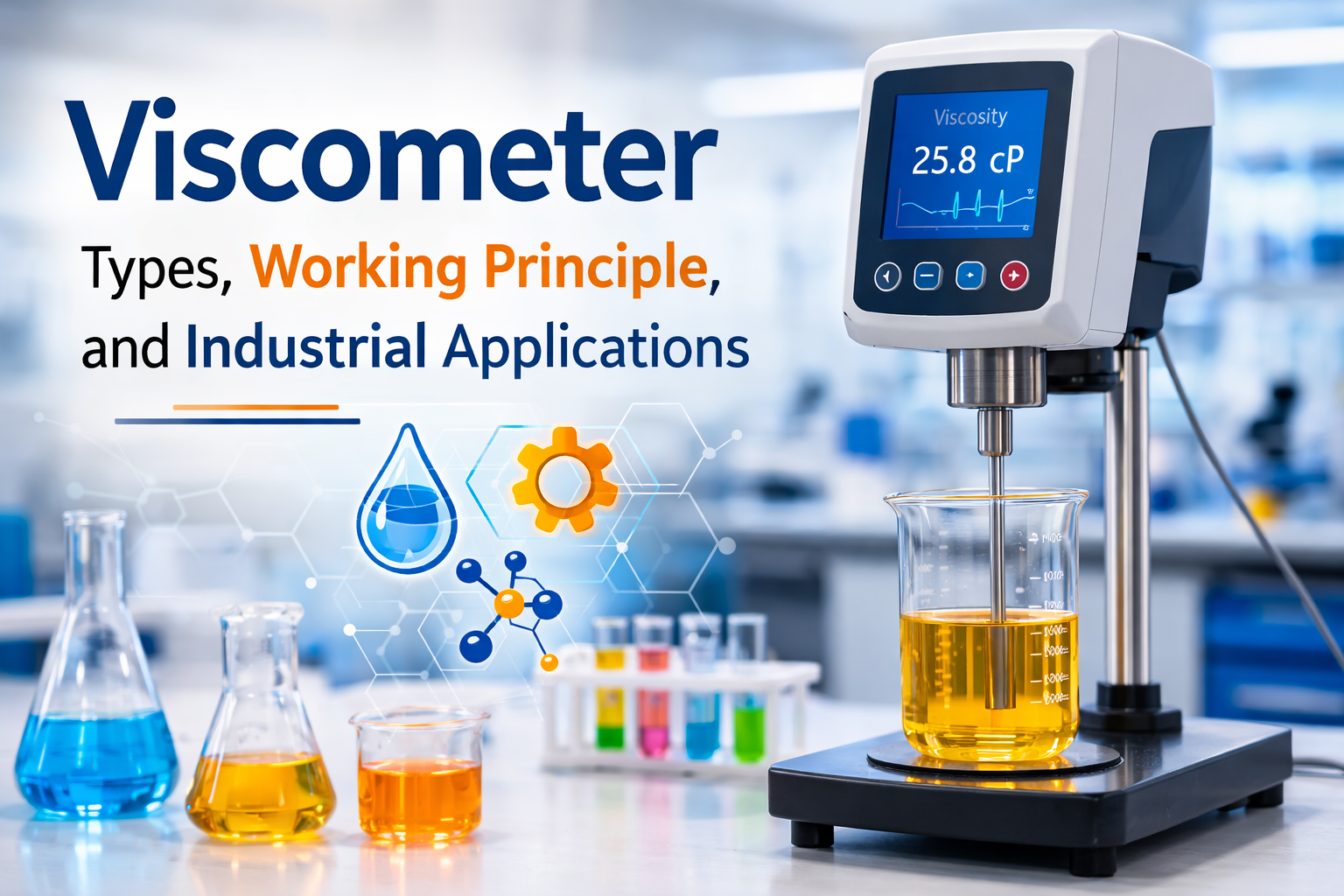
A viscometer is a laboratory instrument used to measure the viscosity of liquids or semi-fluids. Viscosity indicates how easily a liquid flows under specific conditions.
For example:
- Water has low viscosity and flows easily.
- Honey or syrup has high viscosity and flows slowly.
Viscometers help determine this property by measuring the resistance of a liquid when it flows or when an object moves through it.
Accurate viscosity measurement is important because it affects product texture, stability, performance, and quality in many industrial processes.
Working Principle of a Viscometer
The working principle of a viscometer is based on measuring the resistance of a fluid to flow or deformation when force is applied.
Different types of viscometers use slightly different methods, but the basic principle generally involves one of the following:
- Measuring the time it takes for a liquid to flow through a narrow tube
- Measuring the torque required to rotate an object inside the liquid
- Measuring the resistance encountered by a moving spindle or object in the fluid
In many cases, the viscosity measurement follows the relationship:
η=γ˙τ
Where:
- η = Viscosity of the fluid
- τ = Shear stress applied to the fluid
- γ̇ = Shear rate (rate of deformation)
The instrument measures these parameters and calculates the viscosity value, usually expressed in centipoise (cP) or Pascal-seconds (Pa·s).
Types of Viscometers
Various types of viscometers are available depending on the method used to measure viscosity.
1. Capillary Viscometer
A capillary viscometer measures viscosity by observing the time required for a liquid to flow through a narrow tube under gravity.
Common examples include:
- Ostwald viscometer
- Ubbelohde viscometer
These instruments are widely used in chemical laboratories and research institutions.
2. Rotational Viscometer
A rotational viscometer measures viscosity by rotating a spindle inside the liquid and measuring the resistance to rotation.
Key features include:
- High accuracy
- Suitable for a wide range of liquids
- Commonly used in industrial quality control
This type is widely used in pharmaceutical, cosmetic, and food industries.
3. Falling Ball Viscometer
In this method, a ball is allowed to fall through the liquid, and the time taken to travel a specific distance is measured.
The viscosity is calculated based on the speed of the falling ball.
This type is commonly used in research laboratories and teaching laboratories.
4. Vibrational Viscometer
A vibrational viscometer measures viscosity by analyzing the damping of vibration in a probe immersed in the liquid.
These instruments are often used for continuous monitoring in industrial processes.
Industrial Applications of Viscometers
Viscometers are used in many industries where fluid properties must be carefully controlled.
Pharmaceutical Industry
In pharmaceutical laboratories, viscosity measurement helps ensure the proper consistency of syrups, suspensions, gels, and creams.
Maintaining the correct viscosity is important for drug stability and patient usability.
Food and Beverage Industry
Food manufacturers use viscometers to measure the viscosity of products such as:
- Sauces
- Syrups
- Dairy products
- Beverages
Consistent viscosity ensures uniform texture and product quality.
Cosmetic Industry
In cosmetics manufacturing, viscosity testing is essential for products like:
- Lotions
- Creams
- Shampoos
- Gels
Proper viscosity helps maintain product performance and consumer satisfaction.
Chemical Industry
Chemical laboratories use viscometers to analyze the viscosity of polymers, solvents, lubricants, and chemical solutions.
These measurements are important for process control and formulation development.
Petroleum Industry
In the petroleum industry, viscosity measurement helps evaluate fuel oils, lubricants, and crude oil properties.
This information is crucial for transportation, refining, and equipment performance.
Advantages of Using a Viscometer
Viscometers provide several benefits for laboratory testing and industrial quality control.
- Accurate measurement of liquid viscosity
- Helps maintain consistent product quality
- Useful for research and formulation development
- Available in various models for different applications
- Supports process monitoring in industries
Because of these advantages, viscometers are essential tools in quality control laboratories and production facilities.
Factors Affecting Viscosity Measurement
Several factors can influence viscosity measurement results. Understanding these factors helps improve testing accuracy.
Temperature
Viscosity is highly sensitive to temperature. As temperature increases, most liquids become less viscous and flow more easily.
Shear Rate
Some fluids change viscosity depending on the applied force or shear rate, especially non-Newtonian fluids.
Sample Composition
Impurities, suspended particles, or air bubbles can affect measurement accuracy.
Tips for Accurate Viscosity Testing
To obtain reliable results when using a viscometer, follow these best practices:
- Calibrate the instrument regularly
- Maintain a stable testing temperature
- Use clean and appropriate spindles or tubes
- Avoid air bubbles in the sample
- Follow the manufacturer’s recommended testing procedure
These steps help ensure consistent and reproducible measurements.
Viscometers Available at Scispectrum
| Product Name | Type | Measuring Range | Speed (RPM) | Display | Accuracy | Key Features | Applications |
|---|---|---|---|---|---|---|---|
| Touch Screen Viscometer SKY-V201 | Rotational Viscometer | 20 – 2,000,000 mPa.s | 0.3 – 60 RPM | LCD Touch Screen | ±1.0% | Touch interface, RTD temperature monitoring, auto range, RS-232 output | Pharmaceuticals, oils, paints, food, polymers |
| Digital Viscometer SKY-V200 | Rotational Viscometer | 20 – 1,000,000 mPa.s | 6 – 60 RPM | LCD Display | ±1.0% | Standard spindles, temperature probe, RS-232 output | Dairy, chemicals, coatings, solvents, cosmetics |
Conclusion
Viscometers are essential instruments used to measure the viscosity and flow characteristics of liquids in laboratories and industrial processes. By providing accurate viscosity measurements, these instruments help maintain product consistency, improve quality control, and support research and development activities.
From pharmaceutical formulations to food processing, cosmetics manufacturing, and petroleum testing, viscometers play a vital role in ensuring reliable product performance.
As industries continue to demand precise fluid analysis, modern viscometers with advanced digital features are becoming increasingly important for efficient and accurate viscosity measurement.