
Posted by scispectrum on 17th Mar 2026
Viscometer: Types, Working Principle, Industrial Uses & Price in India
Viscometer: Types, Working Principle, Industrial Uses & Price in India
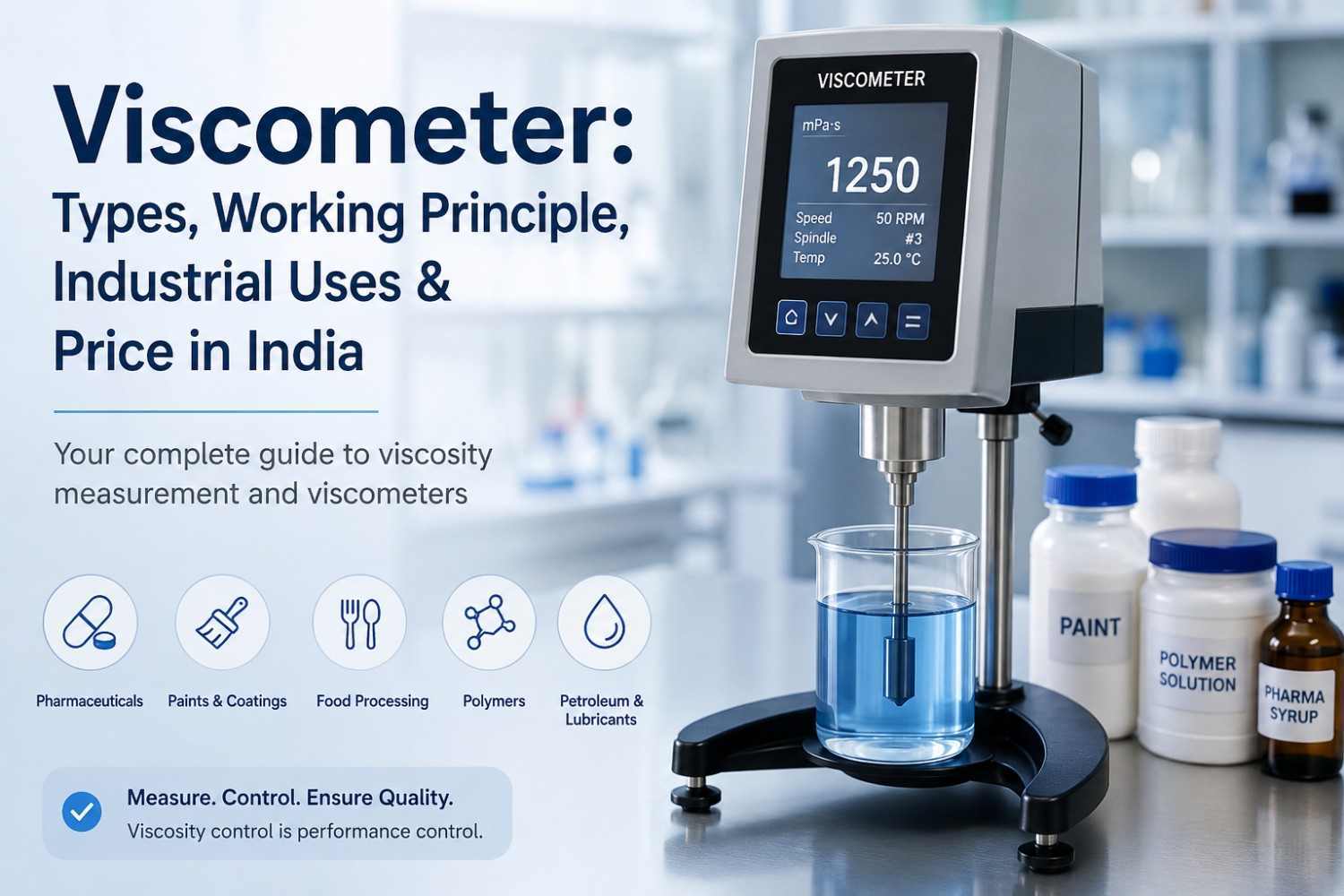
A batch of oral syrup failed the USP viscosity test. The product had passed every other QC parameter — assay, pH, microbial, dissolution — but the viscosity was off by 18%. The investigation traced the problem to a single-point viscometer being used on a pseudoplastic formulation, measured at a non-standardised spindle speed, with no temperature control. Every reading taken over three months of production had been operator-dependent and reproducibility was never verified. The instrument was a viscometer in name; it was not a viscosity measurement system in practice. That distinction matters in every industry where fluid quality is a production variable — and it starts with understanding what type of viscometer your application actually requires, how it works, and what it can and cannot tell you.
Viscometer Definition: A viscometer is an instrument that measures the viscosity of a fluid — its internal resistance to flow under an applied force or shear. Viscosity is expressed in centipoise (cP), millipascal-seconds (mPa·s), or pascal-seconds (Pa·s). Viscometers are used across pharmaceutical manufacturing, paint and coatings, food processing, polymer R&D, petroleum, and cosmetics industries to characterise, control, and quality-test fluid materials.
What Is a Viscometer
A viscometer is the instrument you use when you need to know how a liquid flows — not just whether it is thick or thin, but precisely how much resistance it offers to movement, at what conditions, and whether that resistance changes with the speed of flow. This last point distinguishes simple viscometers from rheometers, but more on that shortly.
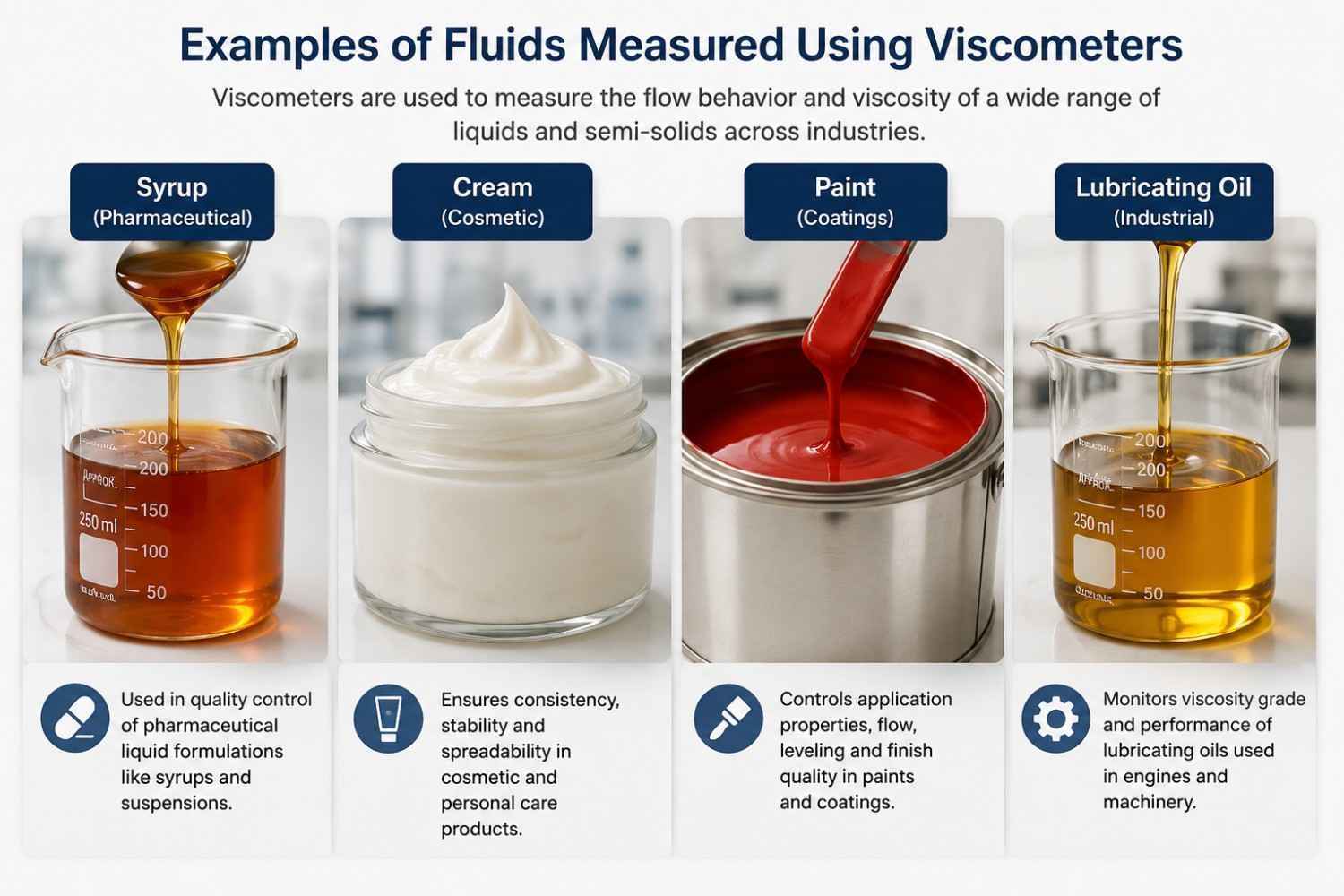
Viscosity is a physical property of fluids that determines pumpability, pourability, coating behaviour, stability in suspension, and patient acceptability in pharmaceutical dosage forms. A syrup that is too thin will be perceived as watery and may destabilise the suspension faster; too thick and it cannot be metered accurately through a dosing pump. A paint with incorrect viscosity will drip off a vertical surface or fail to atomise properly in a spray gun. A lubricating oil with the wrong viscosity grade allows metal-to-metal contact or increases pump load. The viscometer is the instrument that controls all of these outcomes at the manufacturing and QC stage.
Understanding Viscosity: What You Are Actually Measuring
Before choosing a viscometer, you need to understand what type of fluid behaviour you are dealing with — because different fluid types require fundamentally different measurement approaches.
Newtonian vs Non-Newtonian Fluids
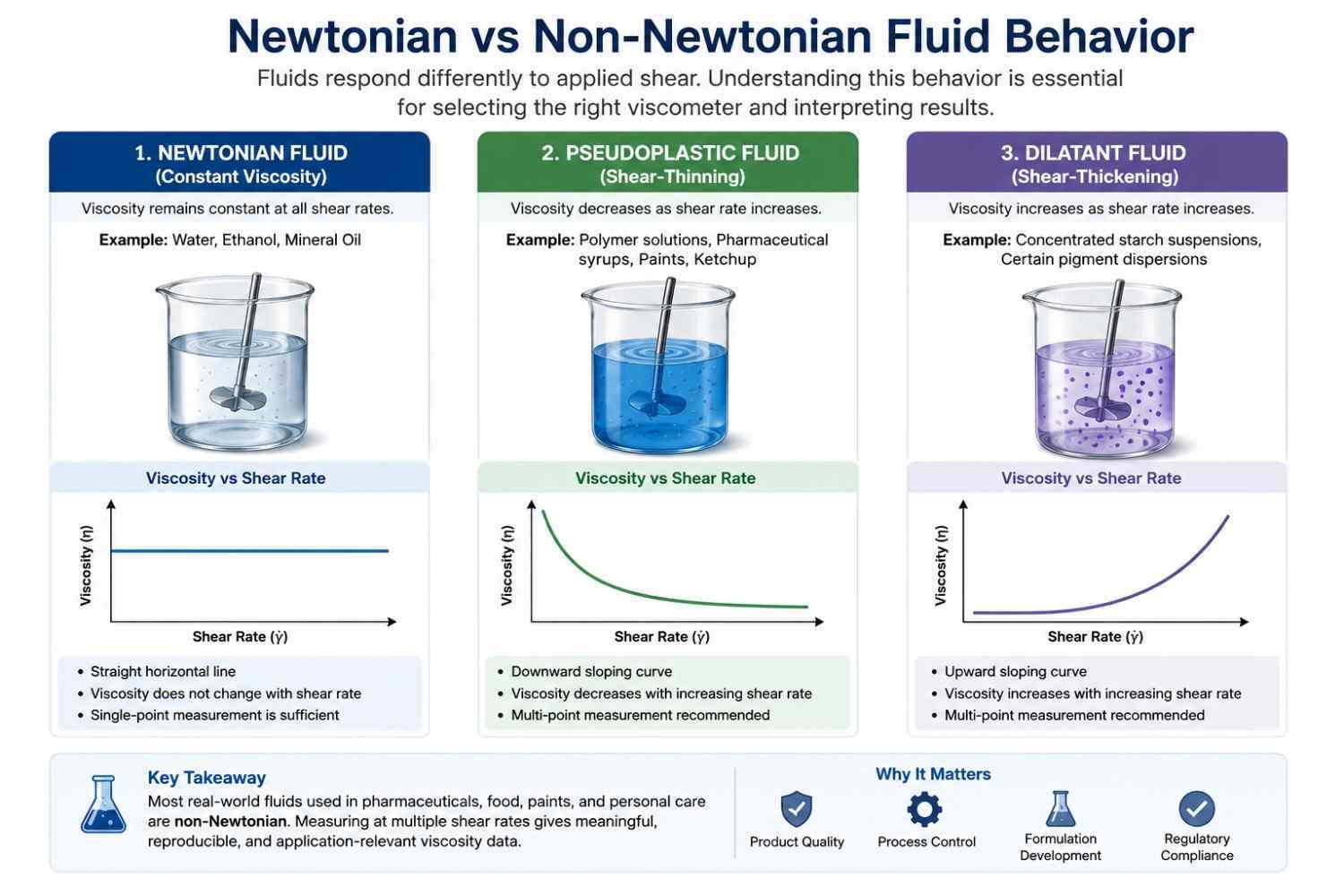
A Newtonian fluid has a constant viscosity regardless of how fast it flows (how high the shear rate is). Water, mineral oil, and ethanol are Newtonian. Measure them at any spindle speed and you get the same viscosity value. A single-point measurement is sufficient.
A non-Newtonian fluid changes viscosity with shear rate. This includes:
- Pseudoplastic (shear-thinning) fluids: Viscosity decreases as shear rate increases. Examples — polymer solutions, pharmaceutical suspensions and gels, tomato ketchup, blood, latex paint. These fluids flow easily when stirred or pumped (high shear) but thicken at rest. Most pharmaceutical liquid and semi-solid formulations are pseudoplastic.
- Dilatant (shear-thickening) fluids: Viscosity increases with shear rate. Examples — concentrated starch suspensions, certain pigment dispersions, quicksand. Less common in pharmaceutical manufacturing.
- Thixotropic fluids: Viscosity decreases over time under constant shear and recovers when shear is removed. Examples — certain paints, drilling muds, gel formulations. Time-dependent behaviour that a simple single-point viscometer cannot characterise.
- Plastic (Bingham) fluids: Require a minimum stress (yield stress) before they flow at all. Examples — toothpaste, certain ointments, heavy-bodied pastes.
The practical implication: if your product is non-Newtonian — and most pharmaceutical liquids, semi-solids, paints, and food products are — a single-speed measurement gives you a number that is meaningless without specifying the spindle, speed, and temperature at which it was taken. A multi-point viscometer that measures across a range of speeds gives you the full flow curve and is the only approach that gives reproducible, meaningful data for these materials.
Dynamic vs Kinematic Viscosity
Dynamic viscosity (also called absolute viscosity) measures the force required to move one layer of fluid over another — expressed in centipoise (cP) or mPa·s. This is what rotational viscometers measure directly.
Kinematic viscosity is dynamic viscosity divided by fluid density — expressed in centistokes (cSt) or mm²/s. This is what capillary viscometers measure. For petroleum products and lubricating oils, kinematic viscosity and ISO viscosity grades (ISO VG 32, 46, 68, etc.) are the industry standard.
| Property | Dynamic Viscosity | Kinematic Viscosity |
|---|---|---|
| Definition | Resistance to shear flow | Dynamic viscosity ÷ density |
| SI unit | Pa·s (pascal-second) | m²/s |
| Common unit | mPa·s or centipoise (cP) | mm²/s or centistokes (cSt) |
| Measured by | Rotational viscometer | Capillary viscometer |
| Typical applications | Pharma, paints, polymers, food | Petroleum, lubricants, engine oils |
Working Principle of a Viscometer
The working principle varies by viscometer type, but all types share the same fundamental concept: applying a known stress or deformation to a fluid and measuring its response. The ratio of applied stress to resulting strain rate gives viscosity. Here is the working principle of each major type:
Rotational Viscometer Principle
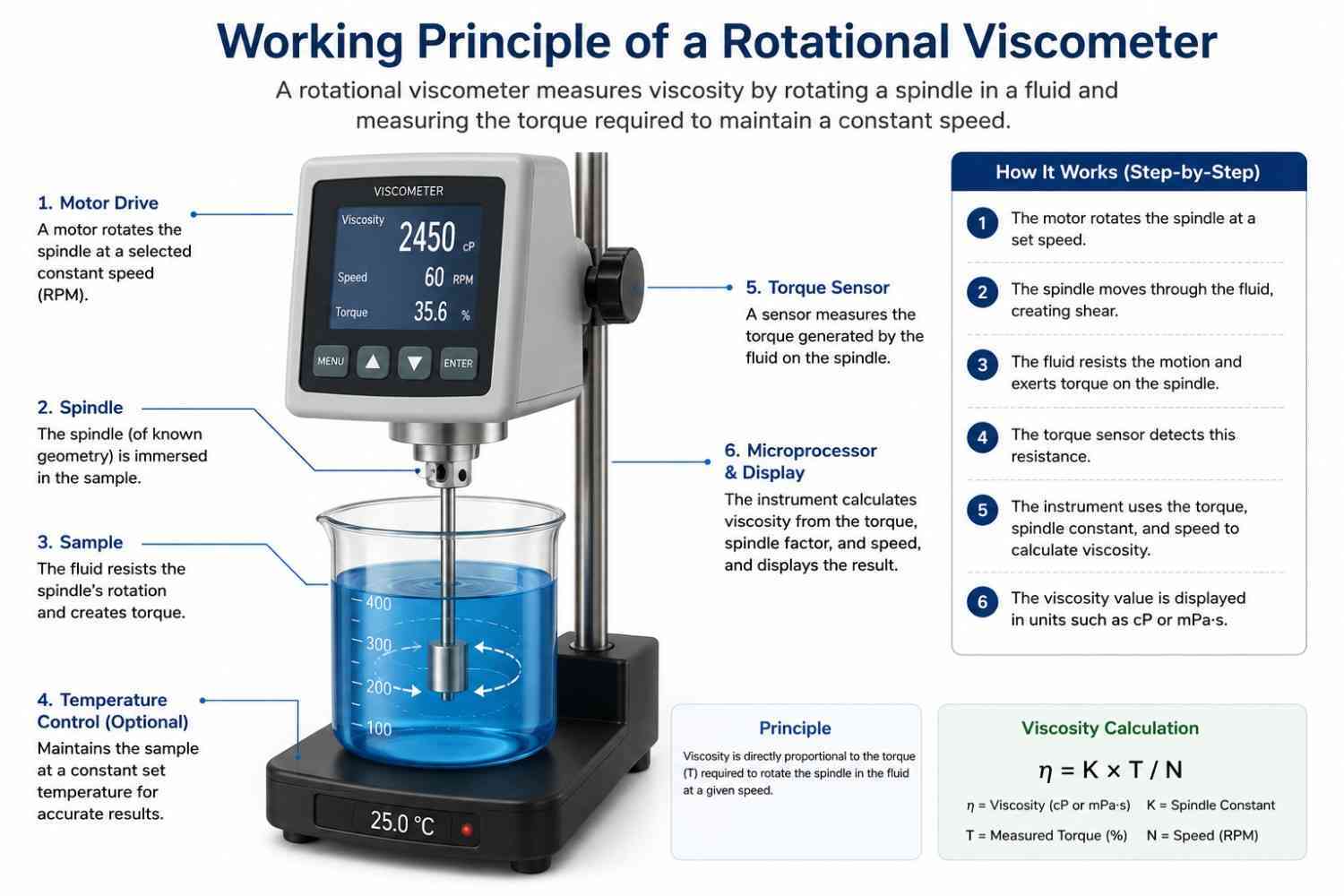
A rotational viscometer works by immersing a spindle (a precisely shaped bob or disc) in the fluid sample and rotating it at a controlled speed using an electric motor. The fluid exerts a drag force (torque) on the spindle proportional to its viscosity. A torque-measuring system — typically a calibrated spring or a strain gauge — measures the resistance, and the instrument converts this to a viscosity reading in cP.
- The spindle is lowered into the fluid sample at a defined depth and immersion level.
- The motor drives the spindle at a fixed rotational speed (RPM).
- The fluid's viscosity creates a drag torque opposing the rotation.
- The torque sensor measures the deflection or resistance.
- The instrument calculates viscosity: η = (Torque × Spindle Factor) ÷ RPM
- Digital models display viscosity in cP directly on screen.
The spindle geometry (disc, T-bar, cylinder, cone-and-plate) and the sample container size determine the measurement range and sensitivity. Each spindle has a specific factor (Fα) that the instrument uses in the viscosity calculation — this is why using the wrong spindle for a viscosity range gives an incorrect reading.
Capillary Viscometer Principle
A capillary viscometer measures the time a fixed volume of fluid takes to flow through a narrow capillary tube under gravity (or applied pressure for high-viscosity materials). The flow time is proportional to kinematic viscosity. The Hagen-Poiseuille equation governs the relationship: viscosity is proportional to flow time multiplied by a capillary constant (determined by calibration with a standard fluid of known viscosity). Capillary viscometers give highly accurate kinematic viscosity measurements for Newtonian fluids and are the reference method for petroleum products (ASTM D445 / IS 1448).
Falling Ball Viscometer Principle
A falling ball viscometer measures the time a ball of known density and diameter takes to fall a defined distance through a vertical tube filled with the sample fluid. At terminal velocity, the gravitational force on the ball equals the drag force exerted by the fluid. By Stokes' law, the dynamic viscosity is directly proportional to the fall time multiplied by the density difference between the ball and the fluid. This method is simple, highly accurate for transparent Newtonian fluids, and is used in pharmaceutical compendial testing (IP, USP, BP methods for certain injectable vehicles and ophthalmic solutions).
Types of Viscometers: A Practical Classification
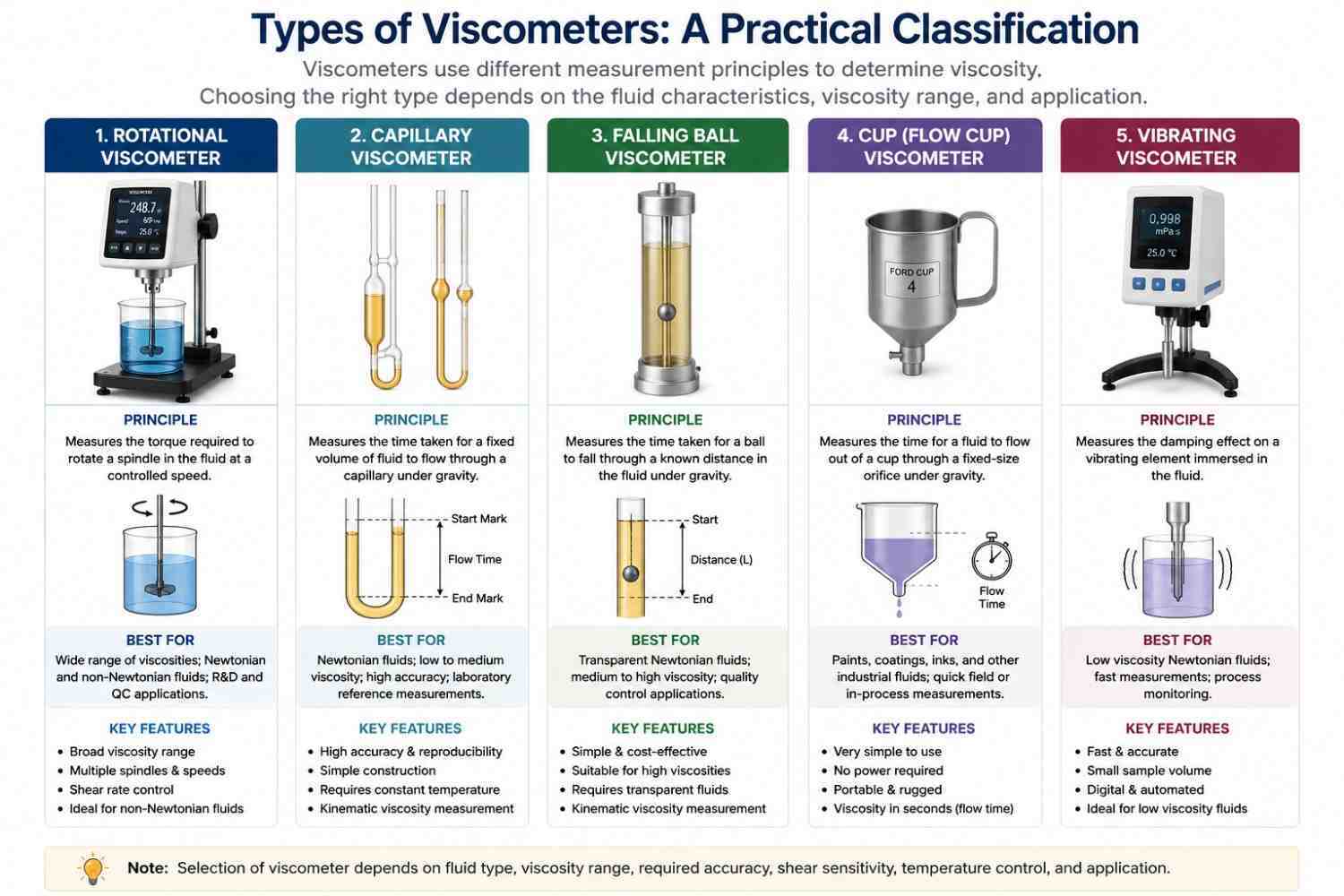
There are five main types of viscometers in industrial and laboratory use. The right type for your application is determined by fluid type (Newtonian or non-Newtonian), viscosity range, sample volume available, required accuracy, and whether you need kinematic or dynamic viscosity.
1. Rotational Viscometer (Brookfield Type)
The most widely used viscometer in Indian industrial and pharmaceutical QC labs. A spindle rotates in the sample fluid and the torque is measured at one or more speeds. The Brookfield design — named after the American instrument manufacturer whose instruments became the industry reference — is the dominant rotational viscometer type worldwide and the instrument referenced in USP, IP, and most industrial standards for viscosity measurement.
Rotational viscometers come in two sub-types:
- Single-speed (single-point): Measures at one fixed RPM with one spindle. Sufficient for Newtonian fluids or for simple pass/fail QC checks on products with well-defined specifications at a single shear rate. Fast, simple, low-cost.
- Variable-speed (multi-point): Measures at multiple RPMs, generating a viscosity profile against shear rate. Required for non-Newtonian fluids — pharmaceutical suspensions, gels, paints, polymer melts. The SKY V200 and V201 digital viscometers available through Scispectrum are variable-speed rotational instruments.
Typical viscosity range: 15 cP to 6,000,000 cP depending on spindle set
Industries: Pharma, paints and coatings, adhesives, food, cosmetics, polymers
Indian standard: IP and USP viscosity chapters specify rotational methods
2. Capillary Viscometer (Ostwald / Ubbelohde)
Glass U-tube instruments through which fluid flows under gravity. The simplest and most accurate type for Newtonian fluids — kinematic viscosity of petroleum products, pharmaceutical vehicles, and water-based solutions. The Ubbelohde design (suspended-level type) is preferred for precise laboratory measurements because it eliminates the meniscus position error of the simpler Ostwald viscometer.
Typical viscosity range: 0.5 to 10,000 cSt
Industries: Petroleum, lubricants, resins, polymer solutions
Indian standard: IS 1448 (P:25) for petroleum viscosity, ASTM D445
3. Falling Ball Viscometer (Höppler Type)
A ball falls through a tilted tube filled with the sample fluid. The fall time is proportional to dynamic viscosity. Highly accurate for transparent or translucent low-to-medium viscosity Newtonian fluids. Used in pharmacopoeial viscosity testing for injectable and ophthalmic preparations, and in food industry applications (vegetable oils, liquid sugar).
Typical viscosity range: 0.5 to 70,000 mPa·s
Industries: Pharma (injectables, ophthalmic), food oils, glycerine
Standard: DIN 53015, IP/USP compendial methods for specific preparations
4. Cup Viscometer (Ford Cup / Zahn Cup)
A cup with a calibrated orifice at the bottom. The time for the cup to drain completely — or until air breaks the stream — is recorded in seconds and converted to viscosity using a conversion factor. The Ford cup is the standard field method for paints and coatings QC in India, specified in BIS and IS standards for alkyd paints, primers, and surface coatings.
Typical viscosity range: 20 to 4,000 cP (orifice-dependent)
Industries: Paints, varnishes, printing inks, adhesives
Indian standard: IS 101 (Part 1/Sec 4) for paint viscosity
5. Vibrating Viscometer (Tuning Fork Type)
A vibrating element — a tuning fork, wire, or rod — is immersed in the fluid. The energy required to maintain resonance, or the shift in resonant frequency, is proportional to the product of viscosity and density. Vibrating viscometers are primarily used for online, continuous viscosity monitoring in process lines — petroleum pipelines, food processing, polymer extrusion. They have no rotating parts, are easy to install inline, and require minimal maintenance.
Typical use: Continuous process monitoring, not lab batch testing
Industries: Petroleum refining, polymer extrusion, food processing pipelines
| Type | Measures | Fluid Type | Best For | Complexity |
|---|---|---|---|---|
| Rotational (Brookfield) | Dynamic (cP) | Newtonian + Non-Newtonian | Pharma, paints, polymers, gels | Medium |
| Capillary (Ostwald/Ubbelohde) | Kinematic (cSt) | Newtonian only | Petroleum, lubricants, solutions | Low–Medium |
| Falling Ball (Höppler) | Dynamic (mPa·s) | Newtonian, transparent | Pharma injectables, oils, glycerine | Low |
| Cup (Ford/Zahn) | Efflux time → cP | Low–medium viscosity | Paints, inks, coatings | Very low |
| Vibrating element | Dynamic (mPa·s) | Newtonian + limited non-Newtonian | Continuous process monitoring | Low (inline) |
Single-Point vs Multi-Point Viscometers
This is the most consequential selection decision for most QC labs in India — and the one most often made incorrectly.
Single-Point Viscometers
A single-point viscometer measures viscosity at one fixed spindle speed (RPM) and reports a single cP value. It is suitable for Newtonian fluids — where the viscosity is independent of shear rate, so the RPM used does not affect the result. Common Newtonian fluids in QC labs include mineral oils, simple aqueous solutions, and certain solvent-based resins.
The limitation: if you measure a non-Newtonian fluid (a suspension, gel, or cream) at a single speed without specifying that speed in your SOP, two operators using different speeds will get completely different viscosity numbers — both of which are correct for their respective speeds, and neither of which is comparable to the other. This is how viscosity data becomes meaningless in a QC system.
Multi-Point Viscometers
A multi-point viscometer measures torque at several different rotational speeds — typically ranging from 0.5 to 100 RPM — and calculates viscosity at each speed. The result is a flow curve (viscosity vs shear rate) that characterises the fluid's non-Newtonian behaviour. From this curve, you can determine:
- The flow index (whether the fluid is pseudoplastic, dilatant, or Newtonian)
- The yield stress (for plastic and thixotropic fluids)
- The thixotropic area (for time-dependent fluids)
- The apparent viscosity at any relevant shear rate — for example, the shear rate in a syringe, a pump, or a mixing vessel
For pharmaceutical suspensions, gels, creams, and ointments — all pseudoplastic materials — a multi-point measurement is the only approach that gives reproducible, meaningful data. The SKY V200 digital viscometer (₹86,900 + 18% GST) and the SKY V201 touch screen viscometer (₹1,95,000 + 18% GST) are both variable-speed instruments capable of multi-point measurement across multiple spindle speeds. For labs requiring USP/IP pharmacopoeial compliance with full GLP documentation, the Brookfield DV-E (₹5,75,000 + GST), DV-1M (₹5,75,000 + GST), and DV-Plus (₹7,50,000 + GST) are also available through Scispectrum — these are the same instruments referenced in international pharmacopoeial viscosity standards.
Viscometer Uses: Industrial Applications in India
Viscometers are used across a wider range of industries in India than most QC professionals realise. The diagram below illustrates the typical measurement setup for a rotational viscometer — spindle immersed in the sample, torque motor above, and digital display unit. Here are the primary viscometer uses by industry and what each application requires from an instrument:
Pharmaceutical Manufacturing
Viscosity is a critical quality attribute (CQA) for liquid oral dosage forms, semi-solid preparations, and parenteral products. The Indian Pharmacopoeia (IP) and USP specify rotational viscometry (Chapter <912> in USP) and capillary/falling ball methods for different product types.
- Oral syrups and suspensions: Rotational viscometer, multi-point measurement. Viscosity specification is part of the finished product specification and batch release criteria.
- Topical gels, creams, ointments: Rotational viscometer. These pseudoplastic materials require multi-point measurement to characterise spreadability and skin-feel properties.
- Ophthalmic solutions: Falling ball viscometer (Höppler method). Viscosity of ophthalmic vehicles (e.g., methylcellulose, polyvinyl alcohol) affects corneal contact time and patient tolerance.
- Injectables: Viscosity of injectable solutions affects syringeability and injectability — the force required to push the solution through a needle. Low-viscosity solutions use capillary or falling ball; higher-viscosity depot formulations use rotational instruments.
Viscosity testing pairs closely with other pharmacopoeial tests in pharma QC labs. A complete physical characterisation suite for a liquid dosage form typically includes viscosity, pH (measured with a viscometer companion instrument), density, and osmolality. Long-term viscosity stability testing under ICH conditions requires a stability chamber to store samples at defined temperature and humidity before measurement.
Paints, Varnishes, and Coatings
Viscosity is the single most important rheological property in paints and coatings manufacturing. It determines:
- Sprayability: Too viscous and the paint cannot be atomised; too thin and it runs and sags on vertical surfaces.
- Levelling: The viscosity immediately after brush or roller application determines how well the coating self-levels before it sets.
- Sag resistance: Paints must be shear-thinning (pseudoplastic) — they should thin under the shear of application but immediately recover viscosity at rest to prevent sagging.
- Shelf stability: Viscosity is monitored over the product life to detect settling, gel formation, or syneresis.
The Ford cup (efflux cup) is the most common field QC instrument in Indian paint factories — simple, no calibration required, gives relative readings in seconds that are correlated to batch specifications. For development and formulation labs, rotational viscometers with multi-point capability give the complete rheological characterisation needed for formulation optimisation.
Food Processing and FMCG
Viscosity affects taste, texture, mouthfeel, and processing characteristics of food products. Common food applications for viscometry in India include:
- Sauces, gravies, and condiments: Viscosity determines pourability and consumer perception. Tomato ketchup is highly pseudoplastic — it pours easily when shaken (high shear) but holds its shape on the plate (low shear).
- Vegetable oils and ghee: Kinematic viscosity using capillary viscometers. FSSAI standards specify viscosity ranges for certain edible oil categories.
- Dairy products: Viscosity of yoghurt, condensed milk, and cream — measured with rotational viscometers. Important for pump selection and filling line specification.
- Honey: Adulteration detection — pure honey has a characteristic viscosity range that is difficult to replicate with diluted or adulterated products.
Polymer and Rubber Industry
Viscosity of polymer melts, solutions, and intermediates is a critical process control parameter. High-viscosity polymer melts (100,000–10,000,000 cP) require specialised high-torque rotational viscometers or rheometers. Polymer solution viscosity — solution viscometry — is a standard method for determining molecular weight of polymers (Mark-Houwink equation), important for polymer characterisation in R&D and quality testing.
Petroleum, Lubricants, and Engine Oils
Viscosity is the defining characteristic of lubricating oils. ISO viscosity grades (ISO VG 32, 46, 68, 100, 150, etc.) and SAE grades for engine oils (SAE 5W-30, 10W-40, etc.) are all viscosity classifications. Indian oil refineries, lubricant blending plants, and industrial maintenance labs use capillary viscometers (kinematic viscosity at 40°C and 100°C, per ASTM D445 / IS 1448) as routine quality and incoming material tests.
Adhesives, Sealants, and Resins
Pot life, open time, and application consistency of adhesives and sealants are viscosity-dependent. Epoxy and polyurethane adhesives change viscosity over time after mixing (pot life measurement). Rotational viscometers with temperature control are used for both quality testing and shelf-life studies.
Viscometer Buying Guide: What to Look for
The choice of viscometer is determined by five parameters. Evaluate them in order:
1. Fluid Type: Newtonian or Non-Newtonian?
If your product is non-Newtonian — any suspension, gel, cream, pseudoplastic polymer solution, or thixotropic material — you need a variable-speed rotational viscometer that can measure at multiple speeds. A fixed single-speed instrument will give you a number, but not a meaningful one for formulation work or non-Newtonian QC testing.
2. Viscosity Range
Rotational viscometers operate across a range that depends on the spindle in use. A standard spindle set (spindles 1–4 or LV/RV/HA/HB types) covers 15 cP to several million cP depending on speed and spindle combination. Always verify your product's expected viscosity range is within the instrument's measurement window — a spindle running at its torque limit gives inaccurate results, and one running below 10% of full-scale deflection is equally unreliable.
3. Temperature Control
Viscosity is highly temperature-sensitive — for many fluids, a 1°C change causes a 2–10% change in viscosity. If you are measuring at a specified temperature per pharmacopoeia or internal specification, you need either a water-jacketed sample cup connected to a circulating water bath, or an instrument with a built-in temperature control system (Peltier-based systems on higher-end models). Measuring viscosity at uncontrolled room temperature and then comparing results across labs, seasons, or shifts is a fundamental methodology error.
4. Spindle Compatibility and Accessories
The spindle selection determines measurement range and sensitivity. The standard Brookfield spindle pattern (UL adapter, LV, RV, HA, HB series) is widely used and compatible across many instrument brands, allowing existing spindle sets to be reused when upgrading instruments. Check spindle availability and pricing before committing to an instrument brand — proprietary spindle systems can be costly to maintain.
5. Data Output and GLP Compliance
For pharmaceutical QC labs, instruments should output viscosity data with time, date, spindle number, and speed — all the parameters needed for a complete batch record entry. RS-232 or USB output for connecting to a PC or LIMS is standard on mid-range and higher instruments. The SKY V201 touch screen viscometer (₹1,95,000 + 18% GST) provides a digital interface with display of all measurement parameters. Manual reading instruments (dial gauges on older Brookfield-type instruments) require operators to record readings by hand — introducing transcription errors and making GLP compliance more difficult to demonstrate.
Viscometers Available in India: Models and Prices
Scispectrum stocks viscometers across all major categories — digital rotational instruments for industrial QC and pharma, Brookfield-brand instruments for USP/IP compendial compliance, Saybolt and Tar viscometers for petroleum and bitumen testing per ASTM D88, kinematic viscosity baths for petroleum laboratory work, and the BEING touch screen series for modern lab environments. All prices below exclude GST. 18% GST is applicable on all instruments.
Rotational Digital Viscometers — SKY & Kerro
Variable-speed rotational instruments suitable for Newtonian and non-Newtonian fluids — pharma syrups, suspensions, gels, paints, adhesives, and polymers.
| Model | Brand | Display | Key Features | Price (₹, excl. GST) |
|---|---|---|---|---|
| SKY V200 | SKY | LCD digital | Variable speed, multi-spindle, 0.1–2,000,000 cP, industrial QC | 86,900 |
| SKY V201 | SKY | Touch screen | Touch screen interface, variable speed, multi-spindle, enhanced data display | 1,95,000 |
| Kerro Digital Viscometer (Standard) | Kerro | Digital LCD | Rotational, variable speed, multi-spindle, industrial QC | 67,500 |
| Kerro Digital Viscometer (Superior) | Kerro | Digital LCD | Higher-grade rotational, variable speed, enhanced construction | 82,500 |
Brookfield Viscometers — AMETEK Brookfield (USP/IP Compendial Reference)
Brookfield instruments are the pharmacopoeial reference for viscosity measurement in the United States Pharmacopeia (USP Chapter <912>) and are the standard choice for pharmaceutical QC labs requiring fully documented GLP compliance. All models include TC (temperature controller) and PJ (printer jack) output; Type D cord for Indian mains power.
| Model | Model Code | Key Features | Price (₹, excl. GST) |
|---|---|---|---|
| Brookfield DV-E Economy Digital | LVDVE | Entry-level, digital display, TC + PJ output, LV spindle range | 5,75,000 |
| Brookfield DV-1M Digital | LVDV1M | Mid-range digital, TC + PJ, LV spindles, wider speed range | 5,75,000 |
| Brookfield DV-1M with RTD Probe | LVDV1M | DV-1M + integrated RTD temperature probe for real-time temp measurement | 6,50,000 |
| Brookfield DV-Plus Economy Digital | LVDVPL | Advanced digital display, data logging, RS-232, TC + PJ, LV spindles | 7,50,000 |
BEING Touch Screen Viscometer
The BEING BPTV-S2 is a modern rotational viscometer with a 7-inch touch screen display, wide speed range (0.1–100 rpm), and 1.6m cable — suitable for labs that need a high-resolution display interface alongside standard rotational viscometry capability.
| Model | Brand | Display | Speed Range | Price (₹, excl. GST) |
|---|---|---|---|---|
| BPTV-S2 | BEING | 7-inch touch screen | 0.1–100 rpm | 4,62,000 |
Saybolt Viscometers — DVI (As Per ASTM D88)
Saybolt viscometers measure the efflux time of petroleum products at standardised temperatures as per ASTM D88 — a requirement for fuel oil, lubricant, and bitumen testing in petroleum refineries, QC labs, and research institutes. DVI is an Indian make. Accessories are sold separately.
| Code | Description | Price (₹, excl. GST) |
|---|---|---|
| V98 | Electrically heated with energy regulator (IP Thermometer Optional, Ref Page *T*) | 12,500 |
| V99 | Essential Accessory: Spare Flask 60 ml | 825 |
| V100 | Spare Heater | 1,750 |
Tar Viscometers — DVI (As Per ASTM D88)
Tar viscometers measure the flow properties of bituminous materials, road tars, and heavy fuel oils at elevated temperatures as per ASTM D88. Used in civil engineering labs, bitumen testing, and road construction quality control.
| Code | Description | Price (₹, excl. GST) |
|---|---|---|
| V104 | Electrically heated with energy regulator (IP Thermometer Optional, Ref Page *T*) | 12,500 |
| V105 | Electrically heated with Digital Temperature Controller | 28,750 |
Kinematic Viscosity Baths — DVI
Kinematic viscosity baths are used to hold glass capillary viscometers (Ostwald/Ubbelohde) at a precise, controlled temperature during petroleum and lubricant viscosity testing per ASTM D445 and IS 1448. The DVI KV bath range offers 0.1°C accuracy across a +40 to 100°C range with toughened glass window chambers for clear observation of the flow meniscus.
| Model | Capacity | Temp Range | Accuracy | Chamber | Price (₹, excl. GST) |
|---|---|---|---|---|---|
| T8038 | 4 viscometers | +40 to 100°C | 0.1°C | 12″ × 9″ × 12″ S.S., toughened glass window | 49,500 |
| T8039 | 6 viscometers | +40 to 100°C | 0.1°C | 12″ × 12″ × 12″ S.S., toughened glass window | 52,500 |
| — | Spare Viscometer Holder | — | — | Universal holder accessory | 1,925 |
Frequently Asked Questions
What is a viscometer?
A viscometer is an instrument that measures the viscosity of a fluid — its internal resistance to flow under an applied force or shear stress. Viscosity is expressed in centipoise (cP), mPa·s, or Pa·s for dynamic viscosity, and in centistokes (cSt) for kinematic viscosity. Viscometers are used across pharmaceutical manufacturing, paints and coatings, food processing, petroleum, polymer R&D, and cosmetics — wherever the flow behaviour of a liquid or semi-solid must be measured, specified, and controlled.
What are the main types of viscometers?
The five main types are: (1) Rotational viscometers — measure torque on a rotating spindle; the Brookfield type is the most widely used in pharma and industrial labs; (2) Capillary viscometers (Ostwald, Ubbelohde) — measure flow time through a narrow tube; standard for petroleum and lubricants; (3) Falling ball viscometers — measure ball fall time through the fluid; used in pharma compendial testing; (4) Cup viscometers (Ford cup, Zahn cup) — simple efflux-time measurement for paints and coatings field QC; (5) Vibrating element viscometers — for inline continuous process monitoring.
What is the working principle of a rotational viscometer?
A rotational viscometer rotates a spindle in the fluid sample at a controlled speed. The fluid's viscosity creates a drag torque on the spindle proportional to its resistance to flow. The instrument measures this torque and calculates viscosity using the formula: viscosity (cP) = Torque × Spindle Factor ÷ RPM. In a Brookfield-type viscometer, the spring deflection measures torque; digital models use strain gauges or force sensors for direct electronic measurement. The spindle geometry and selected RPM determine the shear rate applied and the viscosity range accessible.
What is the viscometer used by advanced countries like the USA?
The dominant viscometer in US pharmaceutical, food, and coatings labs is the Brookfield rotational viscometer — specifically the AMETEK Brookfield DV series (DV1, DV2T, DV3T). It is the instrument referenced in USP Chapter <912> for viscosity measurement of pharmaceutical liquids and semi-solids. For complete rheological characterisation of non-Newtonian materials, rheometers from TA Instruments and Anton Paar are used in US research labs. In India, Brookfield instruments are available through authorised importers, and digital rotational viscometers such as the SKY V200 and V201 offer comparable measurement capability at significantly lower cost for industrial QC applications.
What is the price of a viscometer in India?
Viscometer prices in India (GST inclusive) span a wide range depending on type and brand. All prices listed below exclude GST — 18% GST is applicable on all instruments. Digital rotational viscometers start at ₹67,500 + GST (Kerro standard) and ₹86,900 + GST (SKY V200), stepping up to ₹82,500 + GST (Kerro superior), ₹1,95,000 + GST (SKY V201 touch screen), and ₹4,62,000 + GST for the BEING BPTV-S2. Brookfield instruments — the USP pharmacopoeial reference — are available from ₹5,75,000 + GST (DV-E, DV-1M) to ₹7,50,000 + GST (DV-Plus with data logging). Saybolt and Tar viscometers (ASTM D88) start from ₹12,500 + GST. Kinematic viscosity baths (DVI) start at ₹49,500 + GST (4-viscometer) and ₹52,500 + GST (6-viscometer).
What is the difference between a single point and multi point viscometer?
A single point viscometer measures at one fixed RPM and reports one viscosity value — suitable for Newtonian fluids (oils, simple solutions) where viscosity does not change with speed. A multi point viscometer measures at several RPMs to generate a flow curve — essential for non-Newtonian fluids (pharmaceutical suspensions, gels, paints, polymer solutions) where viscosity depends on shear rate. For any pseudoplastic or thixotropic product, a single point measurement without specifying RPM is not reproducible between operators and should not be used as a QC acceptance method. Multi point viscometers are the only instruments capable of characterising the full rheological behaviour of complex fluids.
How does temperature affect viscosity measurement?
Temperature has a very significant effect on viscosity — most liquids become less viscous (thinner) as temperature increases, with many oils and polymers showing a 2–10% viscosity change per °C. This means viscosity measurements must always be taken at a controlled, specified temperature. For pharmacopoeial viscosity testing, measurements are typically specified at 20°C or 25°C ± 0.1°C. Use a water-jacketed sample cup connected to a circulating water bath, or an instrument with built-in temperature control, to ensure measurements are temperature-controlled. Measuring at uncontrolled ambient temperature and comparing between seasons or locations is a systematic error.
Conclusion
Viscosity measurement done correctly — with the right instrument type for your fluid, at the right speed and temperature, with a fully documented method — is one of the most reliable quality indicators in manufacturing. Done incorrectly — with a single-speed instrument on a non-Newtonian product, at uncontrolled temperature, with an undocumented spindle speed — it generates numbers that have the appearance of data but none of the value. Understanding the types of viscometers, the principle behind each, and the fluid behaviour you are dealing with is what separates a measurement system from an instrument that merely displays a number.
Browse viscometers at Scispectrum Call +91 7448882650