


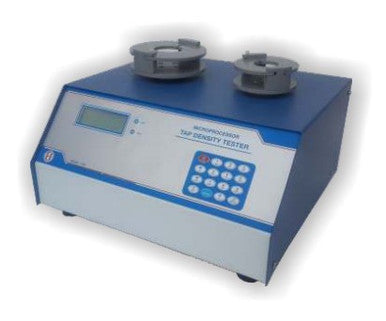

Microprocessor Tap Density Tester Model 1951
The Model 1951 Microprocessor Tap Density Tester is a high-precision instrument designed for comprehensive material characterization in pharmaceutical and chemical laboratories. Manufactured with advanced microprocessor technology, it enables reliable, standardized assessment of tapped density for powders, granules, and flakes.
This equipment is essential for formulation development, ensuring compliance with USP and IP regulatory standards. By accurately calculating parameters like the Compressibility Index and Hausner Ratio, the Model 1951 optimizes tablet and capsule filling processes, ensuring consistent dosage uniformity and manufacturing quality.
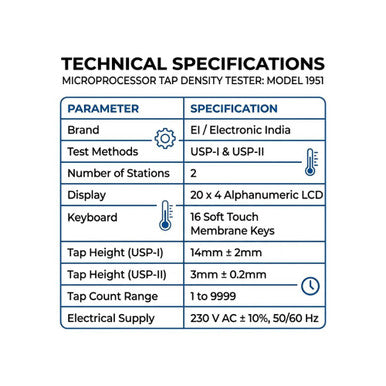
Technical Specifications
| Model | 1951 |
|---|---|
| Test Methods | USP-I & USP-II |
| Stations | 2 (Dual Station) |
| Display | 20 x 4 Alphanumeric LCD (Backlit) |
| Tap Count | 1 to 9999 |
| Tap Height | 14mm (USP-I) / 3mm (USP-II) |
| Drive Type | Direct Drive Stepper Motor |
| Dimensions | 360 x 340 x 190 mm |
Key Features & Benefits
- Regulatory Compliance: Fully supports USP/IP specifications, ensuring your laboratory meets global testing standards.
- Automated Analytics: Automatically computes Tap Density, Initial Bulk Density, Compressibility Index, and Hausner Ratio.
- Precision Mechanics: Stepper motor direct drive system ensures consistent tapping motion with minimal mass loss.
- Data Integrity: Power failure detection retains test results, while the RS232 interface allows for instant hard-copy reporting.
- Versatile Operation: Supports both USP Method I and II with adjustable snap-lock holders for 100ml and 250ml cylinders.
Frequently Asked Questions
1. What is the main use of the Model 1951 Tap Density Tester?
The Model 1951 Tap Density Tester is a critical laboratory instrument used to determine the tapped density of powdered, granulated, or flaked materials. It is indispensable in pharmaceutical quality control (QC) and R&D for assessing powder flow, compressibility, and optimizing tablet and capsule filling uniformity.
2. Does the Model 1951 comply with international pharmacopeial standards?
Yes, the Model 1951 is engineered for strict adherence to international regulatory requirements. It fully supports both USP (United States Pharmacopeia) Method I and Method II protocols, making it a reliable solution for laboratories requiring standardized, repeatable, and globally recognized material characterization results.
3. What happens to test data if a power outage occurs during operation?
The instrument is designed with robust data integrity measures. It includes power failure detection and memory retention features that automatically store the last test result. This ensures your progress is saved and the apparatus remains accurate even if unexpected electrical interruptions occur during a testing cycle.
4. How does the Model 1951 assist with material analysis calculations?
This instrument streamlines lab workflow by performing automatic calculations of essential powder flow parameters. It eliminates manual errors by calculating Tap Density, Initial (Bulk) Density, the Compressibility Index, and the Hausner Ratio directly, providing precise data output via the backlit LCD screen or connected printer.
5. Is the equipment compatible with different cylinder sizes?
Yes, the Model 1951 features dual stations with specialized snap-lock cylinder holders. These platforms are designed to securely accommodate both 100 ml and 250 ml cylinders, providing the flexibility needed to conduct various testing procedures according to your specific formulation requirements.
Product overview
Key features
Applications
Specifications
Applications
Features & benefits
Downloads
Frequently asked questions
Need help selecting a Bulk & Tap Density Apparatus?
Tell us your application and our specialists will recommend the right model.