
Posted by scispectrum on 14th Jul 2026
EC vs TDS: What Is the Difference and Which Should You Measure
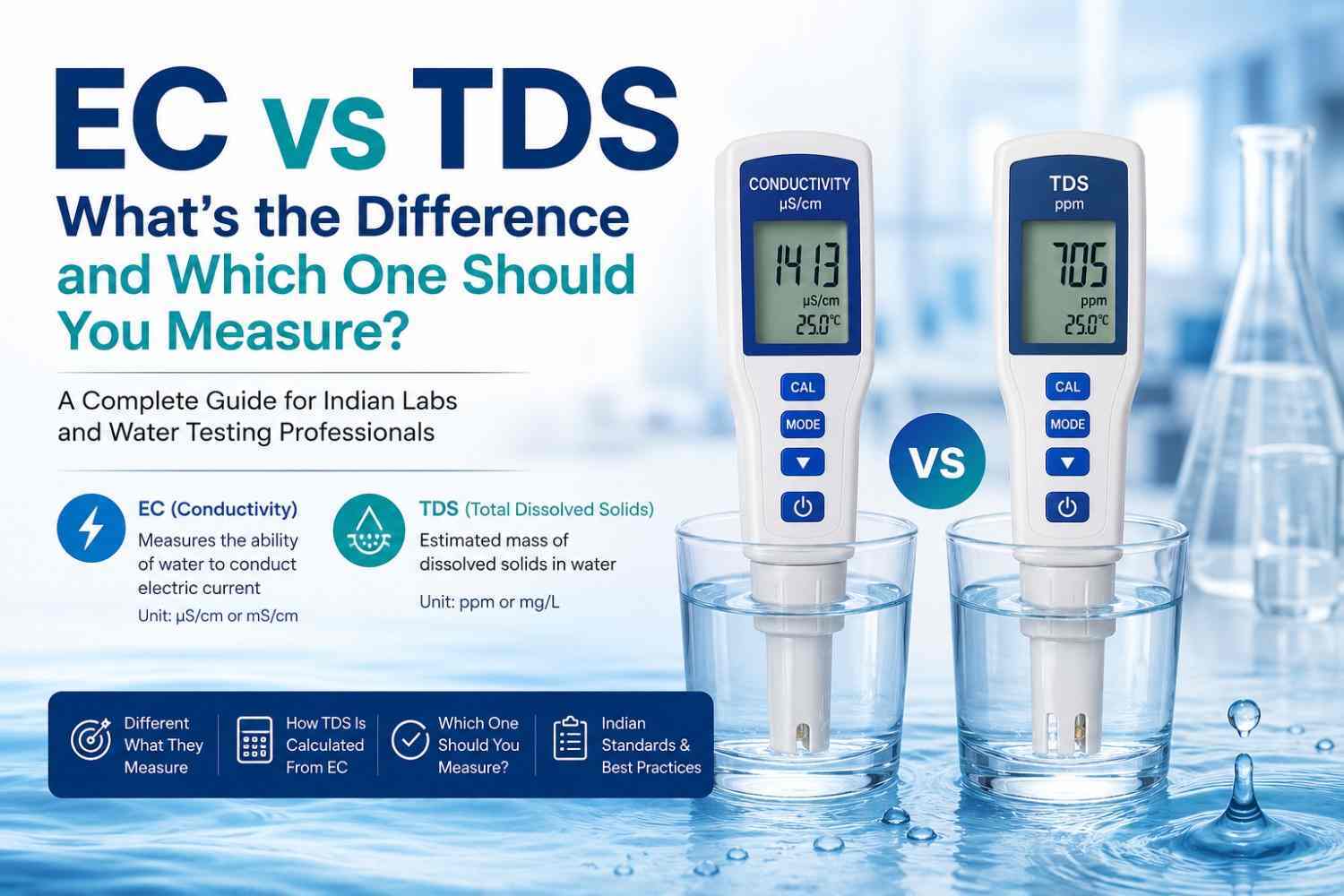
What Is Electrical Conductivity (EC)?
Pure water is a poor conductor of electricity. What makes water conduct is dissolved ions — sodium, chloride, calcium, magnesium, sulfate, bicarbonate, and so on. When you dip a conductivity probe into a sample, it applies a small alternating voltage across two electrodes and measures the resulting current. The more ions in solution, the easier current flows, and the higher the conductivity reading.
Conductivity is reported in microsiemens per centimetre (µS/cm) or millisiemens per centimetre (mS/cm), and it's temperature-dependent — most bench and portable meters apply automatic temperature compensation referenced to 25°C so readings from different days are comparable. In fifteen-plus years of running these probes across pharma, ETP, and food labs, this is the number I trust first: it's a direct physical measurement, not a derived one, and it's what most Indian standards actually specify for compliance testing.
What Is TDS (Total Dissolved Solids)?
TDS is meant to represent the total mass of dissolved inorganic and organic substances in a litre of water — everything that would remain if you evaporated the water away and weighed the residue. That evaporation-and-weighing approach (APHA Standard Methods 2540C, and in India, IS 3025 Part 16:2023) is the only method that measures TDS directly, filtering the sample through a 0.45 µm filter, evaporating at 180°C, and weighing what's left.
Almost nobody does that in the field, or even routinely on the bench, because it takes hours and lab-grade equipment. Instead, every handheld "TDS meter" and every multiparameter meter's TDS channel is doing the same thing internally: measuring EC, then multiplying by a conversion factor to display a ppm number. That's a genuinely useful shortcut — but it means the TDS figure on your meter's screen is only as good as the factor behind it.
The Core Difference: What Each One Actually Measures
The distinction that trips up most buyers: EC measures a water sample's ability to conduct electricity — it doesn't know or care what's dissolved in it, only how many charged particles are present and how mobile they are. TDS is trying to estimate a mass concentration of everything dissolved, ionic or not. Non-ionic dissolved substances — dissolved silica, some organics, non-ionic sugars — barely register on a conductivity probe, so a conductivity-derived TDS reading will systematically under-report water containing significant amounts of these. That's a real limitation labs should know about, not a defect in the instrument.
| Aspect | Electrical Conductivity (EC) | TDS |
|---|---|---|
| What it measures | Ability of water to conduct current | Estimated mass of dissolved solids |
| Unit | µS/cm or mS/cm | ppm or mg/L |
| Measurement type | Direct | Calculated (from EC) or gravimetric (lab reference) |
| Sensitive to non-ionic solids? | No | Only if measured gravimetrically |
| Typical Indian standard | IS 3025 (Part 14):2013 | IS 3025 (Part 16):2023 / BIS IS 10500:2012 limit |
How TDS Is Calculated From EC — and Why the Factor Matters
Most instruments use the relationship TDS (ppm) = EC (µS/cm) × k, where k is a conversion factor that depends on which ions dominate your water and how the meter was calibrated. There is no single universal k — that's the part most datasheets gloss over.
| Water type / dominant ions | Typical factor (k) |
|---|---|
| NaCl-dominant (seawater, brackish, RO reject) | ~0.47–0.50 |
| General natural/municipal water (unknown composition) | ~0.64 |
| Hard water, high Ca²⁺/Mg²⁺ (borewell, cooling tower makeup) | ~0.65–0.70 |
EC or TDS: Which Should You Actually Measure?
In practice, the choice is dictated by what you're testing against, not personal preference.
| Application | Prioritise | Why |
|---|---|---|
| Drinking water screening (BIS IS 10500) | TDS | The standard itself specifies an acceptable limit of 500 mg/L and permissible limit of 2000 mg/L for TDS |
| Pharmaceutical purified water / WFI | EC (conductivity) | USP/IP conductivity-based stage testing is the pharmacopoeial method — no TDS conversion involved |
| ETP / industrial effluent monitoring | EC, cross-checked with TDS for reporting | Process control needs the direct, real-time EC signal; compliance paperwork often asks for TDS |
| Hydroponics, aquaculture, irrigation water | EC | Nutrient/salinity management is conductivity-based by convention in these fields |
| Boiler and cooling tower makeup/blowdown | EC | Fast, continuous, and directly tied to scaling/corrosion risk thresholds |
Standards Indian Labs Should Know
For general water and wastewater testing, two IS 3025 parts govern the two measurements separately: IS 3025 (Part 14):2013 covers specific conductance (the conductivity method), and IS 3025 (Part 16):2023 covers filterable residue — TDS by the 180°C gravimetric method, with a conductivity-based calculation option built in. Drinking water is judged against BIS IS 10500:2012, which sets TDS at an acceptable limit of 500 mg/L and a permissible limit of 2000 mg/L in the absence of an alternate source — the acceptable figure is the one to design toward, not the permissible ceiling.
Pharmaceutical water systems work differently: USP <645> and the equivalent IP monographs specify a staged, temperature-referenced conductivity test for purified water and water for injection, with no TDS conversion in the picture at all. If your lab serves both a municipal/industrial client and a pharma QC client, expect to report EC to one and TDS to the other from the same instrument family — our Conductivity Meter guide covers cell types and calibration in more depth.
Instruments: Conductivity Meters vs TDS Meters
Nearly every conductivity meter sold today — from a ₹1,500 handheld pen to a ₹1 lakh-plus benchtop NABL-traceable unit — also displays TDS, because the sensor and the math are shared. The real differences between instruments are cell constant accuracy, temperature compensation quality, calibration traceability, and whether the conversion factor is fixed or user-adjustable. For labs juggling multiple parameters, a multiparameter meter that reports pH, EC, TDS, and DO from one probe set is often more practical than separate single-parameter units. Browse our conductivity meters and TDS meters ranges to compare cell types, ranges, and calibration options side by side.
Frequently Asked Questions
Is TDS the same as conductivity?
No. Conductivity (EC) is a direct physical measurement of how well water conducts electricity. TDS is almost always a calculated estimate — your meter measures EC and multiplies it by a conversion factor to display a TDS number in ppm or mg/L. The only way to get a true, independent TDS value is the gravimetric method (evaporate and weigh the residue).
What conversion factor should I use to convert EC to TDS?
It depends on your water's ion composition. Roughly 0.5 for seawater/brackish (NaCl-dominant) water, 0.64 as a general natural-water estimate, and up to 0.7 for hard water rich in calcium and magnesium. Most consumer TDS pens use a fixed factor around 0.5, which is why two meters can disagree on the same sample.
Which is more important — EC or TDS?
Neither is universally "more important" — it depends on what you're deciding. Use EC when you need a fast, repeatable, standards-based reading (pharma purified water, ETP process control). Use TDS when you need a number that maps to a familiar limit, like BIS IS 10500 drinking water standards.
Can a TDS meter and a conductivity meter give different readings on the same water?
Yes, and this is expected. If both are converting from EC, differences usually come from different conversion factors, temperature compensation settings, or cell constants. Always compare the underlying EC/µS reading, not just the derived TDS number, when troubleshooting a discrepancy between two instruments.
Does high TDS always mean the water is unsafe?
Not necessarily. TDS is a bulk indicator, not a safety test — it doesn't identify which dissolved substances are present. Water can have low TDS and still carry harmful trace contaminants (like heavy metals or pathogens) that don't register significantly on conductivity. TDS is best used as a screening and process-control tool alongside, not instead of, targeted testing.
What standard should Indian labs follow for conductivity and TDS testing?
For general water and wastewater, IS 3025 (Part 14):2013 covers specific conductance and IS 3025 (Part 16):2023 covers filterable residue (TDS) by the 180°C gravimetric method. Drinking water acceptability is judged against BIS IS 10500:2012 limits. Pharmaceutical water systems instead follow USP <645> / IP conductivity-based stage testing rather than a fixed TDS number.
Conclusion
EC and TDS aren't competing measurements — they're the same underlying signal read two different ways. Know which one your standard actually asks for, know what conversion factor sits behind your meter's TDS display, and you'll stop chasing "why don't our numbers match" discrepancies between instruments, labs, and vendors.
Not sure whether your lab needs a dedicated conductivity meter, a TDS meter, or a multiparameter unit that does both? Tell us your application and we'll recommend the right instrument and cell constant.
Request a Quote