Colorimeter: Principle, Components, and Laboratory Applications
Scispectrum Lab Essentials
Colorimeter: Principle, Components, and Laboratory Applications
Accurate chemical analysis is essential in laboratories across industries such as environmental testing, pharmaceuticals, food production, and research. One of the commonly used instruments for analyzing the concentration of substances in a solution is the colorimeter. Colorimeters are widely used because they are simple to operate, cost-effective, and capable of providing reliable results.
Colorimeter: A laboratory instrument used to measure the concentration of colored compounds in a solution by analyzing the intensity of light absorbed by the sample. Different substances absorb light at specific wavelengths — the amount of light absorbed is directly related to the concentration of the substance in the solution.
Working Principle of a Colorimeter
A colorimeter works based on the absorption of light by colored solutions. When a beam of light passes through a sample solution, certain wavelengths of light are absorbed depending on the chemical composition of the sample. The instrument measures the amount of light that passes through the sample and compares it with the intensity of the original light source.
- A light source emits white light.
- A filter selects a specific wavelength suitable for the test.
- The light passes through the sample solution in a cuvette.
- The detector measures the transmitted light.
- The instrument calculates the absorbance or concentration of the substance.
The amount of light absorbed by the sample increases as the concentration of the colored compound increases, allowing accurate measurement of chemical concentrations.

Main Components of a Colorimeter
Light Source: provides the initial beam of light — most colorimeters use LED or tungsten lamps. Filters: select a specific wavelength of light suitable for the analysis; different filters allow measurement of different substances. Sample Holder (Cuvette): holds the liquid sample, usually made of glass or plastic. Detector: measures the amount of light transmitted through the sample and converts it into an electrical signal. Display System: shows the final measurement result, typically in absorbance, transmittance, or concentration units.
Types of Colorimeters
Digital Colorimeters: provide accurate readings with digital displays, widely used in modern laboratories. Portable Colorimeters: compact and lightweight, suitable for field testing and environmental monitoring. Visual Colorimeters: rely on manual comparison of color intensity with standard color charts — less precise but useful for basic testing.
Applications of Colorimeters in Laboratories
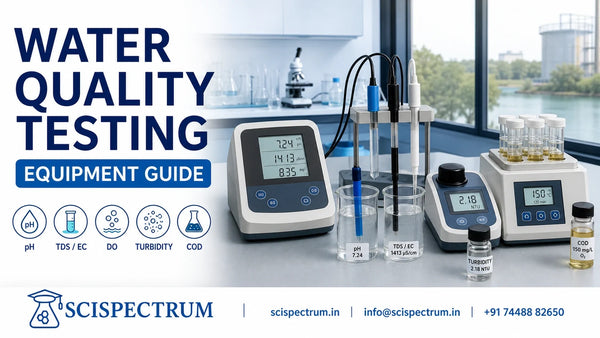
Water Quality Testing: measuring chlorine, nitrates, phosphates, and other contaminants. Food and Beverage Analysis: evaluating food color, quality, and chemical composition. Clinical Laboratories: analyzing blood samples, hemoglobin levels, and biochemical reactions. Environmental Monitoring: detecting pollutants and chemical substances in environmental samples. Chemical Laboratories: chemical analysis and reaction monitoring in research and quality control.
Difference Between Colorimeter and Spectrophotometer
| Feature | Colorimeter | Spectrophotometer |
|---|---|---|
| Wavelength Range | Uses fixed filters | Uses a wide range of wavelengths |
| Accuracy | Moderate accuracy | Very high accuracy |
| Applications | Basic chemical analysis | Advanced analytical research |
| Cost | Lower cost | More expensive |
Colorimeters are generally used for routine laboratory testing, while spectrophotometers are used for detailed analytical research.
Tips for Accurate Colorimetric Analysis
Always calibrate the instrument before use, use clean and scratch-free cuvettes, ensure the sample solution is free from bubbles or particles, select the correct wavelength filter for the test, and handle samples carefully to avoid contamination.
Colorimeters at Scispectrum
We supply digital photo colorimeters suitable for water testing, clinical diagnostics, and quality control applications.
Frequently Asked Questions
Conclusion
Colorimeters are essential instruments used in laboratories to measure the concentration of substances based on color intensity. Their simple design, fast analysis, and cost-effective operation make them ideal for routine laboratory testing, from water quality monitoring to clinical diagnostics and food analysis.
Browse Colorimeters Get a Quote on WhatsApp