What Is a Digital pH Meter? A Beginner-Friendly Guide (2025)
Scispectrum Lab Essentials
What Is a Digital pH Meter? A Beginner-Friendly Guide
From safe drinking water and aquariums to gardening, food safety, cosmetics, and laboratory research, measuring pH (acidity/alkalinity) is essential. A digital pH meter makes this easy by showing an accurate number on a screen — no guesswork from color strips.
Digital pH Meter: An electronic instrument that measures how acidic or alkaline a solution is on the pH scale (0 to 14). 0–6.9 is acidic (vinegar, lemon juice), 7.0 is neutral (pure water), and 7.1–14 is alkaline (baking soda solution). The meter uses a probe (electrode) to detect hydrogen ion activity and converts it into a pH value displayed on screen, usually within seconds.
Why digital wins over paper strips: higher accuracy (as fine as 0.01 or even 0.001 pH), faster and repeatable readings, and extra features like ATC (Automatic Temperature Compensation), memory, and PC connectivity.
How Does a Digital pH Meter Work?
Inside the probe is a special glass membrane that senses hydrogen ions (H+). When dipped in a sample, hydrogen ions create a tiny voltage at the glass surface. The meter's electronics translate that voltage into a pH number. With ATC, the meter auto-corrects for temperature, since pH readings shift with heat/cold. The final pH appears on the screen, typically in 2–10 seconds. Key components: glass pH electrode (often refillable or sealed), reference electrode (stable baseline), temperature sensor (for ATC), and a meter/display (handheld or benchtop).

Where Are Digital pH Meters Used?
Water quality: drinking water, RO units, pools, aquariums, hydroponics. Gardening and soil: soil slurries, nutrient solutions. Food and beverage: brewing, dairy, fermentation. Cosmetics and personal care: lotions, shampoos, skincare formulations. Laboratories and industry: research, pharmaceuticals, chemical processing. Education: classrooms and training labs.
Types of Digital pH Meters (With Use-Case Fit)
Portable meters (field-ready)
Battery-powered, great for quick checks in aquariums, farms, and pools. Look for models with memory and RS-232 output if you need to log field data.
Pen-type testers (pocket-size)
Compact and beginner-friendly, ideal for home users and students. Spear-tip variants handle semi-solid samples like gels and food slurries.
Benchtop meters (lab-grade)
High precision with stable stands, data logging, and multi-point calibration. Some include a built-in magnetic stirrer and USB connectivity for research or QA/QC use.
Key Features To Look For
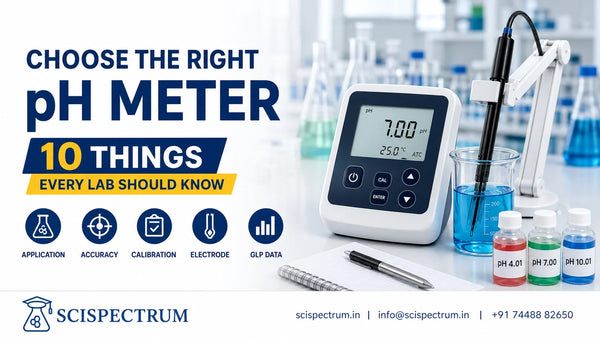
Accuracy and resolution: entry-level is ±0.1 pH, general lab/serious hobby is ±0.01 pH, and high-precision research needs 0.001 pH. ATC: essential when samples are not at room temperature. Calibration: 2–6 points; more points improve accuracy across the pH range. Memory and data output: RS-232/USB for logging and audit trails. Probe type and replaceability: general-purpose vs spear/flat tips; replaceable electrodes reduce long-term cost. Build and ergonomics: portable for fieldwork, benchtop with arm/stand for lab stability. Range: typical is -2 to 16 or 0 to 14 pH.
How To Use a Digital pH Meter
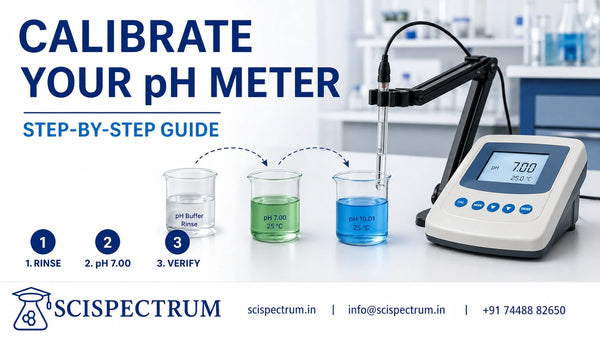
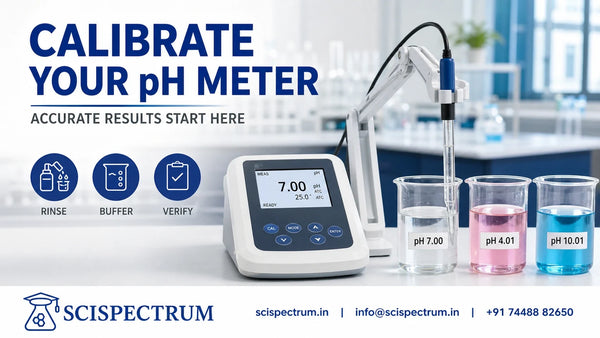
- Calibrate the meter with fresh buffers (pH 7.0, 4.0, and/or 10.0).
- Rinse the probe with distilled water; gently blot dry (no rubbing).
- Immerse the probe in your sample; stir gently or use a magnetic stirrer (benchtop).
- Wait for the reading to stabilize; note the temperature if shown.
- Rinse and store the probe correctly after use.
Pro tips: for soil, mix 1 part soil with 2 parts distilled water, let settle, and measure the liquid phase. For carbonated samples, degas first by stirring gently to release CO₂.
Maintenance: Keep Your Meter Accurate
Always store the pH electrode in storage solution (usually KCl) — never store dry. Rinse with distilled water after measurements. Calibrate monthly or before critical tests. Replace electrodes every 12–24 months or when readings drift/slow down. Keep buffer solutions capped, clean, and within expiry. For sticky/greasy samples, clean the bulb with a suitable electrode cleaner.
pH Meters at Scispectrum
We supply portable, pen-type, and benchtop pH meters, along with electrodes and online monitoring systems, for every use case from home checks to pharmaceutical QC.
Frequently Asked Questions
Conclusion
Beginners and home users should start with a pen-type or simple portable meter. Field users and professionals who log data should pick models with memory and RS-232 output. Laboratories and QA/QC need high precision and connectivity. With the right meter, proper calibration, and good storage habits, digital pH measurement becomes simple, reliable, and cost-effective.
Browse pH Meters Get a Quote on WhatsApp