Digital Thermometer: Types, Working Principle, and Industrial Applications
Scispectrum Lab Essentials
Digital Thermometer: Types, Working Principle, and Industrial Applications
Temperature measurement is a critical parameter in many fields, including laboratories, healthcare, food processing, HVAC systems, and industrial manufacturing. Accurate temperature control ensures product quality, safety, and reliable results in testing and production processes.
Digital Thermometer: An electronic device used to measure temperature and display the reading in a digital format, usually on an LCD or LED screen. Unlike traditional thermometers that rely on liquid expansion, digital thermometers use electronic sensors to detect temperature changes, making them faster, safer, and more accurate.
Working Principle of a Digital Thermometer
The working principle of a digital thermometer is based on temperature-sensitive electronic components that convert temperature into electrical signals.
- A temperature sensor detects the temperature of the object or environment. Common sensors include thermistors (resistance changes with temperature), RTDs (Resistance Temperature Detectors), and infrared sensors (for non-contact measurement).
- The sensor converts temperature changes into electrical signals.
- These signals are processed by an internal microprocessor.
- The processed data is displayed as a digital reading on the screen.
This electronic process allows digital thermometers to provide fast, accurate, and reliable measurements.
Types of Digital Thermometers
Probe Thermometers
Probe thermometers use a metal probe to measure the temperature of liquids, semi-solids, or gases. They are commonly used in laboratories and food industries.
Infrared Thermometers
Infrared thermometers measure temperature without direct contact by detecting infrared radiation emitted by objects. They are ideal for high-temperature or hazardous environments.
Laboratory Thermometers
These are high-precision thermometers used in scientific research and laboratory experiments, providing accurate readings for critical measurements.
Industrial Thermometers
Industrial digital thermometers are designed for heavy-duty applications in manufacturing plants, chemical industries, and HVAC systems. They are robust and capable of handling extreme conditions.

Applications of Digital Thermometers
Laboratory Applications
In laboratories, digital thermometers are used to monitor chemical reactions, sample storage, and experimental conditions.
Healthcare and Medical Use
Digital thermometers are widely used in healthcare for measuring body temperature quickly and safely, replacing traditional mercury thermometers.
Food Industry
In the food industry, temperature control is essential for food safety and quality. Digital thermometers help monitor cooking, storage, and processing temperatures.
HVAC Systems
Heating, ventilation, and air conditioning systems rely on digital thermometers to maintain optimal temperature conditions for comfort and efficiency.
Industrial Manufacturing
Industries use digital thermometers to monitor machinery, production processes, and environmental conditions, ensuring consistent product quality.
Advantages of Digital Thermometers
- Fast and accurate readings
- Easy-to-read digital display
- No mercury (safe and environmentally friendly)
- Portable and user-friendly design
- Wide range of applications
Tips for Accurate Temperature Measurement
Proper Sensor Placement
Ensure the sensor or probe is placed correctly for accurate readings.
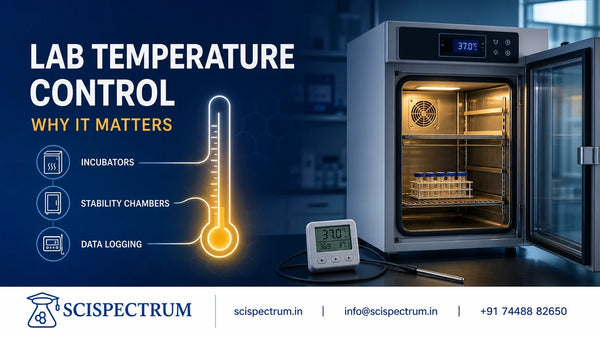
Regular Calibration
Calibrate the thermometer periodically to maintain accuracy.
Avoid Environmental Interference
Keep the thermometer away from direct sunlight, airflow, or heat sources that may affect readings.
Thermometers at Scispectrum
We supply digital thermometers across probe, infrared, laboratory, and industrial types, sourced from established brands with GST invoicing.
Frequently Asked Questions
Conclusion
Digital thermometers have become an essential tool for accurate and efficient temperature measurement across various industries. By using advanced sensors and electronic processing, they provide fast, reliable, and easy-to-read results — from laboratories and healthcare to food processing and industrial manufacturing.
Browse Thermometers Get a Quote on WhatsApp