Gloss Meter: Working Principle and Applications in Surface Measurement
Scispectrum Lab Essentials
Gloss Meter: Working Principle and Applications in Surface Measurement
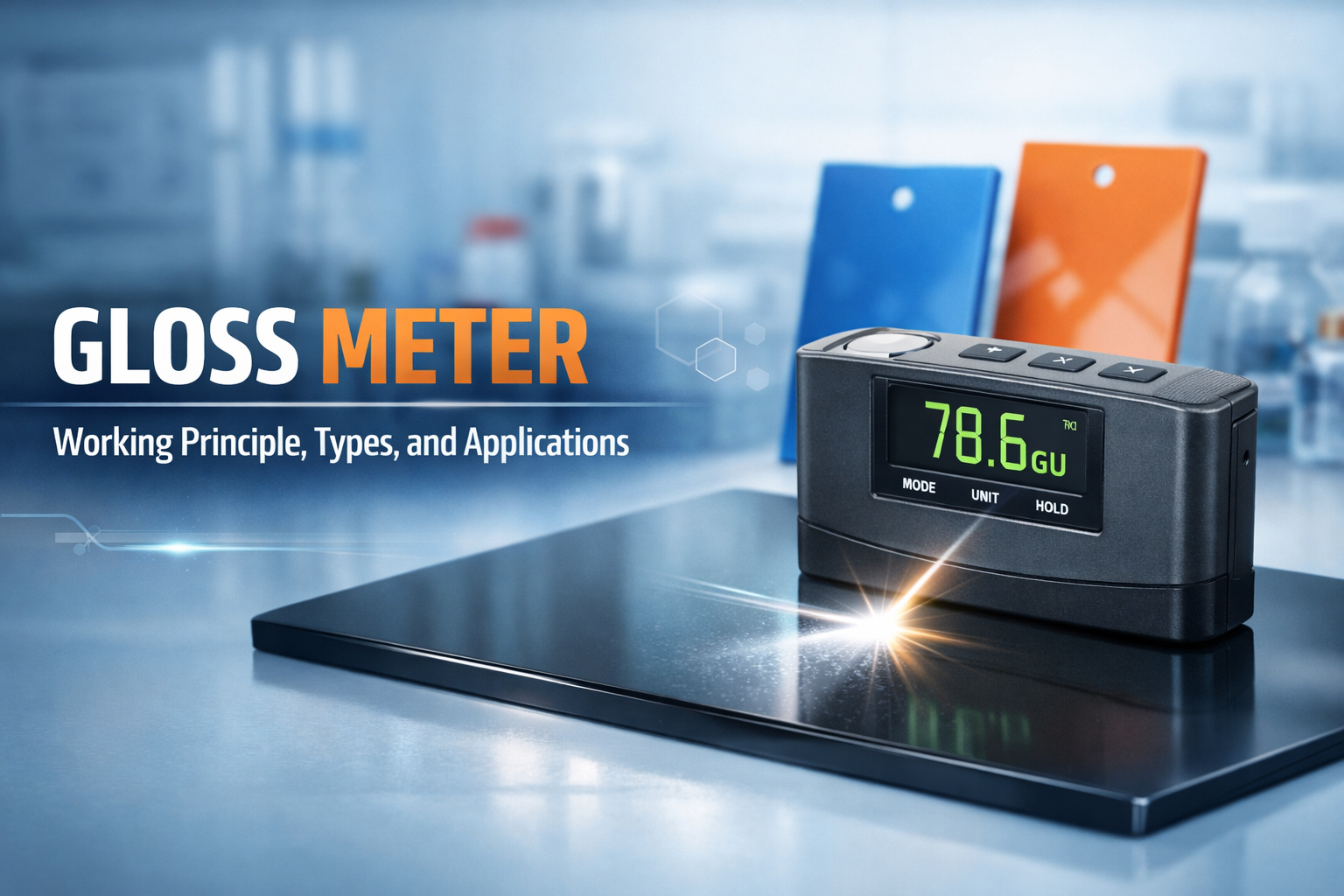
Surface appearance plays a crucial role in determining the quality and appeal of products across various industries. Whether it is a freshly painted car, a polished plastic component, or a coated industrial surface, the level of gloss significantly impacts both aesthetics and performance. Consistent surface finish is especially important in industries such as paints and coatings, automotive manufacturing, plastics, and printing.
Gloss Meter: An instrument used to measure the reflectivity or shine of a surface. It quantifies how much light is reflected from a surface at a specific angle, displaying readings in Gloss Units (GU) — a standardized way to compare surface finishes across different materials.
Working Principle of a Gloss Meter
The working principle of a gloss meter is based on the measurement of reflected light from a surface.
- A light source inside the gloss meter directs a beam of light onto the test surface at a fixed angle.
- The surface reflects a portion of the light depending on its smoothness and finish.
- A detector positioned at a specific angle measures the intensity of the reflected light.
- The instrument converts this reflected light into a numerical value expressed in Gloss Units (GU).
Smooth and highly polished surfaces reflect more light in a specific direction, resulting in higher gloss readings, while rough or matte surfaces scatter light, leading to lower gloss values.
Types of Gloss Meters
20° Gloss Meter
Used for measuring high-gloss surfaces such as polished metals and automotive finishes. Provides accurate readings for highly reflective materials.
60° Gloss Meter
The most commonly used type and considered the standard measurement angle. Suitable for a wide range of surfaces, including paints, coatings, and plastics.
85° Gloss Meter
Designed for low-gloss or matte surfaces — helps measure surfaces that scatter light and have minimal reflectivity.
Single-Angle vs Multi-Angle Gloss Meters
Single-angle gloss meters measure gloss at one fixed angle and are suitable for specific applications. Multi-angle gloss meters can measure gloss at multiple angles, making them more versatile for different surface types.

Applications in Surface Measurement
Paint and Coating Industry
Gloss meters help ensure that coatings have the desired finish and uniformity, used for quality control during production and after application.
Automotive Industry
Automotive manufacturers use gloss meters to measure the shine and consistency of vehicle paint surfaces, ensuring cars have a uniform and high-quality appearance.
Plastic and Polymer Industry
Gloss meters are used to evaluate the surface quality of plastic products and molded components, ensuring consistency in appearance and finish.
Printing and Paper Industry
Gloss measurement helps assess the quality of printed materials and paper coatings, ensuring that products meet visual and commercial standards.
Quality Control Laboratories
Laboratories use gloss meters for testing and research purposes, helping maintain product standards and improve manufacturing processes.
Advantages of Using a Gloss Meter
- Accurate and reliable gloss measurements
- Non-destructive testing method
- Quick and easy operation
- Portable and convenient for on-site use
- Ensures product consistency and quality
Tips for Accurate Gloss Measurement
- Ensure the surface is clean and free from dust or contaminants
- Select the appropriate measurement angle based on the surface type
- Calibrate the instrument regularly for accuracy
- Avoid measuring under strong external light interference
- Take multiple readings to ensure consistency
Gloss Meters at Scispectrum
We supply single-angle and multi-angle gloss meters for paint, coating, plastic, and printing quality control applications.
Frequently Asked Questions
Conclusion
A gloss meter is an essential instrument for measuring the reflectivity and surface finish of materials. By providing accurate and consistent gloss readings, it helps industries maintain product quality and meet visual standards across paints, coatings, automotive, plastics, and printing.
Browse Gloss Meters Get a Quote on WhatsApp