pH Meter Selection Guide for 2026: Common Buying Mistakes Labs Still Make
Scispectrum Lab Essentials
pH Meter Selection Guide for 2026: Common Buying Mistakes Labs Still Make
pH measurement is arguably the most common yet most misunderstood task in the modern laboratory. Whether it is ensuring food safety, maintaining drug stability, or verifying water quality, the margin for error has narrowed in 2026. Regulatory bodies now demand higher digital traceability and tighter accuracy. This guide will help you navigate the technical landscape of pH meter selection and avoid the costly procurement traps that many labs still fall into.
Why Choosing the Right pH Meter Matters in 2026
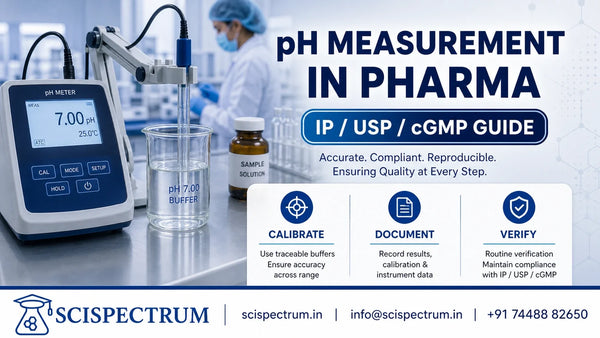
In 2026, a pH meter is no longer just a voltmeter for ions — it is a critical data-node in your lab's digital ecosystem. Audit readiness: modern NABL and FDA audits focus heavily on data integrity; if your meter doesn't log the date, time, and calibration slope of every reading, you are at risk. Data accuracy and traceability: your meter must provide repeatable results that can be digitally traced back to NIST buffers. The cost of error: incorrect pH measurement leads to failed batches, expensive re-testing, and potential product recalls.
Types of pH Meters Used in Laboratories
Bench Top pH Meters
The workhorses of the analytical lab. Designed for stationary use, they offer the highest level of accuracy and resolution. Best for: QC labs, pharmaceutical testing, and R&D.
Portable / Handheld pH Meters
Portable meters have closed the gap with benchtop models in terms of durability — water-resistant and designed for on-the-go testing. Best for: environmental monitoring, wastewater sampling, and large-scale manufacturing floors.
Pen-Type pH Meters
Compact, pocket-sized devices. While convenient, they often have non-replaceable electrodes and lower resolution. Best for: quick screening, hydroponics, and non-critical education labs.
Bench Top vs Portable pH Meter — Which Should You Choose?
| Feature | Bench Top pH Meter | Portable pH Meter |
|---|---|---|
| Accuracy | Highest (up to ±0.001 pH) | High (up to ±0.01 pH) |
| Calibration | Up to 5+ points | 1 to 3 points typically |
| Power Source | AC Adapter (Continuous) | Battery / Rechargeable |
| Data Output | USB, RS232, Bluetooth, LIMS | USB or Bluetooth |
| Durability | Delicate; best for controlled environments | Rugged; often IP67 waterproof |
| Primary Use | Compliance & Research | Fieldwork & Spot Checks |
Key Specifications to Check Before Buying a pH Meter
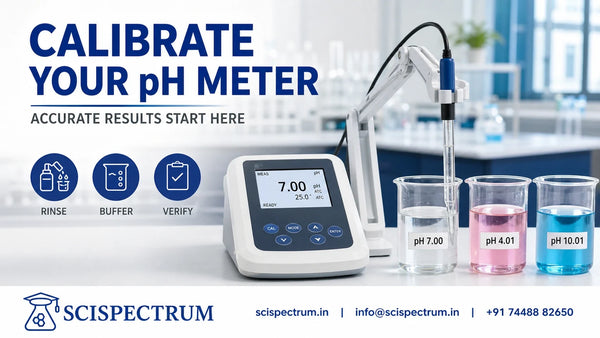
Resolution & accuracy: for FSSAI or pharma labs, look for 0.01 or 0.001 resolution — 0.1 is rarely sufficient for regulated testing. ATC: a meter without automatic temperature compensation is a liability in 2026. Calibration points: look for meters that allow at least 3-point calibration (4.0, 7.0, 10.0). Electrode connection: ensure a standard BNC connector so you can swap electrodes from different brands. Memory & data export: your meter should store at least 500-1,000 data points with GLP timestamps.
Common pH Meter Buying Mistakes Labs Still Make
Prioritizing price over compliance: a budget meter for a regulated lab usually results in audit failure due to a lack of data logging. Ignoring the matrix: using a standard aqueous electrode for viscous fats or dairy leads to slow response times and early sensor failure. Skipping the temperature probe: relying on manual temperature entry is a recipe for human error. Neglecting consumable costs: a meter is a one-time cost, but calibration buffers and storage solutions are ongoing.
pH Meter Electrodes — The Most Ignored Factor
The meter is only as good as the sensor attached to it. Glass vs plastic body: glass is easier to clean and handles high temperatures better; plastic (epoxy) is more durable for field use. Specialized junctions: dairy/food needs an open, clog-resistant junction; wastewater needs a double-junction electrode to prevent heavy metals from poisoning the reference cell; low ionic water needs a specialized electrode to prevent drifting.

How to Extend the Life of Your pH Meter
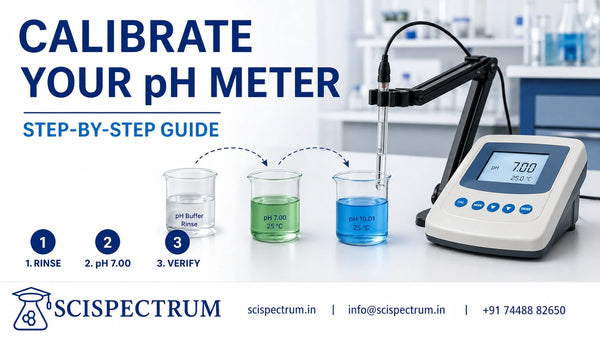
A well-maintained pH electrode should last 12–18 months. Never store in deionized water — use a dedicated pH storage solution (KCl). Clean after every use for food labs, using mild detergent or a specialized cleaning solution. Calibrate daily at the start of every shift. Hydrate a dried-out electrode by soaking it in storage solution for at least 4 hours before calibrating.
pH Meters at Scispectrum
We supply benchtop, portable, and pen-type pH meters with matched electrode options across sample matrices.
Frequently Asked Questions
Conclusion
Selecting a pH meter in 2026 is about balancing technical precision with regulatory compliance. Whether you need a robust benchtop pH meter for high-volume QC or a portable digital pH meter for field audits, the most important factor is matching the electrode to your specific sample matrix.
Browse pH Meters Get a Quote on WhatsApp