Spectrophotometer: Principle, Types, Uses & Price in India
Scispectrum Lab Essentials
Spectrophotometer: Working Principle, Types, Uses & Price in India
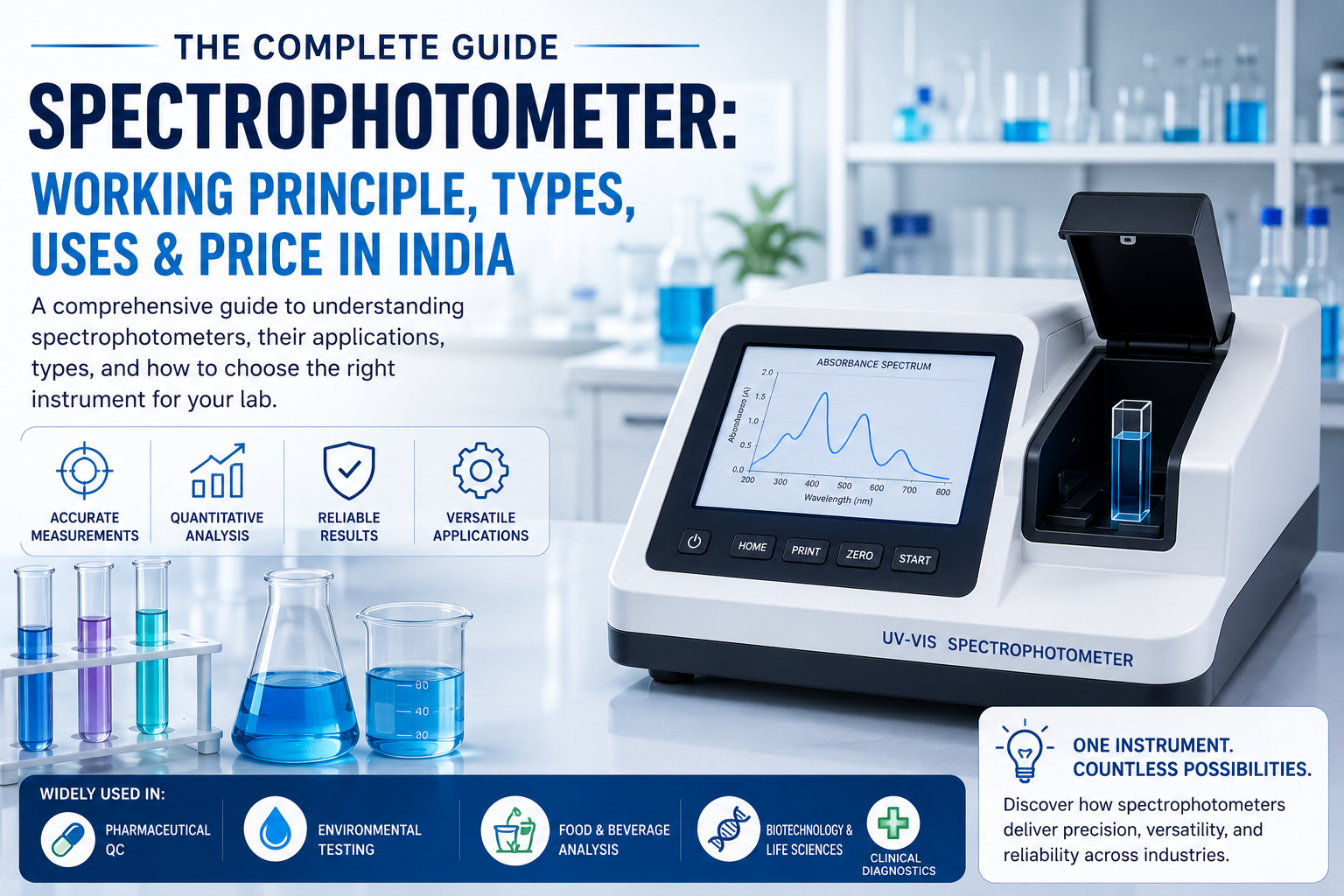
A pharma QC analyst once described her first week working with a UV spectrophotometer as "the moment I understood why chemistry is beautiful." She was quantifying an API using its UV absorbance spectrum — a method specified in the Indian Pharmacopoeia — and realised the instrument was essentially reading molecular identity. Every compound absorbs light differently, at different wavelengths, in a pattern as unique as a fingerprint.
That is precisely what makes the spectrophotometer one of the most fundamental instruments in analytical science. From assaying pharmaceutical active ingredients to measuring water turbidity and food colour, no other instrument matches its combination of versatility, precision, and speed for quantitative analysis.
Spectrophotometer: An analytical instrument that measures the intensity of light absorbed or transmitted by a substance at a specific wavelength, used to determine the concentration of that substance in solution. It operates on the Beer-Lambert Law. Spectrophotometers measure across wavelength ranges from ultraviolet (190 nm) through visible (400–700 nm) to near-infrared (1100 nm), depending on the instrument type.
What distinguishes a spectrophotometer from a simpler light-measuring device is the monochromator — the component that isolates a narrow, precise wavelength from the broad spectrum of the light source.
Working Principle: Beer-Lambert Law Explained
A = ε × c × l
Where: A = Absorbance (dimensionless) | ε = Molar absorptivity (L mol⁻¹ cm⁻¹) | c = Concentration of the analyte (mol/L) | l = Path length through the sample (cm, usually 1 cm cuvette)
Absorbance is also expressed as: A = log₁₀ (I₀ / I), where I₀ is the intensity of incident light and I is the intensity of transmitted light.
In practical terms: double the concentration of your analyte and you double the absorbance. This linear relationship is what makes spectrophotometry such a reliable quantitative method.
How the measurement works — step by step
- Light source — a tungsten halogen lamp (visible range, 340–900 nm) or deuterium lamp (UV range, 190–400 nm) emits broad-spectrum light.
- Monochromator — a diffraction grating or prism disperses the light and an exit slit selects a narrow wavelength band.
- Sample compartment — the selected wavelength passes through the sample, held in a cuvette (usually 1 cm path length).
- Detector — a photodiode or photomultiplier tube measures the intensity of the transmitted light.
- Signal processor — the instrument calculates absorbance (A) or transmittance (T%) and displays the result.
Key Components of a Spectrophotometer
| Component | Function | What Quality Looks Like |
|---|---|---|
| Light source | Produces the incident light beam | Tungsten-halogen for visible; deuterium + tungsten for UV-Vis |
| Monochromator | Isolates a narrow wavelength band | Diffraction grating preferred; bandwidth ≤2 nm for UV work |
| Sample compartment | Holds the cuvette during measurement | Thermostated cell holder; accepts 10 mm standard cuvettes |
| Cuvette | Contains the sample or blank | Glass for visible range; quartz for UV |
| Detector | Measures transmitted light intensity | Silicon photodiode; PMT for high sensitivity UV work |
Types of Spectrophotometers
1. Visible Spectrophotometer (340–960 nm)
Operates only in the visible light range. Suitable for BOD analysis, COD, water quality parameters, food colour measurement, and clinical chemistry tests.
2. UV-Vis Spectrophotometer (190–1100 nm)
Extends into the ultraviolet by adding a deuterium lamp and quartz optics. Standard for pharmaceutical API assay and identification per IP and USP monographs, DNA/protein quantification.
3. Double Beam Spectrophotometer
A beam splitter divides light into two paths — sample and reference — measured simultaneously, eliminating lamp drift errors. Preferred for research, scanning spectra, and pharmaceutical method development.
4. Fluorescence Spectrophotometer
Measures fluorescence emission rather than absorption — 100–1,000 times more sensitive than absorbance. Used for trace-level impurity analysis, vitamin analysis, and PAH detection.
5. Colorimeter
Uses fixed glass filters instead of a monochromator. Purpose-built for routine quantitative tests — water quality, food QC, soil testing. Cannot generate absorption spectra.
| Type | Wavelength Range | Best For |
|---|---|---|
| Colorimeter | Visible (fixed filters) | Routine water QC, BOD, food testing |
| Visible Spectrophotometer | 340–960 nm | Environmental, food, clinical labs |
| UV-Vis Single Beam | 190–1100 nm | Pharma assay, DNA/protein, research |
| UV-Vis Double Beam | 190–1100 nm | Research, pharma method development |
| Fluorescence | 200–900 nm (Ex/Em) | Trace analysis, pharma, biotech research |
Single Beam vs Double Beam: Which Do You Need
Choose a single beam instrument when:
- You are doing routine quantitative analysis at a fixed wavelength
- Measurement sessions are short
- Your application does not require scanning full absorption spectra
- Budget is the primary constraint
Choose a double beam instrument when:
- You need to scan full absorption spectra (200–900 nm)
- Long measurement sessions with many samples
- Higher photometric accuracy is required
- Method development or research work
- The lab will be preparing for NABL accreditation, WHO-GMP, or USFDA audit

Spectrophotometer vs Colorimeter: Key Differences
| Feature | Spectrophotometer | Colorimeter |
|---|---|---|
| Wavelength selection | Monochromator — any wavelength | Fixed glass filters |
| Spectral scanning | Yes — full spectrum | No |
| Accuracy | Higher (±0.001–0.005 A) | Lower (±0.01–0.02 A) |
| IP/USP suitability | Yes | No |
Applications: Where Spectrophotometers Are Used in India
Pharmaceutical QC and R&D
IP and USP specify UV spectrophotometry for assay and identification of hundreds of monographed substances. UV-Vis double beam instruments are standard for method development.
Environmental and Water Testing
CPCB and NABL-accredited labs use visible spectrophotometers for BOD, COD, phosphate, nitrate, nitrite, ammonia, and heavy metals after colour-forming digestion.
Food and Beverage Quality Control
FSSAI-registered labs use spectrophotometers for colour measurement, Brix and sugar content, vitamin C content, and adulteration screening.
Biochemistry and Life Sciences Research
UV absorbance at 260 nm is standard for DNA/RNA quantification. Protein quantification via Bradford, BCA, or Lowry assays requires a spectrophotometer at 595 nm or 562 nm.
Clinical and Diagnostic Laboratories
Clinical chemistry analysers measure haemoglobin, bilirubin, glucose, creatinine, and liver enzymes via colourimetric reactions.
Buying Guide: What to Evaluate Before You Purchase
Verify wavelength range (UV-Vis should reach at least 200 nm), spectral bandwidth (2 nm standard for pharmacopoeial scanning), photometric range and accuracy (0–3 A, ±0.002–0.005 A for routine QC), data output (RS-232/USB for GLP documentation), and cuvette compatibility (10 mm standard, glass and quartz).
Spectrophotometers at Scispectrum
We stock spectrophotometers and colorimeters from Electronics India (EI-DVI) and SKY, sourced through authorised distributors with GST invoicing.
Frequently Asked Questions
Conclusion
Choosing the right spectrophotometer comes down to three questions: what wavelength range do you need, how many samples do you run, and what level of documentation your compliance requirement demands. Get the match right, and the spectrophotometer will serve your lab reliably for a decade.
Browse Spectrophotometers Get a Quote on WhatsApp