84, 1413 or 12,880 µS/cm: How to Choose a Conductivity Calibration Standard
SciSpectrum Lab Essentials
84, 1413 or 12,880 µS/cm: How to Choose a Conductivity Calibration Standard
A laboratory asks for “conductivity solution” because the meter prompts for calibration. The supplier asks which value, and the analyst chooses the bottle used by another department. That order can be technically incomplete even when the solution is genuine.
A better enquiry starts with the measurement: what range is tested, which probe is connected, and how does that instrument use a standard? This guide helps water-testing, ETP and QC teams turn those details into a clear purchasing specification.
What do 84, 1413 and 12,880 µS/cm mean?
These numbers describe electrical conductivity, not pH, TDS in ppm or the cell constant. A label also needs a temperature basis. For example, Hanna identifies HI7033L as an 84 µS/cm standard, HI7031L as a 1413 µS/cm standard and HI7030L as a 12,880 µS/cm standard. Their product pages describe temperature charts on the bottles and lot/expiry identification.
| Nominal value in µS/cm | Equivalent in mS/cm | Selection question |
|---|---|---|
| 84 | 0.084 | Does the documented low-range procedure support this point? |
| 1413 | 1.413 | Is this point suitable for the routine sample range and meter? |
| 12,880 | 12.88 | Is this higher point supported and relevant to the measurement? |
1 mS/cm = 1000 µS/cm. A request for 12.88 µS/cm instead of 12.88 mS/cm specifies a value one thousand times smaller. Write the full unit in the purchase request, quotation and calibration record.

Choose a conductivity standard in five checks
1. Write the full sample range
List the lowest, usual and highest expected result with consistent units. Name each sample stream separately. An ETP laboratory may receive several streams; a single description such as “wastewater” does not tell the supplier which standard the method requires.
Our suggested enquiry format is: “Stream A: expected range ___ to ___ µS/cm; stream B: ___ to ___ mS/cm; temperature basis ___.” These blanks represent information to supply, not recommended operating limits.
2. Check the exact meter and probe
Record both model numbers and the relevant manual section. Automatic recognition, selectable standards, custom entry and calibration point count vary. The Hanna HI6321 manual is one example that specifies its own calibration choices and probe-related requirements. Do not transfer its menu or procedure to another instrument.
3. Confirm the standard’s temperature treatment
Identify the nominal reference temperature and how the meter handles the standard during calibration. Keep the bottle chart or certificate available. The section below explains the difference between a reference value and the liquid’s actual temperature.
4. Define calibration and verification roles
Write which solution will establish the calibration and which check will show that the setup remains acceptable. The laboratory procedure should state the check value, frequency and acceptance rule. A supplier should not invent these decisions from the bottle value.
5. Record the selection reason
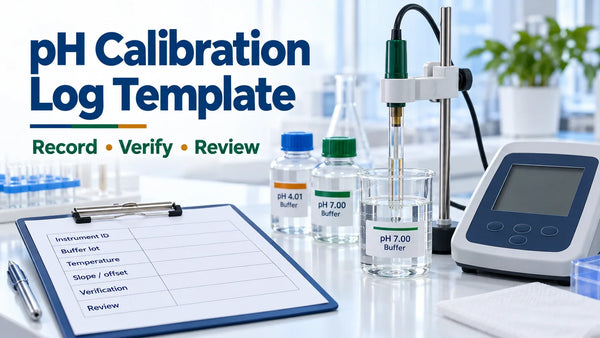
Ask the reviewer to record why the proposed point or set covers the intended work. A useful approval identifies the sample stream, exact setup and supporting document. The worksheet accompanying this article provides space for that decision without automatically marking a choice as suitable.

Match the temperature basis before comparing readings
A nominal value at 25°C is not an instruction to enter that number into every calibration screen at any temperature. Some meters recognise a supported standard and use its temperature behaviour; other workflows require a value appropriate to the current temperature. Follow the exact manual and standard documentation.
The HI6321 manual distinguishes reference temperature from the temperature coefficient and describes allowing the probe to reach thermal equilibrium. Automatic temperature compensation does not make an unsettled temperature reading disappear.
| Record field | Question to answer |
|---|---|
| Standard identity | Which nominal value, unit and reference temperature are supplied? |
| Liquid temperature | What temperature was actually measured during the check? |
| Instrument mode | How does the selected calibration mode treat temperature? |
| Reference document | Which chart, certificate or built-in standard data apply? |
Before treating a mismatch as a faulty bottle, compare the same quantity on both sides. Our practical review sequence is: check the unit, check the selected standard, check the temperature source, then check whether the displayed result is corrected or uncorrected. Keep the original reading and the investigation together.
Low-conductivity water needs extra care
“Buy the closest number” is not a complete rule for very low-conductivity work. Low-value solutions can be affected by contamination and air exposure. METTLER TOLEDO discusses this vulnerability and recommends its 84 µS/cm standard for low-conductivity calibration rather than automatically choosing the lowest solution available. Metrohm gives another example in which a 100 µS/cm standard is preferable for measurements around 1 µS/cm.
These examples show why the approved sensor procedure matters. They are not permission to replace a required standard. If the laboratory uses a sensor with a certified cell constant or a specialised low-conductivity arrangement, establish whether the documented task is calibration, verification or another system check.
For pharmaceutical water, use the current applicable method and laboratory SOP. This buying guide does not prescribe a pharmacopoeial acceptance limit or establish compliance. Avoid purchasing a standard solely because its label says “pure water”.
One point, multiple points or verification?
METTLER TOLEDO’s sensor FAQs describe one-point calibration for a narrow working range and give an example of choosing 1413 µS/cm for an expected 1200 µS/cm sample. They also discuss multiple points when the same sensor covers a much wider range. That is manufacturer guidance to evaluate with the actual setup, not a rule that every conductivity meter needs three standards.
Example for a purchasing review: one department tests one controlled stream; another tests several streams spread across the instrument’s working range. The first request may need one supported calibration solution plus its defined verification material. The second needs a documented range-coverage review before the standard set is selected. Buying a three-bottle kit does not answer that review by itself.
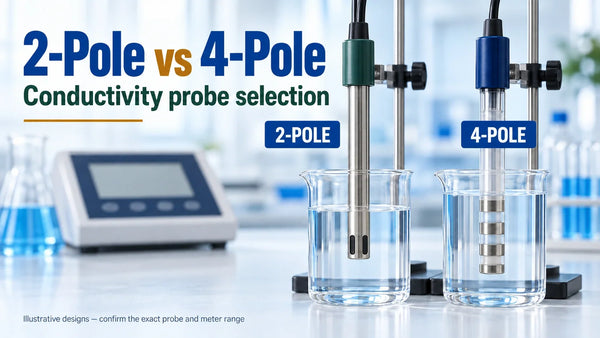
Where an instrument has more than one calibration mode, retain the selected mode in the record. A check performed in measurement mode should not silently become an adjustment that overwrites the calibration. For probe design and range selection, see our 2-pole vs 4-pole conductivity probe guide.
Bottles, sachets and clean working portions
The METTLER TOLEDO conductivity guide advises using dispensed standard promptly, keeping the stock bottle sealed and never returning the used portion. It also warns against dilution or mixing standards. Mark the opening date and reject expired or suspect material.
Choose pack size by your real consumption. A large bottle can create more repeated opening and leftover material when calibration is infrequent. Sachets or smaller packs may simplify portion control, provided there is enough volume for the required immersion. Compare usable calibrations per pack, not bottle volume alone.
Keep a separate clean portion for conditioning or rinsing where the procedure requires it. Rinse-water carryover can alter a standard, especially at the low end. Follow the probe instructions for rinsing, drying or conditioning, immersion and removal of bubbles; avoid imposing one drying technique on every probe.

Do not assign every opened conductivity solution the same number of days. Use the actual manufacturer instructions, labelled expiry and approved laboratory controls. Retain the opening date, storage conditions and any reason for early rejection. A clean-looking solution is not proof that its assigned value remains valid.
What to put in the enquiry and quotation
Use this specification checklist when asking a supplier to quote. It also makes competing offers easier to compare without assuming that different pack descriptions are interchangeable.
| Field | Information to provide or request |
|---|---|
| Meter and probe | Exact model numbers and calibration mode |
| Sample range | Lowest, routine and highest values with units |
| Temperature basis | Nominal reference, sample temperature and compensation mode |
| Intended role | Calibration point or verification check |
| Required standard | Value and unit approved by the method |
| Pack and consumption | Usable volume per session and expected frequency |
| Documentation | Lot-specific certificate, assigned value and stated uncertainty where required |
| Handling | Opening, storage, portion and disposal instructions |
| Acceptance evidence | Applicable SOP, check limits and reviewer |
| Quoted identity | Manufacturer, part number, pack size and quantity |
Hanna’s product descriptions identify traceability to potassium chloride reference material. For your purchase, request the documents for the actual offered product and lot. A general web-page statement is not a substitute for the batch information your laboratory needs.
Please quote conductivity standard(s) for meter ___ and probe ___. Our sample range is ___ to ___, in ___ units, with temperature basis ___. The approved calibration/verification requirement is ___. Please specify the exact part number, nominal value and reference temperature, pack size, available lot documentation and manufacturer handling instructions.
For the operating sequence, use our conductivity meter calibration guide with your manufacturer instructions. For the equipment specification, see conductivity cell constants. The EC vs TDS guide explains why a ppm request needs further clarification.
Frequently asked questions
Is 1413 µS/cm the same as 1.413 mS/cm?
Is 12.88 mS/cm suitable for every wastewater sample?
Should the lowest-conductivity sample always use the lowest-value standard?
Can I dilute a standard to make another calibration value?
Do I need all three standards for every calibration?
How long can an opened bottle be used?
Specify the standard before ordering
SciSpectrum Lab Essentials is a reseller of laboratory instruments and accessories. Send the meter and probe models, sample range with units, required standard value, temperature basis and pack requirement so the proposed supply can be checked against your specification.
Request a conductivity standard quotationManufacturer references
- Hanna Instruments: HI7033L, 84 µS/cm standard
- Hanna Instruments: HI7031L, 1413 µS/cm standard
- Hanna Instruments: HI7030L, 12,880 µS/cm standard
- Hanna Instruments HI6321 manual, calibration and temperature settings
- METTLER TOLEDO: Conductivity sensor FAQs, one-point and multi-point calibration
- METTLER TOLEDO: A Guide to Conductivity Measurement, sections 3.1–3.4
- METTLER TOLEDO: Conductivity standard solutions and low-conductivity guidance
- Metrohm: Improving your conductivity measurements