pH Calibration Log Template: What to Record Before Releasing Sample Results
SciSpectrum Lab Essentials
pH Calibration Log Template: What to Record Before Releasing Sample Results
A notebook entry saying “pH meter calibrated — OK” leaves several questions unanswered. Which electrode was connected? Which buffer lots were used? Was the check made at the correct temperature? What supported the decision to use the system?
This pH calibration log template helps shared QC, food, water and ETP laboratories capture those details in one linked record. Adapt the fields to your approved method and record system. Set the limits, review roles and calibration frequency before using the form.
What should a pH calibration log connect?
The record should connect the setup, the evidence and the decision. A meter ID alone is incomplete when several electrodes are shared. A slope value without its unit or calibration segment is difficult to compare. An “accepted” entry without the applicable limit does not explain how the decision was reached.
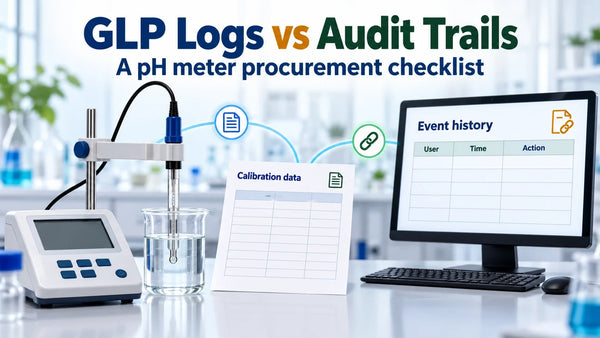
Hanna’s documented GLP implementation illustrates the instrument data available on some meters: calibration date/time, buffers, offset and slope information. Your form adds the context that the instrument may not hold, such as buffer bottle history, sample references and the review outcome.

A copyable pH calibration log template
Copy these four sections into your controlled form or electronic record. Blank cells are intentional. Complete them with actual results; where a field is not available or not applicable, state that and record the reason under your procedure. Extend the buffer table to the number of points actually used.
A. Identify the calibration session
| Field | Entry | Guidance |
|---|---|---|
| Record / session ID | Use one reference for the linked records | |
| Date, time and analyst | Include the time zone where needed | |
| Meter ID / model; electrode ID / model | Identify the actual connected setup | |
| Temperature probe ID / temperature source | Identify ATC or manual entry, as applicable | |
| Method / SOP and revision | Include the applicable limits and check frequency | |
| Buffer group and calibration points | Record what was selected on the meter | |
| Sample or batch references covered | Define the work linked to this session |
B. Identify each buffer
| Point | Buffer / assigned value at temperature | Manufacturer / lot / certificate | Expiry / opened / use-by dates | Measured temperature | Point result / report link |
|---|---|---|---|---|---|
| Point 1 | |||||
| Point 2 | |||||
| Point 3 |
C. Preserve the calibration outcome
| Field | Entry | Guidance |
|---|---|---|
| Calibration date and time / report reference | Link the instrument record or printout | |
| Buffer temperatures | °C; record each point where available | |
| Slope result and type | % or mV/pH; identify segment or average | |
| Offset | mV or the unit actually reported | |
| Warnings / calibration acceptance | Record the message and applicable decision | |
| Applicable criteria and source | SOP / method / manual reference |
D. Record verification and disposition
| Field | Entry |
|---|---|
| Control identity, lot and certificate | |
| Assigned pH at the measurement temperature | |
| Observed pH, temperature and check time | |
| Difference: observed − assigned | |
| Acceptance limit / decision rule / source | |
| Verification outcome and supporting record | |
| System-use / sample-release decision and time | |
| Reviewer / approving role, if required | |
| Deviation / maintenance / repeat-record link |
How to complete the record
1. Identify the actual setup
Record the meter and electrode separately, along with the temperature arrangement. If an electrode is exchanged mid-session, identify the change and link the new calibration. Give the session a reference that can also appear in the sample result record. This makes it clear which setup supported which work.
2. Trace the buffers to the bottles used
Record the selected buffer group, nominal values, manufacturer, lot and certificate reference. Include printed expiry, opening date and the assigned use-by date where applicable. The certificate should match the lot on the bottle. Keep temperature-dependent assigned values traceable to the appropriate certificate or manufacturer table.
Use our guides to reading a pH buffer certificate, matching the buffer group and checking opened-buffer suitability for those specific checks. The log should identify the actual material used, including a sachet lot when single-use portions are selected.
3. Keep preparation and temperature visible
Hanna’s calibration guidance describes electrode preparation, rinsing between buffers and following the exact instrument instructions. Record any conditioning or maintenance that could affect the session, along with the calibration temperatures. The Thermo Scientific pH Measurement Handbook explains why temperature matters to both electrode response and solution pH. “ATC on” alone is less informative than the temperature and its source.
4. Copy results with their meaning and units
Transcribe slope and offset exactly as reported. Distinguish a percentage slope from mV per pH, and an average from individual segments. Link the original report or printout rather than copying selected favourable figures. If the meter cannot display a value, record that limitation and follow the approved alternative. Our slope and offset guide explains interpretation and troubleshooting.
A worked verification example
Calibration establishes the measurement relationship used by the meter; a verification reading checks the response against an assigned value under the procedure. Thermo Scientific’s wastewater guide describes verification using a standard different from the calibration buffers, and refers acceptance limits to the laboratory’s quality procedure. Record whether your check is a read-back of a calibration buffer or a separate verification standard.

| Record item | Illustrative entry |
|---|---|
| Assigned verification value at 25.0°C | 6.860 pH |
| Observed verification result at 25.0°C | 6.892 pH |
| Signed difference | 6.892 − 6.860 = +0.032 pH |
| Absolute difference | 0.032 pH |
| Applicable limit and decision rule | Enter the approved criterion and source |
| Outcome | Decide only after applying that criterion |
The calculation records the difference; it does not declare a pass. Select the actual check standard, temperature-dependent value, reporting precision and acceptance rule from your method. Include the check time so the result can be linked to the relevant measurements. Where the SOP requires checks during or after a sample sequence, retain those results under the same session reference.
What to record when a check fails
Keep the original outcome. Add a linked investigation and repeat record so a later acceptable result does not hide the earlier problem. Use this sequence within your laboratory procedure:
- Hold the affected work. Identify the system status and sample results requiring review.
- Describe the failure. Record the warning, observed result, limit and time.
- Check likely causes. Review buffer identity, condition, group selection, temperature, electrode condition and connections.
- Record the correction. Identify fresh buffer portions, approved cleaning, conditioning or other maintenance actually performed.
- Recalibrate and verify. Give the repeat its own reference and keep both outcomes.
- Document disposition. Record who decided whether work could proceed and how affected samples were handled.

For electrode deposits, follow the protein, oil and wastewater cleaning guide. The METTLER TOLEDO pH measurement guide treats the meter/cable, buffers, temperature, application and electrode as separate troubleshooting checks. A failed check should prompt investigation of the setup rather than an automatic electrode purchase.
Is the meter’s GLP screen enough?
Check the exact model and export options. A screen showing the last calibration may not identify the buffer lot, opening date, samples covered or subsequent review. Preserve the relevant instrument record and link the missing information in the laboratory form.
For a shared meter, check the clock, identify the analyst, and retain the relevant calibration record before later use replaces the displayed session. A spreadsheet, printout and instrument export each need a defined place in your record system. Decide which record is authoritative and how related files are identified.
Before releasing sample results
- Meter, electrode, analyst and session are identified.
- Buffer group, lots, certificate references and usable dates are traceable.
- Temperatures and calibration results include their units and context.
- Required verification checks and limits are recorded.
- Warnings, failures, corrections and repeats remain linked.
- System-use decision and sample/batch references are clear.
- Review and release follow the applicable procedure.
Keep system readiness and sample-result release identifiable as separate decisions where your workflow distinguishes them. A complete calibration record supports the review; sample preparation, method suitability and other required QC still belong to the sample assessment.
Frequently asked questions
What should a pH calibration log contain?
Should the log record slope in percent or mV/pH?
Can I use one log for several pH meters?
How often should I calibrate or verify?
Does this template establish compliance with a standard?
Need a pH setup with useful calibration records?
SciSpectrum Lab Essentials is a reseller of laboratory instruments and accessories. Send your sample type, expected pH range, preferred buffers and required record/export fields when requesting a meter or consumables quotation. If you already own a meter, include its exact model and electrode model so the enquiry can be checked against the requirement.
Discuss a pH setup or buffersBrowse electrodes and probesManufacturer references
- Hanna Instruments: GLP calibration information in an instruction manual
- Thermo Scientific: pH Measurement Handbook
- Thermo Scientific: pH in Wastewater User Guide, calibration verification and QC
- Hanna Instruments: How do I calibrate my pH electrode?
- METTLER TOLEDO: A Guide to pH Measurement