Hot Plate vs Hot Plate Magnetic Stirrer: Which One Should Your Lab Buy in 2026?
Scispectrum Lab Essentials
Hot Plate vs Hot Plate Magnetic Stirrer: Which One Should Your Lab Buy in 2026?
In the fast-paced environment of a modern food testing or pharmaceutical lab, precision is everything. Imagine a technician preparing a reagent for a critical FSSAI compliance test; if the solution isn't heated uniformly or the solute doesn't dissolve completely, the entire batch of results could be compromised.
As we move into 2026, laboratory heating instruments have evolved far beyond simple high/low dials. Choosing between a standard laboratory hot plate and a hot plate magnetic stirrer is no longer just about budget — it's about workflow efficiency, safety standards, and meeting stringent NABL or GMP audit requirements.
What Is a Laboratory Hot Plate?
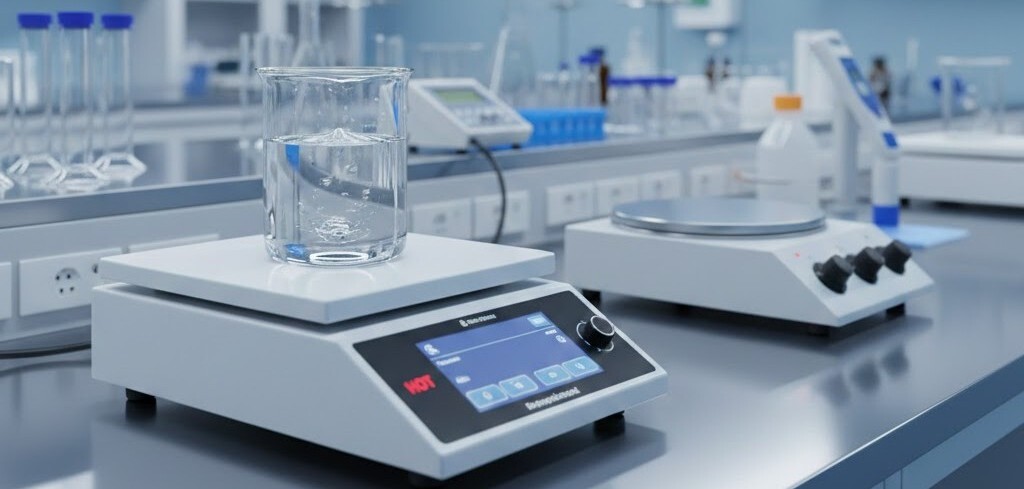
A laboratory hot plate is a standalone heating instrument designed to provide a flat, heated surface for vessels like beakers and flasks. Its primary function is simple: conductive heat transfer.
Typical applications: acid digestion (environmental labs for sample preparation), general heating (boiling liquids or heating samples that don't require agitation), sample drying (removing moisture from solids or precipitates).
Key components: top plate material — usually ceramic (high chemical resistance), aluminum (superior heat uniformity), or stainless steel; temperature controller — modern units feature PID controllers for precise temperature maintenance.
Pros: extremely durable, cost-effective, and easy to operate. Limitations: it cannot move the liquid, which can lead to hot spots where the bottom of the beaker is significantly hotter than the surface, potentially scorching sensitive samples.
What Is a Hot Plate Magnetic Stirrer?
A hot plate magnetic stirrer (often called a stirring hot plate) combines a heating element with a rotating magnetic field. By placing a small, PTFE-coated magnetic stir bar inside the liquid, the machine can heat and agitate the solution simultaneously.
Working principle: a motor under the top plate spins a magnet, which in turn spins the stir bar inside your glassware, creating a vortex that ensures the liquid is constantly moving.
Typical applications: dissolving solids (preparing buffers or media where powders must be fully integrated), chemical reactions (synthetic chemistry where reagents must be mixed while heated), uniform heating (prevents localized boiling and ensures the entire volume reaches target temperature).
Advantages: eliminates the need for manual stirring, reduces the risk of splashing, and provides much better temperature homogeneity throughout the sample.
Hot Plate vs Hot Plate Magnetic Stirrer — Key Differences
| Feature | Laboratory Hot Plate | Hot Plate Magnetic Stirrer |
|---|---|---|
| Primary Function | Static Heating | Heating + Simultaneous Stirring |
| Temp. Uniformity | Low (potential for hot spots) | High (constant circulation) |
| Control Type | Digital or Analog | Mostly Digital (RPM + Temp) |
| Safety | Basic thermal cut-offs | Over-temperature & stirring lock |
| Cost | Budget-friendly | Mid-to-High range |
| Maintenance | Very low | Low (motor may need servicing) |

Which One Should Your Lab Choose in 2026?
Choose a Hot Plate if:
- Only heating is required — samples are stable and don't need mixing (e.g., drying a precipitate)
- Budget is limited and you need multiple heating stations for simple tasks
- Occasional sample prep where manual stirring is sufficient
Choose a Hot Plate Magnetic Stirrer if:
- Uniform heating is critical — FSSAI food testing or pharmaceutical QC where a 1°C variance matters
- Continuous stirring is required — viscous liquids or solutes that settle quickly
- Lab handles acids or reactions where closed-system stirring is safer than manual stirring
- Compliance matters — digital stirring hot plates offer better reproducibility for NABL audits
Common Buying Mistakes Labs Make
Choosing analog over digital: analog knobs are difficult to calibrate and replicate — in 2026, digital is the standard. Ignoring plate material: buying aluminum for a lab that handles corrosive acids will lead to a pitted, ruined plate within months. Underestimating stirring needs: many labs buy a basic hot plate and later realize they need a separate stirrer, wasting bench space. Price-driven decisions: low-cost units often lack "hot top" indicators, a critical safety feature that prevents technician burns.
Key Specifications to Check Before Buying
Plate material: ceramic (best for chemicals) vs ceramic-coated aluminum (best for heat transfer). Temperature range: ensure it exceeds your highest requirement (usually up to 350°C–500°C). Stirring speed: look for a range of 100 to 1500 RPM. Safety features: ensure an independent safety circuit and a clear hot warning light. Warranty: ensure the vendor provides on-site service support.
Hot Plates & Magnetic Stirrers at Scispectrum
We supply both categories with ceramic and aluminum plate options, digital control, and RPM ranges suited for pharma and food QC.
Frequently Asked Questions
Conclusion
The choice between a hot plate and a hot plate magnetic stirrer boils down to the complexity of your samples. If you are simply heating water or drying glassware, a standard hot plate is a rugged, economical choice. However, for any lab involved in precise analytical chemistry, food safety, or pharmaceutical QC, the hot plate magnetic stirrer is the superior investment for 2026.
Browse Hot Plates & Stirrers Get a Quote on WhatsApp