pH Electrode Slope and Offset: How to Decide Between Cleaning and Replacement
SciSpectrum Lab Essentials
Read the calibration report before ordering a replacement.
Your pH meter completes calibration, but the slope has dropped since the last run. Or the slope looks reasonable and the offset has moved. Should you clean the electrode, change the buffers, or order a replacement?
Start with the readings and the conditions that produced them. A poor calibration can come from the electrode, the buffers or the measurement setup. Replacing the probe before separating those causes can leave you with the same problem and a new electrode.
What slope and offset actually tell you
Slope describes sensitivity: how much the electrode potential changes for a change in pH. The theoretical slope has a magnitude of about 59.16 mV per pH unit at 25°C. A meter may show slope in mV/pH or as a percentage of the theoretical response. Some display a negative slope; others show its magnitude.
Temperature matters here. A raw mV/pH result measured at another temperature should not simply be divided by 59.16. Use the temperature-dependent theoretical value and the meter’s calculation convention. METTLER TOLEDO explains both the electrode response and the need to select the correct buffer group for temperature compensation in its laboratory pH instrument FAQs.
Offset describes the potential at a reference pH. In many laboratory systems, it is assessed using fresh pH 7 buffer and reported in mV. It is a different check from slope: an electrode can respond across two buffers while its reference-point potential has shifted. Confirm what “offset” or “zero point” means on your instrument. Thermo Fisher’s electrode maintenance note identifies offset as the mV reading in pH 7 buffer.

A worked example at 25°C
Suppose fresh buffers have assigned values of pH 7.00 and pH 4.01 at 25°C. Stable readings in mV mode are +12.0 mV and +185.4 mV respectively. These are illustrative numbers, not a product test.
pH difference = |7.00 − 4.01| = 2.99
Slope magnitude = 173.4 ÷ 2.99 = 57.99 mV/pH
Slope percentage = (57.99 ÷ 59.16) × 100 ≈ 98.0%
The near-neutral buffer reading is +12.0 mV. Whether these results are acceptable depends on the applicable limits and verification result. The calculation follows the two-buffer mV method described in Hanna’s troubleshooting guide, using the buffer values specified in this example.
Which acceptance limits should you use?
There is no single slope percentage that should automatically retire every pH electrode. Manufacturer guidance uses different ranges for different purposes.
| Source and context | Published guidance | How to use it |
|---|---|---|
| Hanna, general calibration tips | Slope 85–105%; offset within ±30 mV. | A general troubleshooting recommendation. Confirm the instructions for your model and method. |
| Thermo Scientific pH Measurement Handbook, printed page 19, USP <791> discussion | Guideline slope 90–105%; offset ±30 mV. | The table directs users to their internal quality/regulatory SOP. It is manufacturer guidance, not a quoted universal pharmacopoeial limit. |
| Same Thermo handbook, system-specification note below the table | Orion system slope 92–102%; offset ±59 mV. | This is a separate specification context. Do not substitute it for the method’s release criteria. |
Sources: Hanna calibration tips and the Thermo Scientific pH Measurement Handbook. For an Indian pharma QC, environmental or ETP laboratory, record the applicable method/SOP and its limits rather than importing a range from an unrelated meter.
What to check before cleaning or replacement
Keep the failed report. It gives you a starting point for the recheck. Then work through the likely causes in a consistent order.
1. Rule out the buffer and setup
Use fresh buffer portions in clean vessels. Check expiry, the opened-container history and the selected buffer set. Do not return used buffer to its bottle. Give the electrode and temperature probe time to stabilise, and use the assigned buffer values at that temperature. Thermo Fisher’s Perfect pH guidance covers fresh buffers, temperature and two-point standardisation.
If the only change was a new buffer bottle or a different buffer group in the settings, check that change before treating the electrode. A high slope is also a reason to inspect buffers and settings, rather than assume the electrode has improved.
2. Inspect the electrode and its connections
Look for cracks, deposits, a discoloured junction, cable damage and a wet or dirty connector. For a refillable electrode, check the specified electrolyte and the fill-hole instructions. A gel-filled electrode does not have the same maintenance options.
METTLER TOLEDO’s sensor troubleshooting guidance links reduced slope, slow response and instability to several possible causes, including contamination, dehydration and damage. The symptom alone does not identify the cause.
3. Choose maintenance that fits the evidence
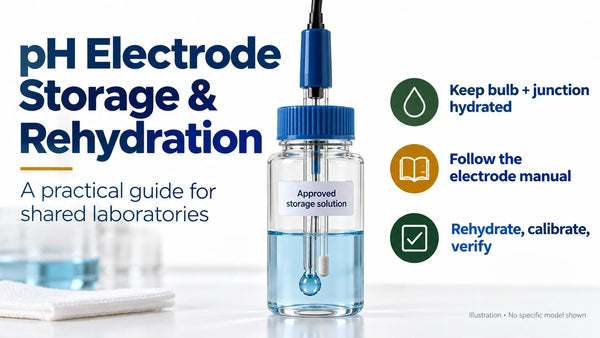
An intact electrode used in protein-rich or oily samples is a reasonable candidate for an approved cleaning procedure. An electrode stored dry may need the manufacturer’s rehydration procedure. Do not apply a generic acid, solvent or soaking time to every electrode.
For cleaner selection and the rinse–clean–condition sequence, use our separate guide: How to Clean a pH Electrode After Protein, Oil and Wastewater Samples. The question here is whether that maintenance restored usable performance.
| What you see | Next useful action |
|---|---|
| Sudden slope change after a buffer or setup change | Repeat with confirmed fresh buffers and the correct settings. |
| Reduced slope or slow response after fouling samples; no physical damage | Use the approved cleaning/conditioning procedure, then recalibrate and verify. |
| Shifted offset with deposits or a suspect reference junction | Check reference-system maintenance and approved cleaning before deciding to replace. |
| Cracked sensing glass or body | Remove the electrode from use and arrange replacement. |
| Failure continues after appropriate maintenance | Isolate electrode, meter and application causes before ordering. |

How to confirm that maintenance worked
After the prescribed cleaning, rinsing and conditioning, repeat calibration with fresh buffers. Hanna’s calibration and electrode maintenance guide recommends reassessing slope and offset after cleaning and reconditioning, and considering replacement if the problem persists.
Record the new results alongside the original report. Keep the buffer set, temperature and other conditions comparable wherever practical. A simple log is more useful than a note saying “cleaned — OK.”
- Identity: meter model, electrode part number/ID and operator.
- Conditions: buffer values, lot/expiry, temperature and ATC/MTC setting.
- Before and after: slope, offset, stability behaviour and maintenance performed.
- Release check: verification standard, assigned value at temperature, observed result, applicable limit and disposition.
Use the verification buffer or control required by your SOP as a check after calibration, without using that result to adjust the calibration again. If sample behaviour caused the original concern, include an appropriate sample or matrix control in the assessment. The calibration recheck log (CSV) leaves the acceptance limits blank for your own procedure.
A good buffer result does not settle every sample problem. For example, Hanna identifies an unsuitable junction in low-conductivity water as a cause of slow response and drift in its drifting-readings guidance. If the electrode behaves normally in buffers but poorly in the sample, revisit electrode suitability and the method.
When replacement is justified
Replace an electrode with a broken sensing membrane, cracked shaft or compromised casing. Cleaning cannot repair that damage; METTLER TOLEDO lists these conditions in its replacement guidance.
For an intact electrode that still fails, separate the electrode from the rest of the system. Where the interface permits, compare with a known-good compatible electrode or follow the meter manufacturer’s instrument checkout procedure. Thermo Fisher’s troubleshooting handbook separates meter, electrode, sample/application and technique for this reason.
If the failure follows the suspect electrode after fresh-buffer checks and approved maintenance, replacement has a clear basis. If it remains with the meter or occurs only in the sample, replacing the same electrode type may leave the cause unresolved. Retain the reports so the purchase decision and the system’s return to use can be reviewed.
Questions that come up at the bench
Does a slope below 95% always mean replacement?
Can I assess slope using pH 7 buffer alone?
Can cleaning fix a shifted offset?
Should I replace the meter and electrode together?
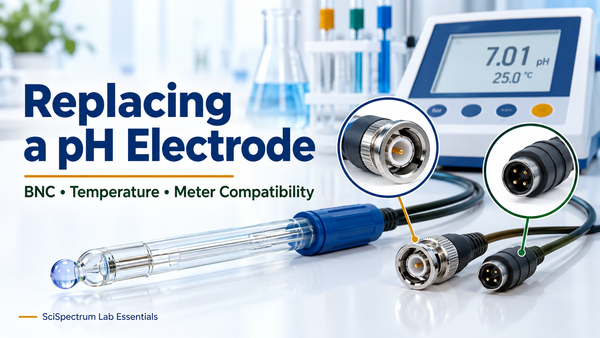
Need a compatible replacement?
Send SciSpectrum your meter model, electrode part number, sample type, working temperature and the before/after calibration reports. Include photos of the connectors. SciSpectrum Lab Essentials is a reseller of laboratory instruments and accessories; these details help us assess suitable replacement options for your application.
Discuss a replacement electrodeManufacturer references are linked beside the relevant guidance. Sources checked on 11 October 2026. This guide supports troubleshooting; use the current manufacturer instructions and your approved method/SOP for acceptance and release.
Back to top ↑