TDS vs Conductivity: What's the Difference and Why It Matters in Water Testing
Scispectrum Lab Essentials
TDS vs Conductivity: What's the Difference and Why It Matters in Water Testing
Water quality testing is essential across laboratories, industrial processes, and drinking water systems. Accurate measurements help ensure safety, regulatory compliance, and consistent performance. Among the most widely used parameters in water testing are Total Dissolved Solids (TDS) and conductivity.
Although these terms are often used interchangeably, they are not the same. This confusion can lead to incorrect interpretations and poor decision-making. Understanding the difference between TDS vs conductivity is key to choosing the right method for your application.
TDS (Total Dissolved Solids): The total concentration of dissolved substances in water — inorganic salts (calcium, magnesium, sodium, potassium), anions (chloride, sulfate, bicarbonate), trace metals, and small amounts of organic matter. Expressed in parts per million (ppm) or mg/L.
Conductivity: A direct measurement of water's ability to conduct electrical current, which depends on the concentration of dissolved ions carrying charge through the solution. Expressed in microsiemens per centimeter (µS/cm) or millisiemens per centimeter (mS/cm).
Why TDS Is Important
TDS provides a general indication of water quality. High TDS levels may affect taste, scaling potential, and suitability for industrial or drinking purposes. In applications like reverse osmosis (RO) systems and potable water monitoring, TDS is often used as a quick indicator of overall purity.
How Conductivity Works
When salts dissolve in water, they split into positively and negatively charged ions. These ions allow electrical current to pass through the solution. The higher the ion concentration, the higher the conductivity. Conductivity provides a fast and accurate measurement of ionic content, widely used in laboratory analysis, industrial monitoring, and process control where precision and repeatability are critical.
Relationship Between TDS and Conductivity
TDS and conductivity are closely related because both depend on the concentration of dissolved substances in water. The relationship is commonly expressed as:
TDS (ppm) ≈ Conductivity (µS/cm) × Conversion Factor
Conductivity is measured directly, while TDS is usually calculated from conductivity using a conversion factor. This means TDS is an estimate rather than an exact measurement.

Conversion Factors Explained
The conversion factor between conductivity and TDS varies depending on the composition of dissolved solids in the water. Different ions contribute differently to conductivity. Typical conversion factors include:
- 0.5 for relatively pure water
- 0.55 to 0.7 for natural water sources
- 0.7 to 0.9 for industrial or high-salinity water
Key Differences Between TDS and Conductivity
| Parameter | TDS | Conductivity |
|---|---|---|
| Measurement Type | Calculated from conductivity | Direct measurement |
| Units | ppm or mg/L | µS/cm or mS/cm |
| Accuracy | Moderate (depends on factor) | High |
| Speed | Fast | Instant |
| What it Measures | Total dissolved solids | Ionic concentration |
| Application | General water quality | Precise analysis and control |
When to Use TDS vs Conductivity
Choosing between TDS and conductivity depends on your application and required accuracy.
Use TDS When:
- Monitoring drinking water quality
- Checking RO system performance
- Performing quick field measurements
- A general indication of water purity is sufficient
Use Conductivity When:
- Conducting laboratory-grade analysis
- Monitoring industrial processes
- Requiring high accuracy and repeatability
- Evaluating ionic changes in real time
Industry Applications
Drinking Water and RO Plants
TDS is commonly used to ensure water meets acceptable standards for consumption. It is also useful for monitoring RO membrane performance and detecting system inefficiencies.
Laboratories
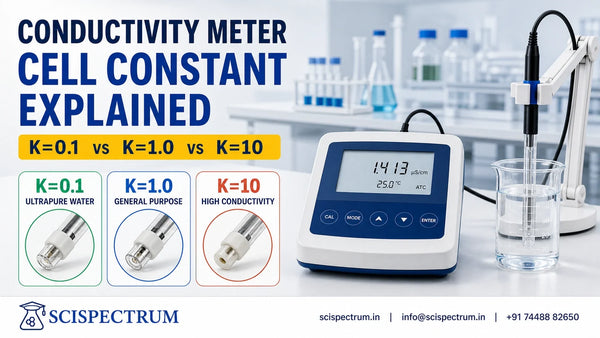
Conductivity is preferred in laboratories due to its precision. It supports analytical testing, chemical preparation, and quality assurance processes. See our cell constant selection guide for choosing the right conductivity probe.
Industrial Processes
Industries such as pharmaceuticals, food and beverage, and chemicals rely on conductivity for process control. TDS may be used for routine monitoring, while conductivity ensures tight control over water composition — our IP/USP Stage 1 conductivity guide covers pharma-specific limits.
Aquaculture
Maintaining the right ionic balance is essential for aquatic life. Conductivity helps monitor this balance, while TDS provides a broader view of water conditions.
TDS & Conductivity Meters at Scispectrum
Reliable measurements depend on the right instruments. We supply TDS meters for quick field assessment and conductivity meters for precise, real-time ionic analysis, across Eutech, Hanna, and Aquasol.
Frequently Asked Questions
Conclusion
Understanding the difference between TDS vs conductivity is essential for accurate water testing. TDS offers a simple and practical indication of overall water quality, while conductivity provides precise measurement of ionic concentration. For best results, use these parameters together — conductivity ensures accuracy, while TDS offers quick insight, enabling better decision-making across laboratory and industrial applications.
Browse TDS & Conductivity Meters Get a Quote on WhatsApp