Electrochemical Analysis in Indian Industries: Complete Overview
Scispectrum Lab Essentials
Electrochemical Analysis in Indian Industries: Complete Overview
A QC manager at a pharmaceutical plant near Ahmedabad needs conductivity accurate to 0.01 µS/cm. A tannery ETP operator in Kanpur needs ORP accurate to confirm chromium reduction is complete before discharge. A shrimp hatchery manager near Nellore needs dissolved oxygen readings he can trust at 5 AM before the morning feed. A boiler engineer at a textile mill in Coimbatore needs conductivity trending to catch a cooling tower scaling problem before it shuts down production. Four completely different industries, four completely different consequences for getting the measurement wrong — and all four rely on the same five electrochemical parameters: pH, conductivity, dissolved oxygen, ORP, and TDS.
Electrochemical Analysis in Industry: The application of pH, conductivity, dissolved oxygen, ORP, and TDS measurement to industrial process control, quality assurance, regulatory compliance, and safety monitoring — tied directly to a production decision such as releasing a water batch, dosing chemical, or stopping a discharge.
Why Electrochemical Analysis Spans Every Indian Industry
Water is the universal industrial input. Electrochemical instruments are the fastest, cheapest, and most universally applicable way to characterise water quality in real time, which is why the same five parameters recur across industries that otherwise have nothing in common. What differs is not the measurement principle but the consequence of error — a wrong conductivity reading triggers an investigation in pharma; a wrong ORP reading can mean a lethal gas release in ETP cyanide treatment; a missed DO drop can mean a complete pond mortality event in aquaculture.

Pharmaceutical and Biotechnology Manufacturing
India's pharmaceutical sector is the largest single driver of demand for GLP-capable electrochemical instruments. Every facility manufacturing under Schedule M for domestic supply, or under WHO-GMP, EU GMP, or USFDA registration for export, is required to test purified water and WFI against IP and USP limits.
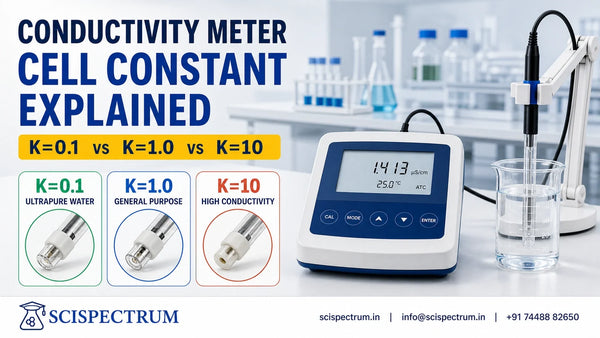
Conductivity is the primary purity indicator — the IP/USP Stage 1 limit is not more than 1.3 µS/cm at 25°C, measured with a K=0.1 cell directly at the sampling valve using a flow-through cell, since CO₂ absorption from atmosphere can raise conductivity from 0.06 to over 1.3 µS/cm within two minutes of exposure. pH must fall between 5.0 and 7.0, measured with a low-ionic-strength electrode. Dissolved oxygen is increasingly monitored during water system qualification as an early indicator of RO-EDI membrane breach.
Pharmaceutical QC instruments must produce GLP-compliant, time-stamped calibration records exportable to LIMS or a validated printer — not just a display reading. See our pH Meter for Water Testing guide and Conductivity Meter guide for the full detail.
Industrial Effluent Treatment — Textiles, Tanneries, Electroplating
India's ETP sector spans textile dyeing, tanneries, electroplating, and chemical manufacturing — each governed by CPCB discharge norms under the Environment Protection Act 1986.
Textile dyeing ETPs
Textile dyeing effluent is alkaline and high in dissolved solids. The CPCB inland surface water discharge norm is pH 6.5–8.5. Dissolved oxygen monitoring of the aeration tank — typically targeting 2–4 mg/L — predicts whether biological treatment will succeed before the discharge sample is even taken.
Tannery effluent — chromium reduction
Tanneries generate effluent containing hexavalent chromium (Cr⁶⁺), which must be reduced to trivalent form (Cr³⁺) before discharge. This reduction is controlled by ORP — target below +300 mV using ferrous sulphate. Without real-time ORP monitoring, operators must estimate dosing by volume and time, routinely resulting in incomplete reduction or excessive chemical use.
Electroplating ETPs — cyanide destruction
Electroplating operations using cyanide-based plating baths must destroy cyanide via alkaline chlorination before discharge. This is the most safety-critical electrochemical measurement application in Indian industry. First-stage oxidation target is ORP +350–400 mV; the breakpoint requiring complete destruction is +600 mV or above. Incomplete oxidation releases hydrogen cyanide gas, lethal above 300 ppm in air.
See our complete ORP measurement guide for calibration and electrode maintenance detail.
Food and Beverage Manufacturing
pH is a fundamental quality and safety parameter across dairy fermentation, sauce manufacturing, beverage production, and bakery products — FSSAI references pH limits where pH is directly tied to microbiological safety. Packaged drinking water and beverage manufacturers monitor conductivity and TDS of RO-treated process water continuously; BIS IS 14543:2016 specifies a TDS limit of not more than 500 mg/L.
Power, Boiler, and Cooling Water Treatment
Boiler feedwater quality requirements scale with operating pressure. Low-pressure boilers (under 20 bar) target conductivity below 100 µS/cm; high-pressure boilers (above 60 bar) require below 10 µS/cm. IS 10496 provides the Indian reference guideline. Exceeding these limits causes scale formation and reduces thermal efficiency. Cooling towers use conductivity to determine cycles of concentration and control blowdown rate; ORP increasingly supports biocide dosing control.
Municipal Water Treatment and Distribution
Governed primarily by BIS IS 10500:2012 and IS 3328. The WHO recommends ORP above +650 mV for effective chlorine or ozone disinfection — a threshold that captures the combined effect of chlorine, pH, and organic demand better than chlorine concentration alone.
Aquaculture and Fish Farming
Dissolved oxygen is the single most operationally critical parameter — MPEDA and NaCSA guidelines specify a minimum of 4–5 mg/L, and DO below this for even a few hours during the pre-dawn period can trigger mass mortality. pH targets 7.5–8.5 for marine/shrimp systems, 6.5–8.0 for freshwater. ORP, increasingly monitored, targets +150 to +350 mV. Given the outdoor pond environment, portable, waterproof, and multiparameter instruments dominate this sector.
Environmental, Research, and Academic Laboratories
NABL accreditation under ISO/IEC 17025 requires validated test methods — IS 3025 Part 11 for pH, Part 14 for conductivity, Part 16 for TDS, Part 44 for DO — with documented calibration traceability. Research applications often need multiparameter meters for field surveys across dozens of sampling points.
Quick Reference — Instruments by Industry
| Industry | Primary Parameters | Key Standard | Instrument Class Required |
|---|---|---|---|
| Pharma / Biotech | Conductivity, pH, DO | IP / USP / WHO-GMP | GLP benchtop, K=0.1 cell, low-ionic electrode |
| Textile ETP | pH, DO | CPCB norms | Portable IP67, double-junction electrode |
| Tannery ETP | ORP, pH | CPCB category-specific | Portable ORP, Pt electrode |
| Electroplating ETP | ORP (safety-critical) | CPCB category-specific | Portable/benchtop ORP, frequent calibration |
| Food & Beverage | pH, Conductivity/TDS | FSSAI / BIS IS 14543 | Portable/entry benchtop, food-grade electrode |
| Power / Boiler | Conductivity | IS 10496 / ASME | Benchtop, K=0.1–1.0 depending on pressure |
| Municipal Water | pH, TDS, ORP | IS 10500 / IS 3328 | Portable, K=1.0 cell |
| Aquaculture | DO, pH, ORP | MPEDA / NaCSA | Portable waterproof, multiparameter preferred |
| Environmental / NABL | All five parameters | IS 3025 series / NABL | RS-232/USB output, calibration traceability |

Electrochemical Instruments at Scispectrum
Scispectrum supplies electrochemical instruments across every industry covered in this guide — from GLP benchtop pH and conductivity meters for pharma QC to rugged portable ORP meters for ETP cyanide destruction to waterproof multiparameter meters for aquaculture field use, sourced from Eutech, Hanna, Mettler Toledo, Lutron, and Aquasol with GST invoicing.
Frequently Asked Questions
Conclusion
Electrochemical analysis instruments serve every major Indian industrial sector, but the right instrument, electrode, and calibration protocol differ sharply by application. Understanding which standard governs your industry — IP/USP, CPCB, BIS, IS 3025, or MPEDA — is the first step to specifying the right instrument.
Browse all instruments at Scispectrum Get a Quote on WhatsAppFor the complete overview of all five electrochemical parameters and instrument types, see: Electrochemical Analysis Instruments: The Complete Laboratory Guide.