Turbidity in Water: What It Means and How Laboratories Measure It (2026 Guide)
Scispectrum Lab Essentials
Turbidity in Water: What It Means and How Laboratories Measure It (2026 Guide)
Turbidity: The cloudiness or haziness of water caused by suspended particles such as sediment, microorganisms, organic matter, and other fine materials. These particles scatter light passing through the water, making it appear cloudy or unclear. The higher the concentration of suspended particles, the higher the turbidity level. Turbidity is commonly measured in NTU (Nephelometric Turbidity Units).
Common sources of turbidity include:
- Soil and sediment runoff
- Industrial wastewater discharge
- Algae and microorganisms
- Organic matter decomposition
- Construction and mining activities
Why Turbidity Testing Is Important
Turbidity measurement is essential for several reasons in environmental and laboratory analysis.
1. Drinking Water Safety
High turbidity can indicate the presence of harmful microorganisms or pollutants. Drinking water treatment plants monitor turbidity to ensure safe water supply.
2. Wastewater Monitoring
Industries and wastewater treatment plants measure turbidity to evaluate the efficiency of treatment processes.
3. Environmental Protection
Environmental laboratories test turbidity levels in rivers, lakes, and groundwater to detect pollution and sediment contamination.
4. Filtration Process Monitoring
Turbidity analysis helps water treatment plants determine whether filtration systems are working effectively.
5. Regulatory Compliance
Government agencies and pollution control boards often specify turbidity limits for drinking water and discharged wastewater.
What Causes Turbidity in Water?
Turbidity occurs when small particles remain suspended in water instead of settling down. These particles may include:
- Clay and silt
- Organic debris
- Bacteria and algae
- Industrial waste particles
- Fine sand and sediment
Natural events such as heavy rainfall, floods, or erosion can increase turbidity in surface water sources. Similarly, industrial discharge and agricultural runoff may significantly raise turbidity levels in water bodies.
How Laboratories Measure Turbidity
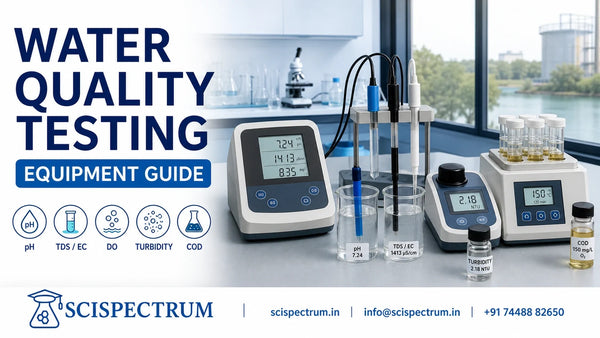
Laboratories use specialized instruments known as turbidity meters or nephelometers to measure turbidity accurately. These instruments work by measuring how much light is scattered by particles suspended in the water sample.
Basic principle:
- A light beam is passed through the water sample.
- Suspended particles scatter the light.
- A detector measures the scattered light at a specific angle.
- The instrument converts the scattered light intensity into turbidity units (NTU).
This method is called nephelometric measurement, which is the most widely accepted technique for turbidity analysis.

Equipment Used for Turbidity Testing
Accurate turbidity measurement requires specialized laboratory instruments and accessories.
1. Turbidity Meter (Nephelometer)
A turbidity meter is the primary instrument used to measure turbidity levels in water samples. It uses a light source and photodetector to measure scattered light.
2. Sample Cuvettes or Tubes
Transparent glass or plastic cuvettes are used to hold water samples inside the turbidity meter.
3. Calibration Standards
Standard turbidity solutions are used to calibrate the instrument and ensure accurate measurements.
4. Laboratory Glassware
Beakers and sample containers are used to collect and prepare water samples before analysis.
Step-by-Step Turbidity Testing Procedure
Step 1: Sample Collection
Collect the water sample in a clean container. Avoid shaking or disturbing the sample excessively.
Step 2: Prepare the Sample
Fill the turbidity measurement cuvette with the sample water. Ensure the cuvette is clean and free from scratches.
Step 3: Calibration
Calibrate the turbidity meter using standard turbidity solutions before testing.
Step 4: Measurement
Insert the sample cuvette into the turbidity meter and start the measurement.
Step 5: Record the Result
The instrument displays the turbidity value in NTU.
Factors That Affect Turbidity Measurements
- Dirty or scratched sample cuvettes
- Air bubbles in the sample
- Improper calibration
- Fingerprints on the sample tube
- Instrument misalignment
- External light interference
Applications of Turbidity Testing
Drinking Water Treatment Plants — monitoring turbidity ensures effective filtration and disinfection.
Environmental Monitoring Laboratories — environmental agencies track turbidity levels in rivers, lakes, and reservoirs.
Wastewater Treatment Facilities — industries measure turbidity to evaluate wastewater treatment performance.
Food and Beverage Industry — turbidity testing is sometimes used in quality control processes.
Research and Academic Laboratories — researchers analyze turbidity to study water quality and environmental changes.
Turbidity Meters at Scispectrum
We supply digital and portable turbidity meters across established brands, sourced through authorised distributors with GST invoicing suitable for laboratories, environmental agencies, and industrial customers.
Frequently Asked Questions
Conclusion
Turbidity is a critical water quality parameter that indicates the presence of suspended particles in water. Measuring turbidity helps laboratories monitor pollution, evaluate water treatment systems, and ensure regulatory compliance. By using accurate turbidity meters and following proper testing procedures, laboratories can reliably assess water clarity and detect potential contamination.
Browse Turbidity Meters Get a Quote on WhatsApp