Dissolved Oxygen (DO) Test in Water: Principle, Procedure, and Equipment Used (2026 Guide
Scispectrum Lab Essentials
Dissolved Oxygen (DO) Test in Water: Principle, Procedure, and Equipment Used
Water quality analysis is essential for environmental protection, wastewater management, and maintaining safe drinking water supplies. Among the many parameters used to evaluate water quality, Dissolved Oxygen (DO) is one of the most important indicators of the health of aquatic ecosystems and the effectiveness of water treatment processes.
Dissolved Oxygen (DO): The amount of oxygen gas dissolved in water, on which aquatic organisms such as fish, algae, and microorganisms depend for survival. Oxygen enters water through diffusion from the atmosphere, photosynthesis by aquatic plants and algae, and water movement such as waves and turbulence. The concentration is typically measured in milligrams per liter (mg/L).
Why Dissolved Oxygen Testing Is Important
Aquatic life support — fish and other aquatic organisms require adequate oxygen levels to survive; low DO levels can lead to stress or death. Wastewater treatment monitoring — plants monitor DO levels to ensure biological treatment processes function efficiently. Environmental pollution detection — low DO can indicate pollution from organic waste, sewage discharge, or industrial effluents. Water quality assessment — environmental labs use DO testing to assess the health of rivers, lakes, and reservoirs. Regulatory compliance — many environmental regulations require monitoring of DO levels in surface water and wastewater discharge.
Principle of Dissolved Oxygen Testing
Dissolved oxygen in water can be measured using chemical or electrochemical methods.
Winkler Method (Chemical Method)
A classical chemical technique. Dissolved oxygen reacts with manganese sulfate under alkaline conditions, forming a precipitate. After acidification, iodine is released in proportion to the oxygen present, and the released iodine is titrated with sodium thiosulfate to calculate DO concentration. This method is highly accurate and widely used for laboratory reference analysis.
DO Meter Method (Electrochemical Method)
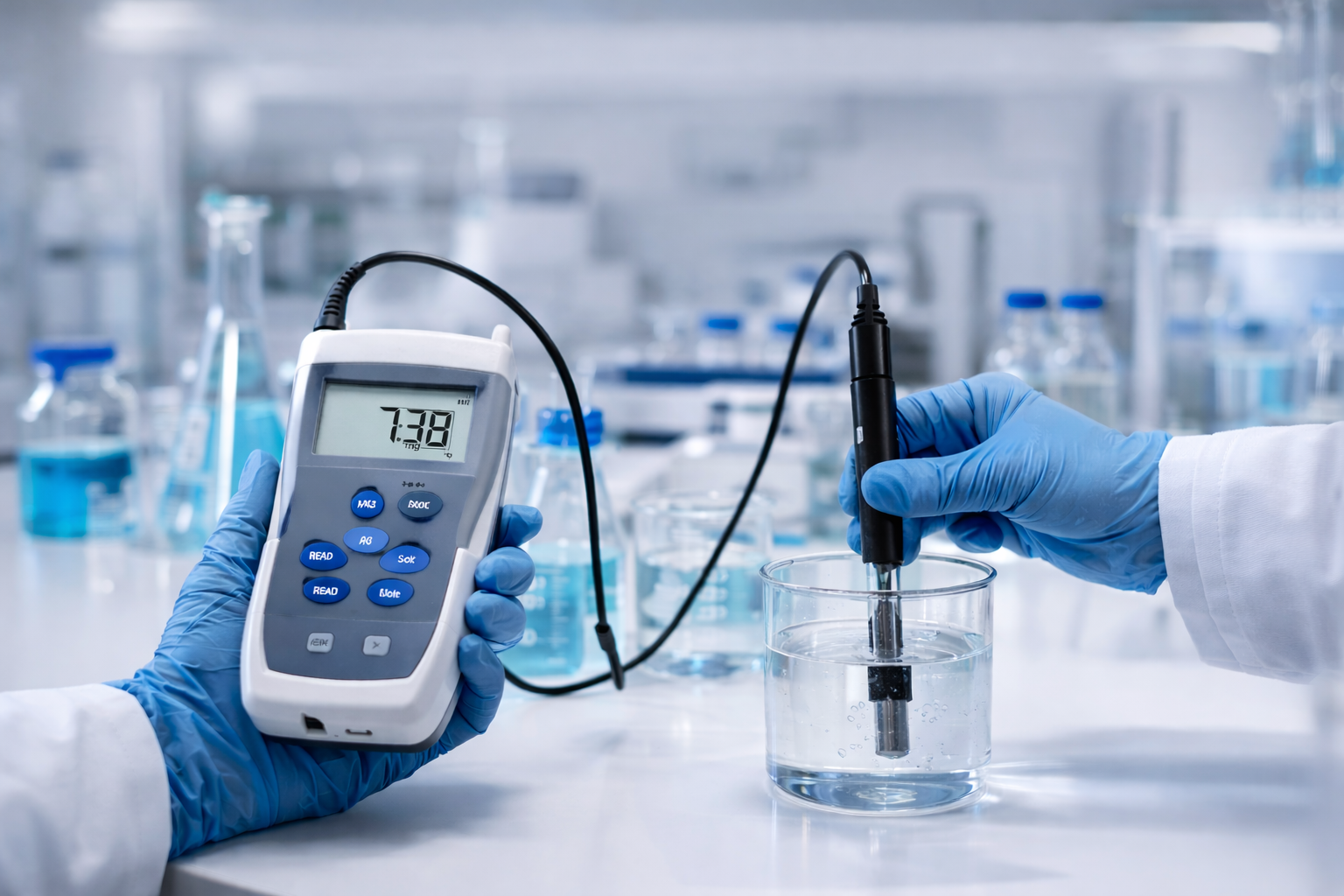
Modern laboratories often use digital dissolved oxygen meters equipped with electrochemical or optical sensors. The probe is placed directly into the water sample, and the instrument displays the DO value digitally — faster and more practical for routine and field testing.

Equipment Used for DO Testing
Dissolved oxygen meter — the most commonly used instrument, with a probe that detects oxygen concentration. DO probe or sensor — contains the sensing element. BOD bottles — special glass bottles for collecting water samples for Winkler titration or BOD testing. Titration equipment — burettes, pipettes, conical flasks, and standard titration reagents for the Winkler method. Magnetic stirrer — ensures uniform mixing during sample preparation or titration.
Step-by-Step DO Testing Procedure (Winkler Method)
Step 1: Sample Collection
Collect the water sample in a clean BOD bottle, ensuring that no air bubbles are trapped inside.
Step 2: Add Reagents
Add manganese sulfate solution followed by alkaline iodide reagent to the sample.
Step 3: Formation of Precipitate
The dissolved oxygen reacts with the reagents to form a precipitate.
Step 4: Acidification
Add sulfuric acid to dissolve the precipitate and release iodine proportional to the oxygen concentration.
Step 5: Titration
Titrate the released iodine with sodium thiosulfate until the solution becomes colorless.
Step 6: Calculation
Calculate the dissolved oxygen concentration based on the volume of titrant used. The final result is expressed in mg/L of dissolved oxygen.
Factors Affecting Dissolved Oxygen Levels
Temperature — warm water holds less dissolved oxygen than cold water. Organic pollution — organic waste increases microbial activity, which consumes oxygen. Water movement — turbulence and aeration increase oxygen transfer from the atmosphere. Algal growth — photosynthesis can increase oxygen levels during daylight hours.
Applications of Dissolved Oxygen Testing
Environmental monitoring — government agencies monitor rivers and lakes to detect pollution. Wastewater treatment plants — operators monitor oxygen levels to maintain biological treatment efficiency. Aquaculture and fisheries — fish farms monitor DO levels to ensure healthy aquatic conditions. Research and academic laboratories — researchers study dissolved oxygen variations to understand ecosystem dynamics. Industrial water systems — industries monitor DO levels in cooling water and process water systems.
DO Meters at Scispectrum
We supply dissolved oxygen meters and Winkler titration equipment for environmental, ETP, and aquaculture testing, sourced from established brands with GST invoicing.
Frequently Asked Questions
Conclusion
Dissolved oxygen is a critical indicator of water quality and ecosystem health. Measuring DO levels helps laboratories monitor pollution, evaluate wastewater treatment efficiency, and protect aquatic life. By understanding the principle, procedure, and equipment used in dissolved oxygen testing, laboratories can ensure accurate water quality analysis.
Browse Dissolved Oxygen Meters Get a Quote on WhatsApp