Electrochemical Analysis Instruments: The Complete Laboratory Guide for Indian Labs
Scispectrum Lab Essentials
Electrochemical Analysis Instruments: The Complete Laboratory Guide for Indian Labs
Walk into a pharmaceutical QC lab, an effluent treatment plant, or an environmental testing laboratory anywhere in India and you will find a common set of instruments on the water testing bench. A pH meter. Probably a conductivity meter. Occasionally a dissolved oxygen meter. Rarely an ORP meter. Almost never a well-maintained set where every instrument is calibrated, documented, and configured correctly for the specific water type being tested.
Electrochemical Analysis Instruments: Laboratory instruments that measure chemical properties of a liquid sample by detecting or applying electrical signals. The five core types measure pH, conductivity, dissolved oxygen (DO), oxidation-reduction potential (ORP), and total dissolved solids (TDS, derived from conductivity).
These instruments together tell the complete story of any water system: how acidic or alkaline it is, how pure or contaminated, how oxygenated, and whether disinfection is actually working. Separately, each tells you only part of the story — and the wrong instrument for the wrong application tells you an authoritative-sounding lie.
Why Indian Labs Depend on These Instruments
Demand is driven by three forces: regulatory compliance, quality assurance, and process control. India's pharmaceutical sector requires purified water and WFI testing for pH and conductivity as a minimum under IP/USP. CPCB mandates pH monitoring of industrial effluent discharge, plus ORP for cyanide and chromium treatment. NABL-accredited environmental labs require validated methods under IS 3025 with traceable calibration.
The Five Core Electrochemical Parameters
These are not five separate topics — they are five windows into the same water chemistry. A conductivity spike with a simultaneous pH shift signals ion exchange resin exhaustion; a DO drop predicts ETP biological treatment failure days before the discharge sample is taken.
| Parameter | Unit | Indian Regulatory Standard | Key Application |
|---|---|---|---|
| pH | pH units (0–14) | IP/USP PW: 5.0–7.0; IS 10500: 6.5–8.5 | Pharma water, ETP discharge, drinking water |
| Conductivity | µS/cm or mS/cm | IP/USP Stage 1: ≤1.3 µS/cm | Pharma purified water, RO monitoring, boiler water |
| TDS | ppm or mg/L | IS 10500: ≤500 mg/L (acceptable) | Drinking water, field screening, ETP monitoring |
| Dissolved Oxygen | mg/L or % saturation | IS 3025 Part 44; IS 2296 Class A: >6 mg/L | ETP aeration, BOD testing |
| ORP | mV | WHO: >+650 mV for disinfection | Chlorine disinfection, ETP cyanide/chrome treatment |

pH Meters — The Most Widely Used Electrochemical Instrument
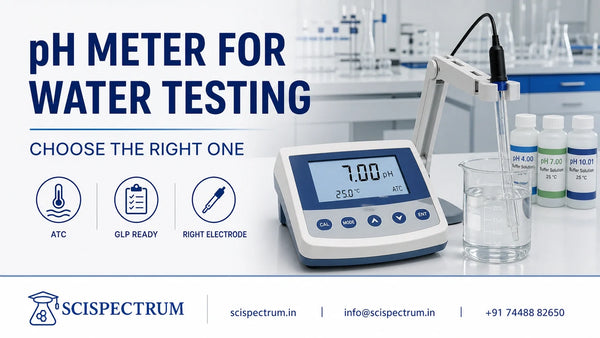
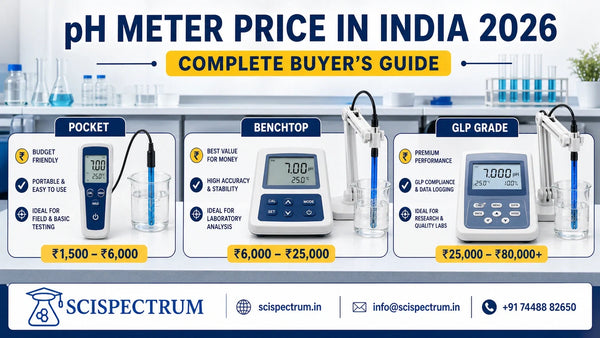
The measurement principle is simple: a glass electrode develops a voltage proportional to hydrogen ion activity, converted to a pH reading via the Nernst equation. The complexity lies in matching the electrode, calibration protocol, and measurement technique to the water type. Pen-type testers suit quick field screening but are not acceptable for compliance testing. Portable meters with replaceable BNC-connector electrodes suit ETP and environmental sampling. Benchtop GLP-capable meters are the standard for pharma QC and NABL labs.
For complete pH meter selection and calibration detail, see: pH Meter for Water Testing — Complete Guide.
Conductivity and TDS Meters — Water Purity at a Glance
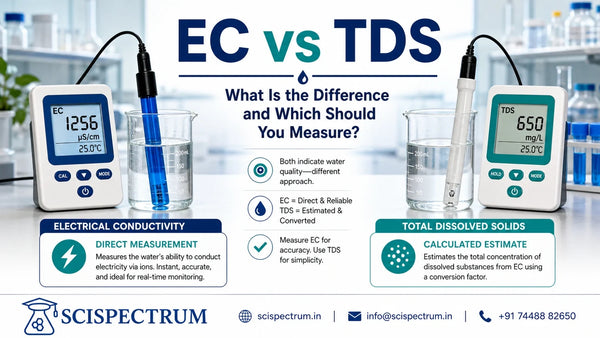
A conductivity meter measures how easily current passes through water — more dissolved ions, higher conductivity. TDS is not a direct measurement: it's conductivity multiplied by a conversion factor. The cell constant (K) determines the measurement range — K=0.1 for pharmaceutical purified water, K=1.0 for drinking water and general testing, K=10 for seawater and concentrated effluent.
For complete conductivity guidance, see: Conductivity Meter: Types, Working Principle, Uses and Price in India.
Dissolved Oxygen Meters — The Most Underused Parameter
DO consistently separates well-run water management programmes from those that discover problems too late. Polarographic sensors use a platinum cathode behind a PTFE membrane, requiring stirring and membrane replacement every 2–4 weeks. Optical sensors use a fluorescent dye cap quenched by oxygen — no membrane, no stirring, cap lasts 1–2 years, and are the correct choice for continuous monitoring and sulphate-rich wastewater.
At Bangalore, Pune, and Hyderabad altitudes, uncorrected DO meters overread significantly — enter local barometric pressure before every calibration session.
ORP Meters — Disinfection, Oxidation, and Safety
ORP measures whether the chemical reaction in your water is actually working. The WHO recommends ORP above +650 mV for effective disinfection. In electroplating ETPs treating cyanide, ORP is safety-critical — incomplete oxidation releases lethal hydrogen cyanide gas.
For the complete ORP meter guide, see: ORP Meter: Working Principle, Uses and Price in India.
How to Choose the Right Instrument for Your Application
Start with four questions: what exactly are you measuring and in which water matrix, which Indian regulatory standard governs the measurement, do you need GLP data logging, and what is the total cost of ownership over two years.
Calibration and Maintenance — Where Most Labs Go Wrong
Calibration errors are the leading cause of non-compliant electrochemical measurements in Indian labs: wrong calibration standard for the range, expired buffers, uncorrected altitude in DO measurement, measuring pharma water from an open beaker, and electrode storage in pure water.

Electrochemical Instruments at Scispectrum
Scispectrum stocks electrochemical analysis instruments from Eutech (Thermo Fisher), Hanna Instruments, Mettler Toledo, Lutron, Aquasol, and Electronics India, sourced from authorised distributors with GST invoicing.
Frequently Asked Questions
Conclusion
Electrochemical analysis instruments are not commodities where any instrument will do. Every instrument decision has a specific right answer — and the wrong answer silently corrupts data, fails audits, or in the most serious cases, creates hazards.
Browse all instruments at Scispectrum Get a Quote on WhatsApp