ORP Meter: Working Principle, Uses and Price in India
Scispectrum Lab Essentials
ORP Meter: Working Principle, Uses and Price in India
A swimming pool maintenance contractor in Chennai was measuring free chlorine religiously — 1.5 ppm every morning, exactly within the BIS IS 3328 recommendation. Yet the health inspector found coliform contamination on two consecutive monthly tests. The chlorine was there. The disinfection was not working. The reason? The pool pH had drifted to 8.4. At that pH, over 90% of the free chlorine exists as hypochlorite ion (OCl⁻), which has roughly 80 times less germicidal power than hypochlorous acid (HOCl). A chlorine meter cannot tell you this. An ORP meter can — it was reading +430 mV, well below the +650 mV minimum needed for effective disinfection. The chlorine concentration was adequate. The oxidising power was not.
That distinction — between having a disinfectant present and having it work — is precisely what ORP measurement provides. It is the most underused electrochemical parameter in Indian water treatment, and arguably the most informative for anyone managing disinfection, oxidation, or biological treatment processes.
ORP (Oxidation-Reduction Potential): The net electrical potential of all oxidising and reducing species dissolved in a water sample, measured in millivolts (mV) using a platinum or gold indicator electrode against a silver/silver chloride reference. A positive ORP indicates oxidising conditions (chlorine, ozone, dissolved oxygen dominant); a negative ORP indicates reducing conditions (sulphides, organic matter, anaerobic environment dominant).
What Is ORP and What Does an ORP Meter Measure
Every water sample contains a mix of substances that can either donate electrons (reducing agents) or accept electrons (oxidising agents). ORP measures the net balance between these two forces. When oxidising agents dominate — chlorine, ozone, dissolved oxygen, permanganate — the ORP is positive and the water has the capacity to oxidise organic matter and inactivate pathogens. When reducing agents dominate — sulphides, ferrous iron, organic matter, ammonia — the ORP is negative and the water is in a chemically reducing state.
An ORP meter uses a noble metal electrode (platinum or gold) that develops a voltage proportional to the redox balance of the solution, measured against a stable reference electrode (Ag/AgCl). The reading is in millivolts — typically ranging from -2000 mV to +2000 mV, though practical water treatment measurements sit between -400 mV and +800 mV.
What makes ORP powerful is that it does not measure any single chemical — it measures the net effect of all redox-active species simultaneously. Chlorine concentration alone does not tell you whether chlorine is effective; ORP does. BOD concentration does not tell you whether your ETP's oxidation stage is actually oxidising; ORP does.
Working Principle of an ORP Meter
The working principle is electrochemical, closely related to pH measurement — both use a sensing electrode and a reference electrode to measure a potential difference.
- Sensing electrode — a platinum (Pt) or gold (Au) wire or band mounted in the probe tip. This inert metal surface develops a voltage determined by the ratio of oxidised to reduced species in the sample, following the Nernst equation.
- Reference electrode — a silver/silver chloride (Ag/AgCl) half-cell with a KCl filling solution, identical in principle to a pH reference electrode.
- High-impedance voltmeter — the meter reads the potential difference between the Pt sensing electrode and the Ag/AgCl reference in millivolts. No current is drawn — the measurement is potentiometric.
- Display — the reading is shown directly in mV. Unlike pH, ORP does not require temperature compensation as a standard feature.

ORP vs Chlorine: Why ORP Is the Better Disinfection Indicator
This is the single most important concept for anyone involved in water disinfection in India — municipal treatment, swimming pools, packaged water plants, or hospital water systems.
Free chlorine concentration (measured by DPD colorimetric test or amperometric sensor) tells you how much chlorine is in the water. ORP tells you how effective that chlorine is at killing pathogens. These are not the same thing, because chlorine's disinfecting power depends on pH, temperature, and organic demand — none of which a chlorine test captures.
| Factor | Chlorine Test (DPD/Amperometric) | ORP Measurement |
|---|---|---|
| What it measures | Free chlorine concentration (ppm) | Net oxidising power of all species (mV) |
| pH effect captured? | No — shows same ppm regardless of pH | Yes — ORP drops as pH rises and HOCl converts to weaker OCl⁻ |
| Temperature effect? | Partially (reagent kinetics) | Yes — captures temperature effect on disinfection kinetics |
| Organic demand captured? | No — shows residual after demand met | Yes — ORP drops when organic load consumes oxidising capacity |
| Real-time continuous monitoring? | DPD: no (manual test); Amperometric: yes | Yes — standard for automated dosing systems |
| WHO recommendation for safety | Free chlorine ≥0.5 ppm residual | ORP ≥ +650 mV for pathogen inactivation |
| Instrument cost (India) | ₹500 (DPD kit) to ₹25,000 (amperometric) | ₹5,000 to ₹26,000 (portable ORP meter) |

Applications of ORP Meters in India
Water Treatment Plant Disinfection Control
Municipal water treatment plants, packaged drinking water facilities, and hospital water systems use ORP to control chlorine or ozone dosing in real time. An online ORP controller adjusts the chemical dosing pump to maintain ORP above +650 mV at the disinfection contact tank outlet. Many Indian packaged water plants under FSSAI and BIS IS 14543 compliance are now adding ORP monitoring alongside residual chlorine measurement.
Swimming Pool and Recreational Water Sanitation
BIS IS 3328 specifies free chlorine residual for swimming pools, but the best-managed pools in India use ORP as their primary control parameter. The target is +650 to +750 mV. Automated dosing systems adjust both chlorine and pH simultaneously — if the pH controller fails and pH drifts above 8.0, ORP drops immediately even though chlorine concentration is unchanged, catching problems before they become microbiological.
ETP Oxidation Processes
ETPs treating cyanide (electroplating), chromium (tannery), or phenolic (petrochemical) wastewater use chemical oxidation as a treatment step. For cyanide destruction using sodium hypochlorite, the ORP must reach +350 to +400 mV to ensure complete oxidation. For chrome reduction using ferrous sulphate, ORP must drop below +300 mV to ensure Cr⁶⁺ is fully reduced to Cr³⁺ before precipitation.
Pharmaceutical Water Systems
ORP is not a compendial test parameter for pharmaceutical purified water under IP or USP, but it is increasingly measured as a system health parameter. A sudden ORP shift in a closed pharmaceutical water loop may indicate a microbiological biofilm developing before a bioburden test catches the problem.
Aquaculture and Fish Farming
Healthy aquaculture water typically shows ORP between +150 and +350 mV. A drop below +100 mV suggests deteriorating conditions — accumulating organic waste, insufficient aeration, and potential disease risk.
ORP Ranges: What the Numbers Actually Mean
| ORP Range (mV) | Condition | What It Means | Typical Application |
|---|---|---|---|
| +700 to +800 | Strongly oxidising | Ozone or high chlorine residual active; rapid pathogen kill | Ozone-treated drinking water, cooling tower shock treatment |
| +650 to +700 | Effective disinfection | WHO-recommended range for safe drinking water disinfection | Municipal water treatment, swimming pools, packaged water |
| +400 to +650 | Mildly oxidising | Some oxidising capacity but may be insufficient for full pathogen kill | ETP post-treatment, cooling tower recirculation |
| +200 to +400 | Transitional | Low oxidising capacity; monitor closely | Pharma water systems (normal range), aquaculture (acceptable) |
| 0 to +200 | Near-neutral redox | Minimal oxidising or reducing activity | Clean natural freshwater, RO permeate |
| 0 to -200 | Mildly reducing | Anaerobic conditions developing; sulphide formation begins | Poorly aerated ETP, anaerobic digesters |
| -200 to -400 | Strongly reducing | Anaerobic environment; H₂S present; septic conditions | Anaerobic treatment, sludge digesters, septic tanks |
Buying Guide: What to Look For in an ORP Meter
1. Measurement range
Most ORP meters cover ±1000 mV or ±2000 mV. For water treatment disinfection monitoring (+400 to +750 mV) and ETP oxidation control (+200 to +700 mV), a ±1000 mV range is sufficient.
2. Electrode type and replacability
ORP electrodes use a platinum (Pt) or gold (Au) sensing element. Platinum is standard for most water treatment applications. The electrode is a consumable — verify that replacement electrodes are available and affordable.
3. Standalone ORP vs pH/ORP combination meter
If you already own a benchtop pH meter with a BNC connector, you can measure ORP by simply connecting an ORP electrode in place of the pH electrode. This saves buying a separate ORP instrument.
4. IP rating for field use
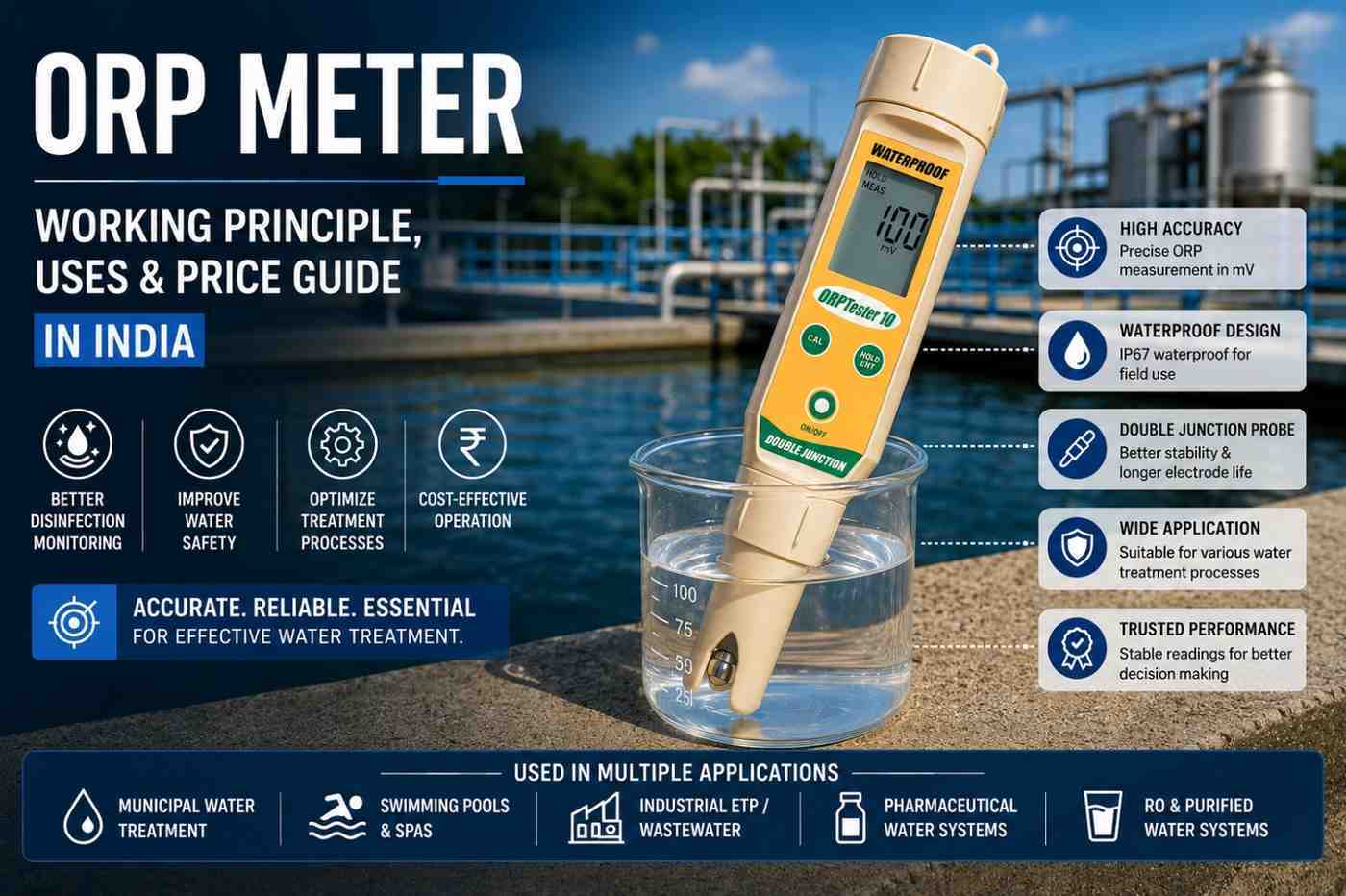
For ETP, swimming pool, and outdoor applications, waterproof construction is essential.
ORP Meters at Scispectrum
We supply ORP meters and pH/ORP combination instruments from Eutech, Hanna, Lutron, and Aquasol. All prices exclude GST; 18% GST is applicable.
Frequently Asked Questions
Conclusion
ORP is the parameter that tells you whether your water treatment is actually working — not whether chemicals are present, but whether they are effective. For disinfection, the WHO's +650 mV threshold is the gold standard for pathogen inactivation. For ETP cyanide destruction, ORP is a safety-critical control. At ₹5,000 for an entry-level handheld, an ORP meter is one of the most cost-effective water quality instruments available.
Browse ORP meters at Scispectrum Get a Quote on WhatsApp