How to Choose the Right UV-Visible Spectrophotometer for Your Laboratory in 2026
Scispectrum Lab Essentials
How to Choose the Right UV-Visible Spectrophotometer for Your Laboratory
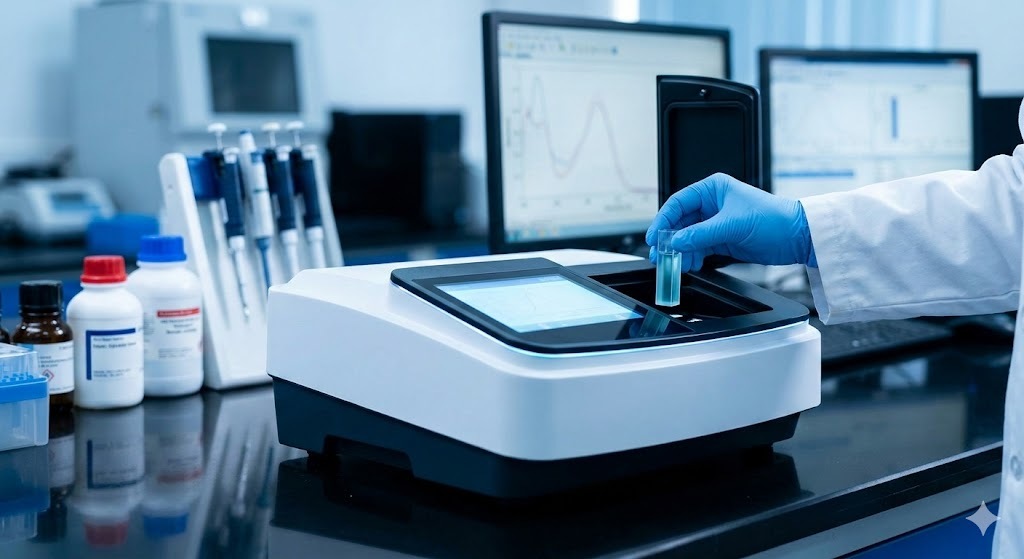
UV-Visible Spectrophotometer: An analytical instrument used to measure the amount of light absorbed or transmitted by a sample as a function of wavelength, operating on the Beer-Lambert Law — absorbance is directly proportional to concentration and path length. UV region: 190–380 nm. Visible region: 380–1100 nm.
By measuring how much light is absorbed at specific wavelengths, laboratories can perform quantitative analysis to determine concentrations of chemicals, proteins, nucleic acids, and more.
Types of UV-Visible Spectrophotometers
1. Single Beam Spectrophotometer
A single path of light passes through the sample; the user must measure a "blank" reference before measuring the sample. Best for educational labs and routine, quick concentration checks. Pros: compact, cost-effective, easy to maintain.
2. Double Beam Spectrophotometer
Splits light into two paths — one for the sample, one for a simultaneous reference blank. Best for pharmaceutical QC, kinetics research, and high-precision analytical tasks. Pros: exceptional stability, compensates for lamp fluctuations in real-time, superior reproducibility.
3. Microprocessor vs PC-Controlled Models
Microprocessor-based: built-in screen and keypad for standalone operation, great for labs with limited space. PC-controlled: connected to a computer with specialized software, essential for 21 CFR Part 11 compliance and complex data mapping.
| Feature | Single Beam | Double Beam |
|---|---|---|
| Optical Path | Single path (manual blanking) | Dual simultaneous paths |
| Stability | Susceptible to lamp drift | Automatically compensates for drift |
| Scan Speed | Slower | Faster & more efficient |
| Maintenance | Minimal | Moderate (more optics) |
| Investment | Low to Moderate | High |

Key Features to Consider
1. Spectral Bandwidth: fixed bandwidth (1–2 nm) is sufficient for most routine pharmaceutical and chemical assays; variable bandwidth is essential for research labs needing fine peak separation. 2. Wavelength Accuracy & Repeatability: look for ±0.3 nm or better to ensure compliance with pharmacopeia standards. 3. Stray Light Rejection: high-end models feature dual monochromators to keep stray light below 0.01%. 4. Software & Connectivity: for pharma, software must support audit trails, electronic signatures, and user access levels. 5. Validation and Calibration: check for built-in automated validation routines (e.g., holmium oxide filters) for daily performance checks.
Applications Across Industries
Pharmaceutical Analysis: monitoring drug purity, dissolution testing, and identification of Active Pharmaceutical Ingredients. Water & Wastewater Testing: detecting pollutants like nitrates, phosphates, and heavy metals. Food & Beverage: analyzing color consistency, vitamin content, and detecting adulterants. Academic Research: studying protein-DNA interactions and reaction kinetics in real-time.
Common Buying Mistakes to Avoid
Choosing based only on price (low-cost models may compromise accuracy and durability), ignoring future requirements, overlooking compliance needs (pharma and NABL labs require compliance-ready instruments), not checking service availability, and ignoring software capabilities.
Budget & Investment Considerations
Price varies by single vs double beam configuration, software features, brand reliability, and automation level. Entry-level models suit academic labs, routine QC testing, and budget-conscious setups. Advanced models are recommended for pharmaceutical manufacturing, research institutions, and regulatory-compliant laboratories — while they have higher upfront costs, they offer better long-term ROI through accuracy, durability, and compliance readiness.
| Lab Type | Recommended Model |
|---|---|
| Academic Lab | Single Beam |
| Routine QC Lab | Single or Entry Double Beam |
| Pharma Manufacturing | Double Beam with Compliance Software |
| Research Institute | High-Resolution Double Beam |
Spectrophotometers at Scispectrum
We supply single beam and double beam UV-Vis spectrophotometers from Electronics India (EI-DVI) and other established brands.
Frequently Asked Questions
Conclusion
Selecting the right UV-Visible Spectrophotometer requires careful evaluation of accuracy, features, compliance, and long-term support. Whether you operate a pharmaceutical facility, water testing lab, or research institution, choosing the correct model ensures reliable results, operational efficiency, and regulatory confidence.
Browse UV-Vis Spectrophotometers Get a Quote on WhatsApp