pH Electrode Filling Solution vs Storage Solution: What Goes Where?
SciSpectrum Lab Essentials
The right liquid, in the right place.
You have two clear liquids on the bench. One bottle says “electrode filling solution”. The other says “electrode storage solution”. Both are used with a pH electrode. Can you use either one?
Check before you pour. The liquids have different jobs, and the right choice depends on the electrode. The meter brand alone is not enough.
Watch: Filling solution vs storage solution
See which liquid goes inside a refillable electrode and which belongs in the storage cap.
Scheduled YouTube premiere: 12 October 2026. Playback becomes available when the premiere starts.
The difference at a glance
A combination pH electrode has a glass sensing part and a reference part. They work together to give the meter a signal. The reference chamber is the space that holds the reference liquid. This liquid is also called an electrolyte. It helps carry the electrical signal.
| Liquid | Its job | Where it goes |
|---|---|---|
| Filling solution | Maintains the electrode's reference system. | Inside the correct chamber of a refillable electrode, through its fill hole. |
| Storage solution | Keeps the sensing tip ready between uses. | In the storage cap or bottle, covering the bulb and reference junction. |
| pH buffer | Provides a known pH for calibration or a check. | In a clean test vessel. Do not use it as filling solution. |
| Cleaning solution | Removes sample deposits. | Used as a treatment, for the time and method stated in the instructions. |
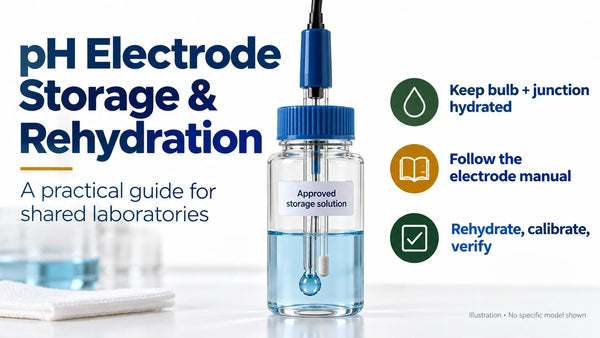
The reference junction is the small contact point between the reference liquid and the sample. On many electrodes, it sits just above the glass bulb. Storage liquid needs to cover both parts.
METTLER TOLEDO explains the role of the reference liquid in its electrolyte guide. Hanna's storage advice explains why the correct storage liquid matters.

Can your electrode be refilled?
Read the electrode label and manual first. A refillable electrode has a fill opening, often covered by a cap, plug or sleeve. A sealed gel-filled electrode is not meant to be opened and topped up by the user.
“Gel-filled” describes the material inside the reference part. It does not mean the glass tip can be left dry. The storage instructions still apply. Hanna's electrode selection guide explains refillable and gel-filled designs.
Does the fill-hole cap stay open?
For many refillable electrodes, the fill hole is opened during calibration and measurement. It is closed for storage. Follow your electrode's instructions for the liquid level and cap position.
Hanna's maintenance guide covers opening the fill cap for use. Thermo Fisher's care note includes closing the fill hole for storage. Do not apply one fill level to every electrode.
How to choose the correct bottle
- Find the electrode part number. Look on the shaft, cable label or packing record. Note the meter model too.
- Find the matching manual. Check whether the electrode is refillable. Look for the filling and storage solution codes.
- Match the bottle code. Check the full code, stated use and expiry date. “KCl solution” on its own is not enough.
- Check which chamber is meant. Some electrodes have separate inner and outer liquids. A user fill hole may serve only one chamber.
- Follow the stated procedure. Check whether the task is a top-up or a full liquid change. Use the stated level and preparation steps.
KCl means potassium chloride. It is a salt used in many electrode liquids. Numbers such as 3 M or 3.5 M tell you its concentration. AgCl means silver chloride. These details can matter even when both liquids look the same.

Why solution codes matter
These manufacturer examples show why “any KCl solution” is a poor buying rule. They are examples, not a match for every electrode with the same junction type.
| Solution | What the maker lists | What to check |
|---|---|---|
| Hanna HI7071 | 3.5 M KCl with AgCl; filling solution for its single-junction electrodes. | Confirm that your electrode manual lists this code. |
| Hanna HI7082 | 3.5 M KCl; filling solution for its double-junction electrodes. The page describes silver-free liquid in the outer chamber. | Do not assume it replaces the liquid in every inner chamber. |
| Thermo Scientific Orion 810007 | ROSS filling solution. Thermo Fisher specifies it for ROSS and ROSS Ultra pH electrodes. | Check the exact sensor instructions, including whether the model is refillable. |
Hanna explains that silver can form deposits in some samples and clog a junction. This is one reason the outer liquid in its double-junction example is silver-free. The liquid is part of the electrode design, not just a bottle used to keep it wet.
Can one liquid do both jobs?
Sometimes. METTLER TOLEDO's pH questions guide allows storage in the electrode's specified reference filling liquid. It directs users to the electrode leaflet for the correct choice.
That does not mean a bottle sold as storage solution can be poured into any electrode. Check both uses in the manual. If only storage is listed, treat it as a storage product.
What if you used the wrong solution?
Pause sample testing. Note the electrode ID, the bottle code, where you added the liquid and when it happened. Keep the bottle label or a clear photo. These details help the manufacturer or supplier check the next step.
- Wrong liquid in the storage cap: follow the electrode's approved rinse and conditioning steps. Conditioning means preparing the tip in the correct solution before use.
- Wrong liquid inside a refillable electrode: ask for the exact drain, rinse and refill procedure. Do not keep topping up with another liquid to dilute the mistake.
- Liquid added to the wrong opening, or a sealed electrode opened: stop and get model-specific advice before further use.
After the approved care steps, recalibrate with fresh buffers. Then do the check required by your lab procedure. Use its pass/fail limits. A successful calibration alone does not show that every problem has been fixed. For basic preparation, see Hanna's calibration guide.
Common questions
Can I use storage solution to top up an electrode?
Only if the exact electrode manual approves that liquid for filling. The words “storage solution” do not confirm that it is suitable inside the electrode.
Can I add DI water when the filling level is low?
Do not top up with DI water unless the exact service instructions call for it. Use the specified filling solution for routine top-ups. Water changes the salt concentration.
Does a gel-filled electrode need storage solution?
It still needs the storage care stated by its maker. A sealed reference part and a wet sensing tip are separate matters.
Can I use pH 7 buffer instead?
Use pH buffer for calibration. Some manuals allow certain buffers for limited storage. That does not make buffer a filling solution.
Check the code before you pour
Start with the electrode part number. Find the solution code in the manual. Then check whether you are filling the reference chamber or storing the sensing tip. A clear bottle label makes this easier for the next person too.
Need help choosing the right solution?
Send SciSpectrum the electrode part number, meter model and a photo of the bottle you have. Tell us whether you need filling or storage solution. We can check the documented match before suggesting an option. SciSpectrum Lab Essentials is a laboratory-instrument reseller.
Send your electrode details