How to Buy the Right pH Meter for Your Needs: A Simple Beginner's Guide
Scispectrum Lab Essentials
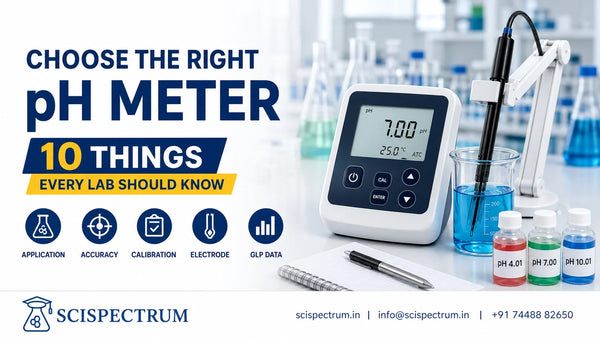
How to Buy the Right pH Meter for Your Needs: A Simple Beginner's Guide
A pH meter measures how acidic or alkaline a liquid is on a scale of 0–14. Think of it as a "thermometer for chemistry." Whether you're testing soil for gardening, monitoring a fish tank, running a lab, or brewing coffee, the right pH meter ensures accuracy and saves time. But with so many options, how do you choose? Let's break it down.
What Is a pH Meter?
A pH meter uses an electrode to detect hydrogen ion activity and converts it into a numeric pH value, displayed digitally in seconds. It's used across labs, aquariums, farms, kitchens, and industrial water testing wherever knowing the acidity or alkalinity of a liquid matters.
3 Key Factors to Consider First
1. Your Use Case
Labs/research need high precision and calibration features. Pools/aquariums need portability and waterproofing. Farms/gardens need durability and multiparameter support. Home/hobby use needs a budget-friendly, easy-to-use model.
2. Accuracy Needs
Standard use (pools, gardens) is fine with ±0.1 pH accuracy. Scientific work should aim for ±0.01 pH or better.
3. Budget
Basic pens start affordably; pro lab gear runs considerably higher, so match your spend to your actual accuracy and documentation needs.
Types of pH Meters Demystified
1. Benchtop Meters (Lab Heroes)
Ideal for labs, factories, or frequent testing. Features: large displays, multi-point calibration, data logging.
2. Portable Meters (On-the-Go Testing)
Perfect for fieldwork, pools, or classrooms. Features: waterproof, battery-powered, data storage.
3. Pen-Type Meters (Simple & Affordable)
Great for quick checks (aquariums, kitchens, schools). Features: pocket-sized, instant readings.
4. Multiparameter Meters (All-in-One Powerhouses)
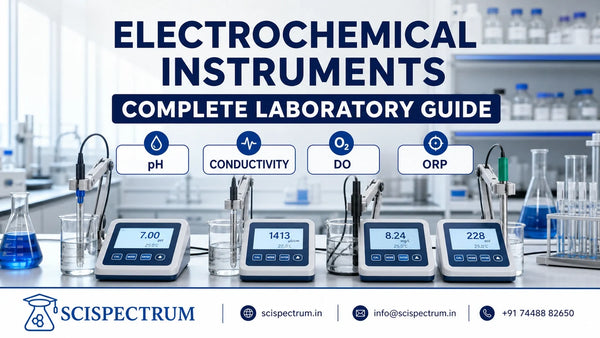
Test pH plus conductivity/temperature/TDS/salinity in one device — convenient when you need more than one water quality reading per sample.

5 Must-Check Features
Calibration: more points means better accuracy — choose 2–5 point calibration. Display: backlit LCD beats LED for low-light areas. Durability: look for an IP67 waterproof rating. Probe quality: replaceable probes save long-term costs. Temperature compensation: automatic (ATC) adjusts readings for temperature changes.
Step-by-Step Buying Guide
- Define your use (lab, field, home?).
- Set a budget.
- Prioritize features (e.g., waterproofing for outdoors).
- Check calibration needs (more points = higher accuracy).
- Verify warranty & support.
pH Meters at Scispectrum
We stock benchtop, portable, pen-type, and multiparameter pH meters from Eutech, Hanna, and other trusted brands, with service support across India.
Frequently Asked Questions
Conclusion
Whether you're a hobbyist or a lab pro, the right pH meter balances your needs, budget, and durability. Start small with a pen-type if you're new, or invest in a benchtop for heavy-duty accuracy.
Browse pH Meters Get a Quote on WhatsApp